
Introduction
How You Feel explores the beautiful relationship between emotions, imagination, and visual arts. Human beings experience many emotions every day, such as happiness, excitement, calmness, sadness, fear, anger, surprise, and love. Sometimes it is difficult to express these feelings through words, but art provides a creative way to communicate them.
Artists can express emotions through colours, lines, shapes, textures, patterns, forms, and facial expressions. Bright and lively colours may suggest joy and energy, while soft or darker colours may create feelings of calmness, mystery, or seriousness. Similarly, curved and flowing lines can create a gentle feeling, whereas sharp and irregular lines may suggest movement, tension, or excitement.
The same colour or image may create different feelings in different people. Our experiences, memories, surroundings, and imagination influence how we respond to an artwork. Therefore, there is not always one correct emotional response to a painting or drawing.
Exploring emotions through art helps students observe their feelings, develop imagination, understand others, and express themselves confidently. Through drawing, painting, and experimenting with different visual elements, students can discover how art can become a powerful language for feelings and ideas.
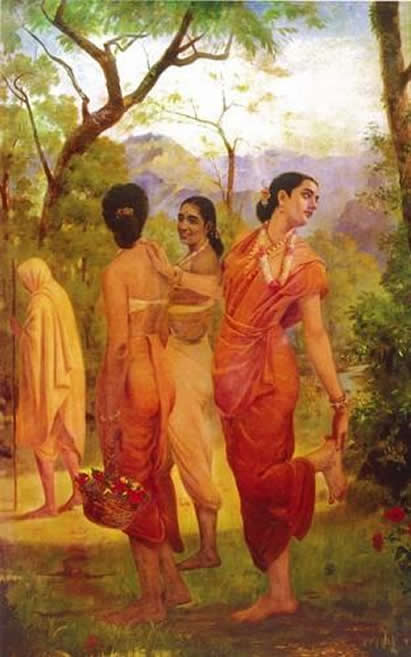
NOTE:
In this chapter, you will study many aspects of the human body and facial expressions.
You will discover hidden ratios and proportions as you learn to draw faces and depict emotions.
You will travel through time to explore a rock-cut sculpture in Mahabalipuram.
You will learn to make clay reliefs depicting facial expressions.
Finally, you will examine the stereotypes that exist in popular culture and create artwork that shows them in new ways.
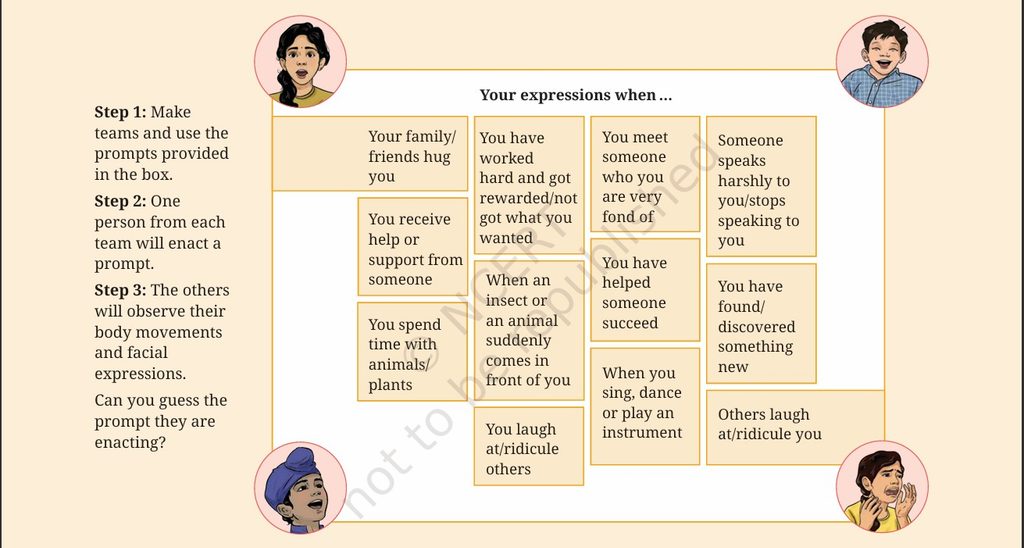
ACTIVITY 17.1: ACT AND GUESS
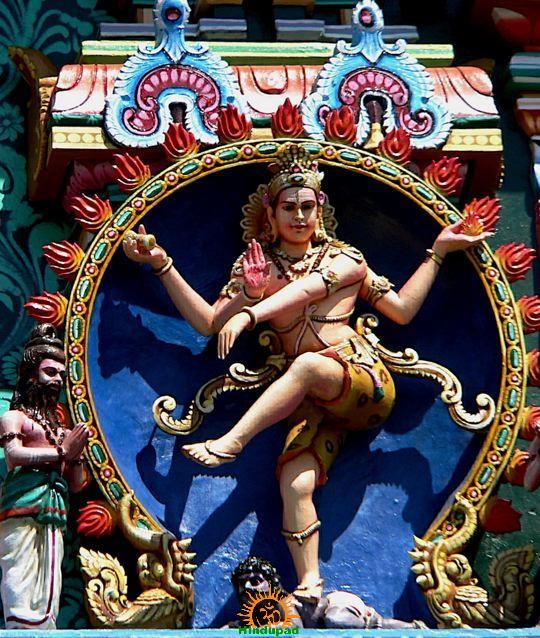
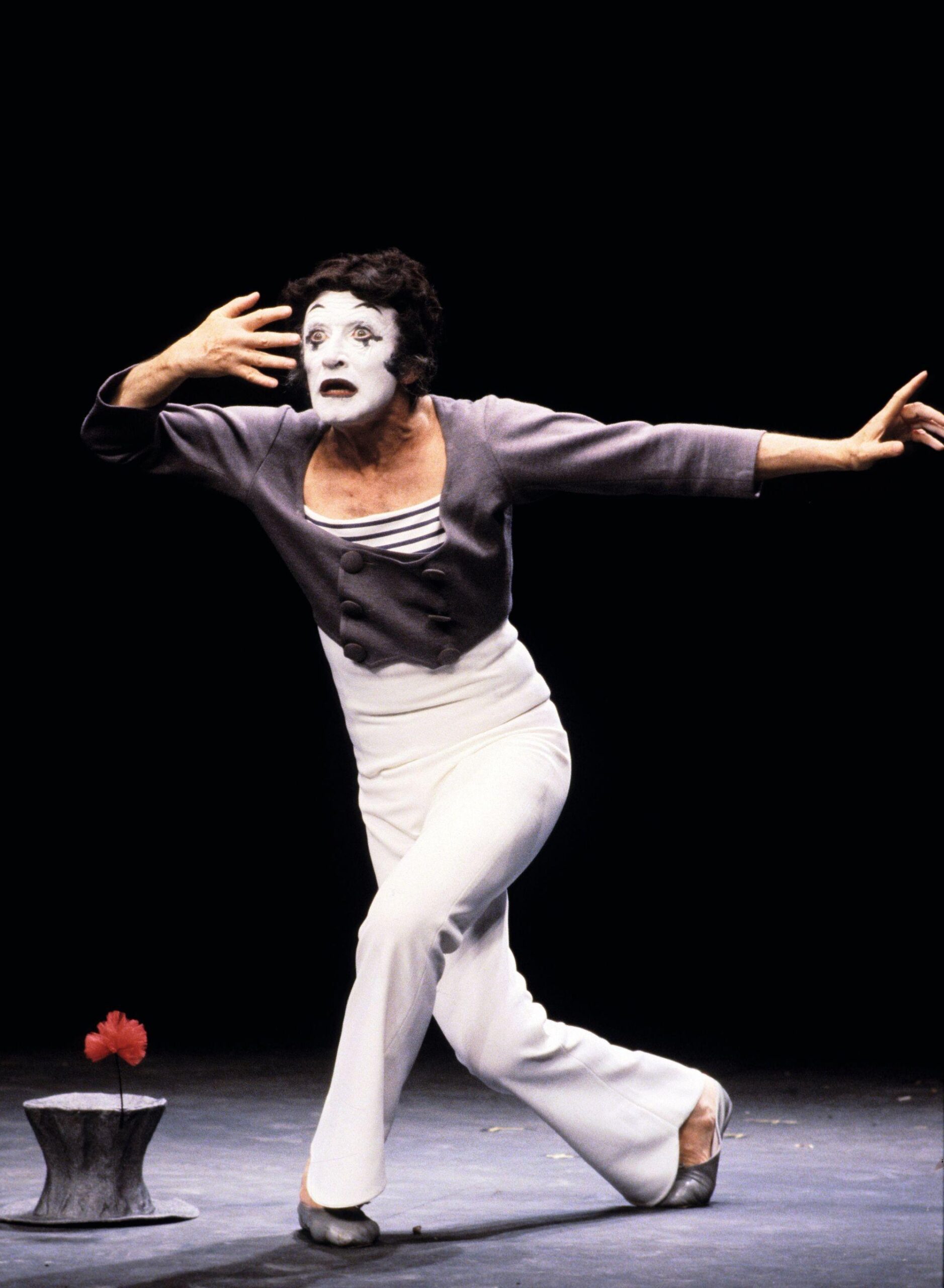
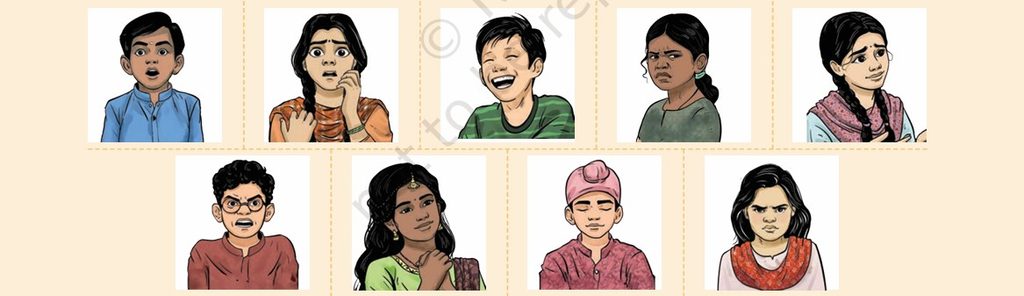
You have learnt about navarasa in theatre and dance. Let us play a game with facial expressions based on the same.
Act and Guess is a fun activity through which students explore the Navarasa—the nine emotional expressions of Indian theatre and dance. In this game, one student acts out an emotion using only facial expressions, eye movements, gestures, and body language, while the others observe carefully and try to guess the emotion.
The activity encourages students to understand how emotions can be communicated without speaking. It also helps them notice how small changes in the eyes, eyebrows, mouth, posture, and gestures can express different feelings.
| No. | Navarasa | Meaning | Common Expression |
| 1. | Shringara | Love, beauty, affection | Loving, graceful expression |
| 2. | Hasya | Laughter, humour, joy | Smile, laughter, cheerful face |
| 3. | Karuna | Compassion, sorrow | Sadness, sympathy, tears |
| 4. | Raudra | Anger, fury | Fierce eyes, tense face |
| 5. | Veera | Courage, heroism | Confidence, strength, determination |
| 6. | Bhayanaka | Fear, terror | Wide eyes, anxious expression |
| 7. | Bibhatsa | Disgust, aversion | Unpleasant or rejecting expression |
| 8. | Adbhuta | Wonder, amazement | Wide eyes, surprise, curiosity |
| 9. | Shanta | Peace, tranquillity | Calm face, relaxed posture |
ACTIVITY 17.2: PROPORTIONS OF THE HUMAN HEAD
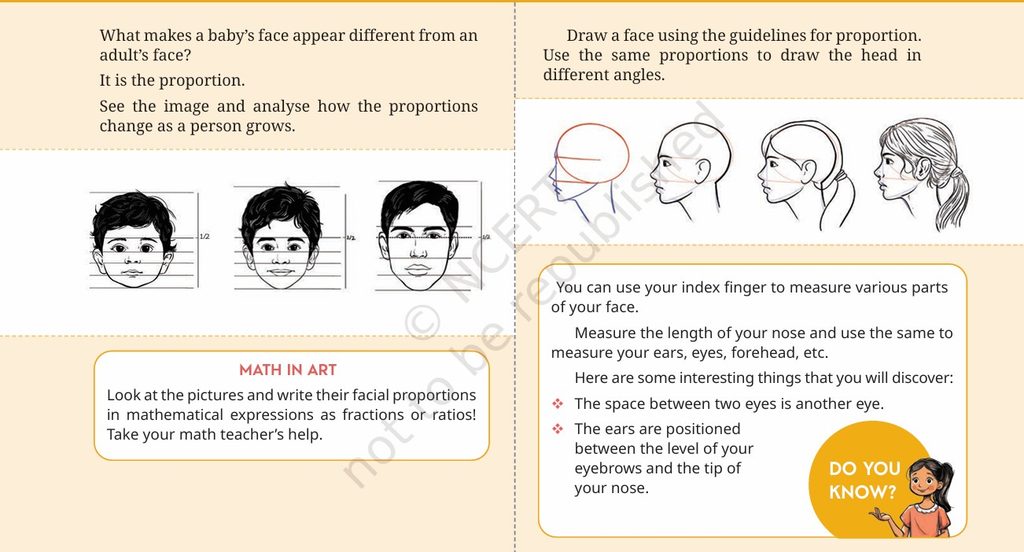
The proportions of the human head describe the relative size, placement, and relationship of different facial features. Learning these proportions helps artists create portraits that look balanced, natural, and expressive. Although every person has unique facial features, basic guidelines can help beginners understand where to place the eyes, nose, ears, mouth, and chin.
When drawing a head from the front, artists often begin with a light oval or egg-shaped outline. A vertical centre line can then be drawn to help align the facial features. A horizontal guideline is used to position the eyes. In a basic drawing approach, the eyes are placed approximately halfway between the top of the head and the chin.
The nose is generally placed between the eyes and mouth. The mouth lies below the nose and above the chin. The ears are commonly placed around the level between the eyes and the nose, although their apparent position changes when the head is tilted or turned. The forehead, cheeks, jawline, and chin also contribute to the overall balance of the face.
Proportions change when the head is viewed from different angles. In a front view, both sides of the face are visible. In a side view, the artist mainly observes the profile of the forehead, nose, lips, chin, and one ear. In a three-quarter view, one side of the face appears narrower because of perspective.
These guidelines should not be treated as strict rules. Human faces naturally vary in shape and proportion. Careful observation allows artists to capture these individual differences and create more realistic or expressive portraits.
Understanding head proportions develops observation, drawing skills, perspective, balance, and confidence. With regular practice, students can learn to draw faces from different viewpoints while appreciating the uniqueness of every person.
ACTIVITY 17.3: DRAWING FACIAL EXPRESSIONS
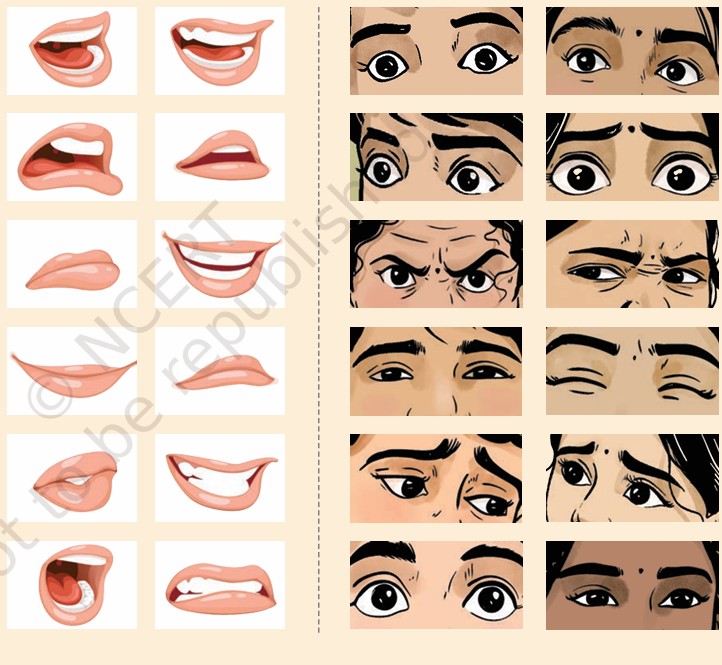
Drawing Facial Expressions is an engaging visual arts activity that helps students understand how emotions can be shown through the face. Small changes in the eyes, eyebrows, nose, mouth, cheeks, and shape of the face can communicate different feelings. By observing and drawing these changes, students can learn how artists create expressive and lively portraits.
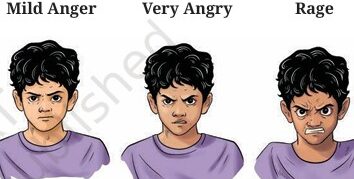
Facial expressions are closely connected with the Navarasa studied in Indian theatre and dance. Happiness may be shown through a raised or smiling mouth and bright eyes, while sadness may be expressed through lowered eyebrows and a downturned mouth. Anger can be suggested through narrowed eyes and strongly drawn eyebrows, whereas surprise may be shown through wide eyes and an open mouth.
Step 1: Ask your friends to pose for a few minutes in different expressions. They can show a funny face, sad face, laughing face, worried face, etc. Observe how the eyes, eyebrows, mouth and jawline change for each expression.
Step 2: Draw four to five faces while paying attention to the proportions.
Step 3: Modify the eyes, eyebrows and mouth to create different facial expressions.
Step 4: Have fun creating your own emojis.
ASSESSMENT
1. Observe and depict the ratios and proportions of the human head.
2. Depict a variety of facial expressions to express emotions.
ACTIVITY 17.4: LET US TRAVEL BACK IN TIME!
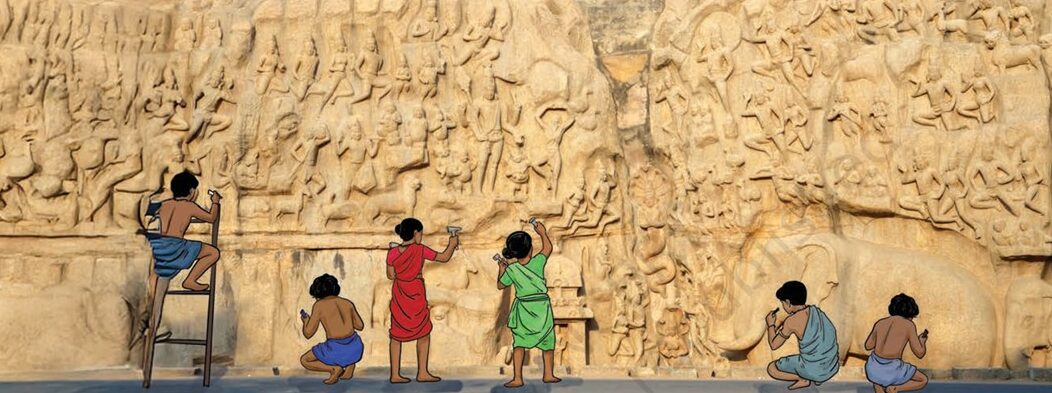
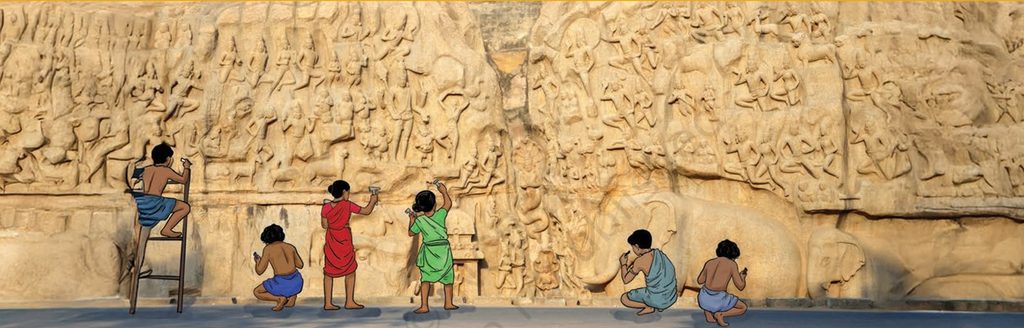
Imagine you have entered a time machine and have been transported to the 8th century CE. You find yourself standing before a massive rock-cut temple sculpture at Mahabalipuram, Tamil Nadu. Around you, skilled artists are carefully shaping the hard stone, turning a single rock into a magnificent work of art.
Look closely at the sculpture. Can you see the figures of people, animals, gods, trees, and other elements carved into the rock? Notice how the artists have used lines, shapes, textures, movement, and proportions to bring the stone to life. Imagine the sounds of chisels striking the rock and the artists discussing how to represent stories and ideas through sculpture.
Mahabalipuram, also known as Mamallapuram, became an important centre of art and architecture under the Pallava rulers. Its rock-cut temples, sculptures, and reliefs show the remarkable skill and imagination of artists of that period.
As you explore this artwork, think about what it tells us about the people, beliefs, stories, nature, and artistic traditions of the past. Let us travel back in time and discover how artists transformed stone into a powerful form of visual storytelling.
You see the sculptors at work. They tell you that they are carving the “Descent of Ganga”, while some others tell you the story of “Arjuna’s Penance.” As you watch them carefully shaping the massive rock, you begin to imagine the ancient stories coming alive before your eyes.
The natural cleft between the two huge boulders appears like the path of a flowing river. Around it, you can imagine gods, sages, humans, animals, birds, and other forms of life gathering near the water. The sculptors use the natural shape of the rock to create a lively scene filled with movement and meaning.
Some figures are carved clearly with fine details, while others appear unfinished. This gives you a glimpse of how the artists worked patiently, shaping the stone little by little. As you observe the sculpture closely, you discover new figures, expressions, movements, and details.
The artwork connects mythology, nature, water, and everyday life. It shows how a large rock surface can become a powerful form of storytelling. Each time you look at it, you notice something new and are drawn deeper into its fascinating world.
As you watch the sculptors at work, you begin to imagine the river flowing down the natural cleft between the two enormous boulders, with people, animals, birds, sages, and other forms of life gathering around it. The entire rock surface seems to come alive with movement and activity.
The sculpture brings ancient stories, myths, and legends to life while celebrating the importance of water and its connection with all living beings. The flowing river becomes a central element, bringing together the different figures and creating a sense of harmony between nature, people, and the divine.
Look closely and you will notice that some figures are carved with great clarity and detail, while others appear unfinished. These unfinished forms offer a fascinating glimpse into the process of rock carving and sculpture-making. They allow us to imagine how the artists gradually transformed the massive boulders into a remarkable work of art.
The more you look, the more you discover. A figure, an animal, a gesture, or a small detail that you did not notice at first suddenly catches your attention. Each scene draws you in, inviting you to look closer and uncover more stories hidden within the stone.
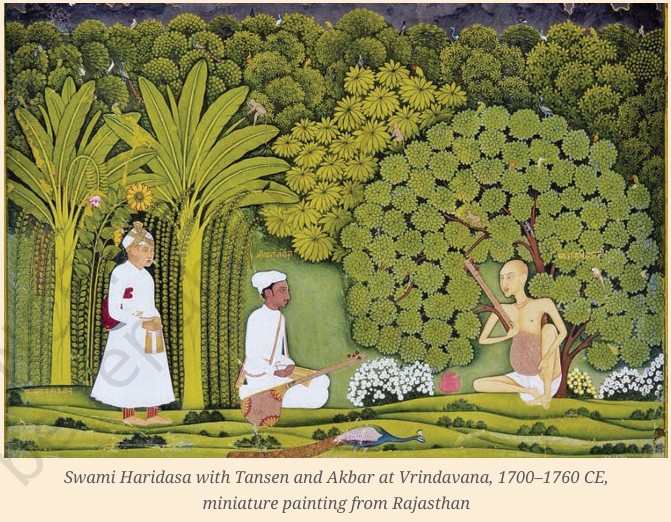
Art is a wonderful way to discover the past and understand how people lived, thought, and expressed themselves. When we look at paintings, sculptures, manuscripts, murals, and other artworks created centuries ago, we can learn about the people, places, traditions, beliefs, clothing, occupations, and surroundings of earlier times.
Indian art has a long and fascinating history. From rock paintings and ancient murals to palm-leaf manuscripts and miniature paintings, artists have used different materials, techniques, colours, and styles to record their experiences and ideas. These artworks provide valuable clues about the culture and daily life of different periods.
As we travel back in time, we will observe how artistic practices changed and how artists continued to draw inspiration from nature, people, stories, and their surroundings. We will also explore how colours, forms, patterns, and artistic techniques developed over the years.
So, get ready to become an art explorer! Observe carefully, ask questions, compare artworks from different periods, and discover the stories hidden within them. Let us step into the past and see how art connects us with our rich cultural heritage.
FACES IN RELIEF USING CLAY
Faces in Relief Using Clay is a creative sculpture activity in which students use clay to create a three-dimensional face that rises from a flat surface. Unlike a fully three-dimensional sculpture, a relief remains attached to its background, allowing students to explore facial features, proportions, texture, and expression.
Clay is soft and easy to shape, making it an excellent material for learning about sculpture. Students can observe how the forehead, eyebrows, eyes, nose, cheeks, lips, chin, and ears are formed and how their placement affects the appearance of a face. By adding or removing clay, they can create different levels of depth and make some features stand out more than others.
The activity also connects with the idea of facial expressions. A slight change in the eyebrows, eyes, or mouth can communicate emotions such as happiness, sadness, surprise, anger, or calmness.
Materials
- Clay
- A flat cardboard or wooden base
- Clay modelling tools or simple household tools
- Water in a small container
- Newspaper or a protective sheet for the work surface
Swishhhh! … The time machine suddenly snaps back to the 21st century, and you find yourself holding this book in your hands.
Your journey through the past may be over, but the artwork you discovered continues to tell its story. The sculptures at the Shore Temple of Mahabalipuram have been exposed to the passage of time, weather, and the elements, causing some details to erode and become less distinct.
Look carefully at the surviving sculptures. You can still notice a variety of body movements, postures, gestures, ornaments, and objects held in the hands of the carved figures. These details give us clues about the characters and the stories they represent.
Although many of the characters can still be identified, their facial expressions are no longer clearly visible. This makes us wonder: How might these figures have looked when they were newly carved? What emotions could their faces have expressed? How would the stories have changed if we could clearly see their expressions?
Through careful observation and imagination, we can try to reconstruct the emotions and expressions that may once have been visible in these ancient sculptures. This reminds us that artworks can change with time, while still preserving valuable stories about the past.
1. Kinnaras — Half-human and half-bird/animal
Kinnaras are mythical beings described in Indian literature, mythology, sculpture, and painting. They are often represented as half-human and half-bird or animal, combining human characteristics with features of the natural world. Their imaginative forms reflect the close relationship between humans, animals, nature, and the divine in Indian art.
Kinnaras are frequently shown with a human face and upper body combined with bird-like or animal features. In some artistic traditions, they may have wings, feathers, or the body of a bird. Their appearance can vary according to the region, period, artistic tradition, and story being represented.
In traditional Indian art, Kinnaras are commonly associated with music, dance, beauty, devotion, and the celestial world. They are often shown playing instruments such as the veena, flute, or other musical instruments, singing, or dancing. Their graceful postures and flowing movements add liveliness to temple sculptures and painted scenes.
Kinnaras can be seen as examples of how artists use imagination to create forms that do not exist in the ordinary world. By combining human and animal features, artists could represent supernatural beings and communicate ideas about the relationship between the earthly and heavenly worlds.
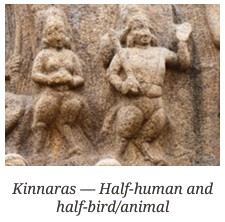
When observing a sculpture of a Kinnara, notice its facial features, body posture, wings or animal features, clothing, ornaments, gestures, and musical instruments. These details help us understand the character and the story in which the figure appears.
Kinnara figures are therefore important in the study of Indian visual culture because they demonstrate the creativity of artists and the rich connection between mythology, nature, music, movement, and sculpture.
2. Gandharvas — Celestial singers, musicians or dancers
Gandharvas are divine or celestial beings described in Indian mythology and represented in traditional Indian art. They are especially associated with music, singing, dance, and the performance of arts in the heavenly realm. They are often shown as graceful and joyful figures participating in divine or celestial scenes.
In sculptures and paintings, Gandharvas may be depicted playing musical instruments, singing, dancing, or accompanying gods and other divine beings. They may hold instruments such as the veena, flute, drum, or other traditional instruments. Their expressive gestures, flowing movements, ornaments, and elegant postures make them visually lively.
Gandharvas are important examples of how Indian artists used human figures to represent divine qualities and artistic expression. Their presence in temple sculptures and other artworks highlights the importance of music and dance in Indian cultural and spiritual traditions.
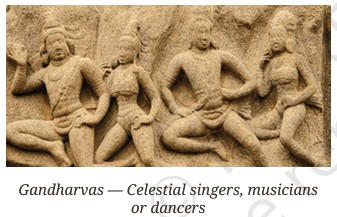
When observing a Gandharva figure, notice the facial expression, body posture, hand gestures, clothing, ornaments, and musical instrument. These details can help us understand the character and imagine the performance taking place in the scene.
Gandharvas therefore beautifully connect mythology, music, dance, movement, and visual art, showing how artists transformed stories of the celestial world into expressive and imaginative forms.
3. Yakshas — Dwarves
Yakshas are supernatural or nature-associated beings found in Indian mythology, literature, sculpture, and painting. They are traditionally connected with nature, forests, trees, water, fertility, and hidden treasures. Yakshas may be represented in different forms depending on the artistic tradition.
In Indian art, Yakshas are often shown as strong, well-built figures, while some smaller or playful figures may be depicted in dwarf-like forms. They can appear as attendants, guardians, or companions of important deities and may be seen around temples, pillars, gateways, and sacred spaces.
Artists often emphasise their rounded bodies, expressive faces, ornaments, costumes, and lively postures. Their figures can add humour, movement, protection, or a connection with the natural world to a sculpture.
Yakshas are important in Indian visual art because they demonstrate how artists combined mythology, nature, imagination, and human-like forms. When observing a Yaksha figure, look carefully at its body proportions, facial expression, posture, gestures, clothing, ornaments, and position within the larger composition.
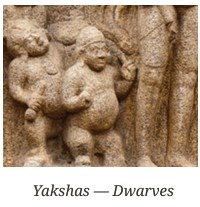
Note: “Yakshas — Dwarves” is an oversimplification. Yakshas are not generally defined as dwarves; dwarf-like figures are one possible artistic representation among many.
4. A sage sitting near the shrine
A sage sitting near the shrine represents a person engaged in meditation, prayer, spiritual practice, and the search for knowledge. In Indian art, sages are often shown in peaceful surroundings such as temples, forests, mountains, and riverbanks. Their presence creates a feeling of calmness, devotion, and contemplation.
The sage may be shown sitting cross-legged in a meditative posture, with a straight back and a composed expression. His hands may be placed on his knees or held in a meaningful gesture. Artists may also show traditional objects such as prayer beads, a water pot (kamandalu), a staff, or sacred texts near the sage.
The shrine beside the sage suggests a sacred or spiritual space. The figure may be shown worshipping, meditating, teaching, or simply observing the surroundings. His simple appearance and peaceful posture can contrast with the movement of other figures, animals, or activities in the larger sculpture.
When looking at such a figure, observe the posture, facial expression, hand gestures, clothing, hair, ornaments, and objects around him. These details help us understand what the sage might be doing and how the artist has created a sense of spirituality.
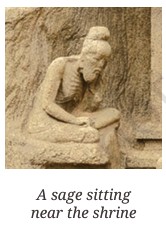
The sage also reminds us that ancient sculptures were not only decorative. They often told stories, represented beliefs, and showed different aspects of life. Through a single seated figure, an artist could communicate ideas of wisdom, devotion, peace, and connection with the divine.
5. Sage Bhagirath, also identified as Arjuna
The ascetic figure standing with raised arms in the great rock relief at Mahabalipuram is traditionally interpreted in two ways. Some scholars identify him as Bhagiratha, the king who performed severe penance to bring the sacred river Ganga down to Earth. Others identify the figure as Arjuna, performing penance to obtain divine blessings and powerful weapons.
This dual interpretation is one of the fascinating features of the sculpture. The figure is shown in a slender, upright posture with his arms raised, suggesting intense meditation and devotion. His simple appearance and focused posture communicate the idea of austerity, determination, and spiritual concentration.
If understood as Bhagiratha, the figure connects directly with the story of the Descent of Ganga. According to the legend, Bhagiratha performed rigorous penance to persuade the goddess Ganga to descend from heaven and purify the Earth.
If understood as Arjuna, the figure represents the great warrior’s penance and determination to receive divine assistance.
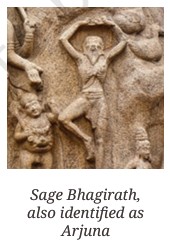
The sculpture therefore allows us to explore two important stories through one powerful figure, showing how ancient Indian art can bring mythology, spirituality, and storytelling together.
Look at the pictures carefully. Locate the same characters in the bigger picture on the previous page. Since you have learnt to draw facial expressions, reimagine their faces. Sketch each face with expressions on separate sheets of 15 cm × 15 cm size. After completing your drawings, choose one, cut it out and keep it ready for your clay relief.
Process of making relief in clay
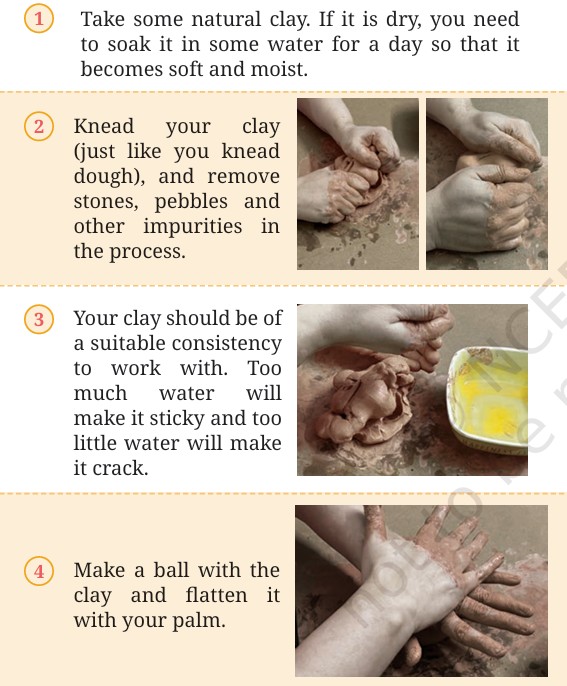
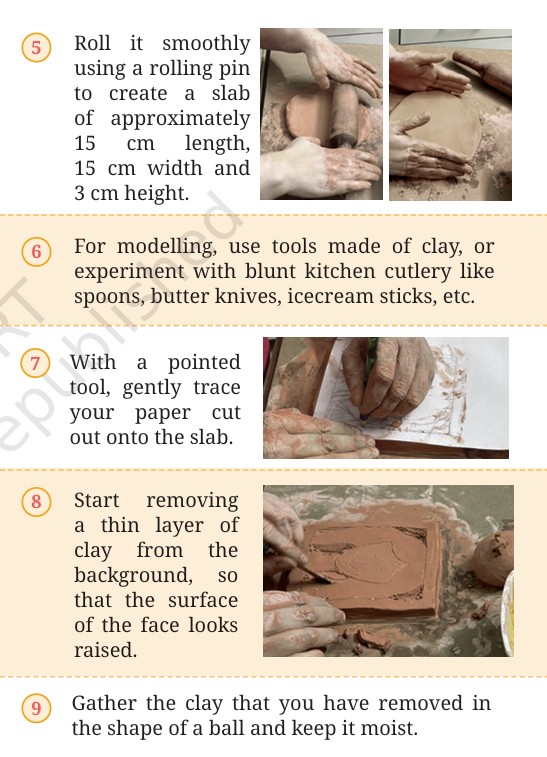
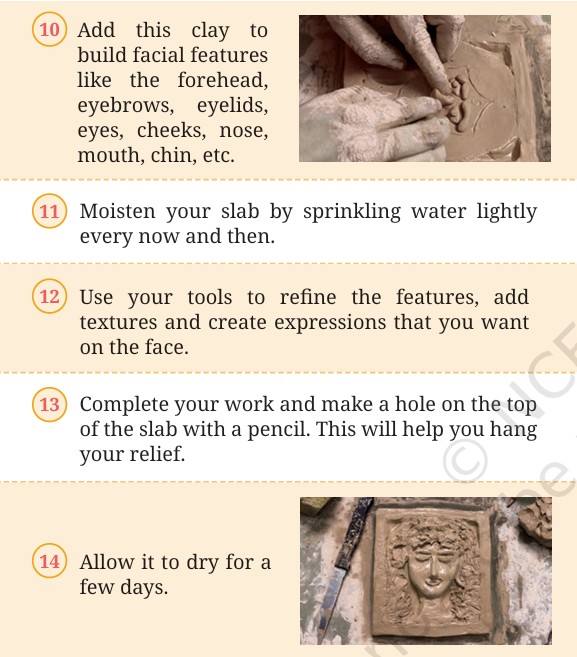
Optional: You can paint your clay relief after it is completely dry.
Technical Tip
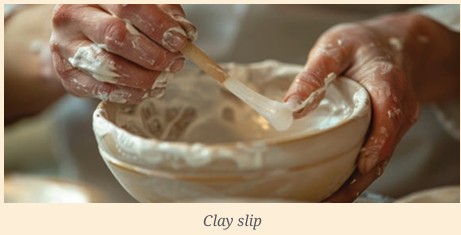
Different parts of a clay sculpture can be joined securely by using a smooth clay paste called slip. Slip works like a natural glue and helps the clay pieces stick together.
To join two clay parts, first scratch or score the surfaces that need to be connected. Making the surfaces rough helps the slip hold the pieces firmly. Apply a thin layer of slip to the scored areas and carefully press the two parts together. Smooth the joint gently with your fingers or a modelling tool so that the connection becomes strong and neat.
Remember to handle the clay carefully and avoid using too much water, as this can make the clay soft and difficult to work with.
ACTIVITY 17.5: EVERYBODY HAS A BEAUTIFUL STORY
The “Descent of Ganga” at Mahabalipuram shows a fascinating variety of human figures with different body types, sizes, proportions, postures, and movements. Look closely at the sculpture and notice how each figure has been represented in a unique way.
Artists in different periods and traditions have depicted people in many styles of painting and sculpture. Some figures may be shown realistically, while others may have elongated bodies, simplified forms, exaggerated features, or stylised proportions. These choices are often influenced by the artist’s imagination, culture, artistic tradition, and the story being represented.
Look at paintings from different regions and periods. Notice how artists represent height, body shape, facial features, clothing, gestures, and posture. Compare these figures with the people you see around you. You will notice that human beings naturally have many different appearances and body types.
Look at people with various body types around you — short, tall, thin, fat, dark-skinned, light skinned, bald, hairy, hunched, etc. Observe your own body. What thoughts run through your mind?
A stereotype is a widely accepted idea, generalising a person, place or community. It is not factual. Discuss common assumptions that are made about body types, promoting certain stereotypes.
For example, it is assumed that a person with a large body cannot run fast or a person with a slender body is weak or that one skin colour is more beautiful than another.
The images we see in magazines, hoardings, films, videos and social media influence the way we think about our bodies. Gather more examples of body stereotypes. You may find these in advertisements, story illustrations, videos, films, etc.
Note down your thoughts. Create sketches of your own version that challenge the stereotypes you come across.
1. Mughal portrait
Mughal portrait painting is an important tradition of Indian miniature painting that developed in the royal courts of the Mughal period. Mughal artists were known for their careful observation and attention to detail. They created portraits of emperors, princes, nobles, courtiers, scholars, musicians, and other important people.
Artists tried to capture the individual features and personality of the person being portrayed. They carefully painted the eyes, nose, face shape, beard, hairstyle, and expressions. The figures were shown in different postures, such as standing, sitting, riding a horse, reading a book, or taking part in courtly activities.
Mughal portraits are also known for their fine lines, delicate brushwork, rich colours, detailed costumes, jewellery, and decorative backgrounds. Artists often included objects such as weapons, books, musical instruments, or flowers to provide more information about the person.
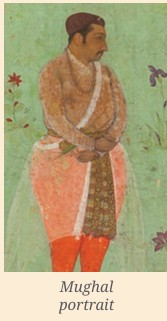
These paintings are valuable not only as works of art but also as visual records of history and culture. They give us glimpses of clothing, traditions, court life, occupations, and social customs of the time.
By studying Mughal portraits, we can understand how artists used facial features, body language, colours, and details to make a person look distinctive and expressive.
2. Dancer in a Jain manuscript
A dancer in a Jain manuscript is an example of how Indian artists used small paintings to illustrate stories, ideas, and cultural life. Jain manuscripts were traditionally handwritten texts decorated with colourful illustrations. These paintings often show people, religious scenes, musicians, and dancers.
The dancer is usually shown in an expressive pose, with carefully arranged arms, hands, legs, and body movements. The posture and gestures suggest rhythm, movement, and grace, even though the painting itself is still. The artist may also show the dancer wearing colourful clothes, jewellery, and a decorative hairstyle.
Jain manuscript paintings are known for their clear outlines, bright colours, stylised figures, and fine details. Artists worked carefully because the illustrations were often small.
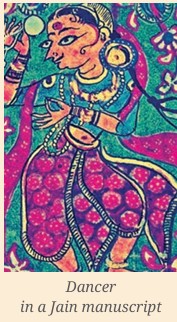
The dancer shows the close relationship between visual art, dance, music, and storytelling. It also helps us understand how artists represented the human body and movement in traditional Indian art.
3. Bengal patachitra
Bengal Patachitra is a traditional folk painting style from West Bengal. The word pata means cloth or scroll, while chitra means painting. Artists create long scrolls called patas, which are painted with colourful scenes and images.
Patachitra often depicts stories from Indian mythology, folk tales, and everyday life. Artists use bold outlines, bright colours, decorative patterns, and expressive figures. The paintings are traditionally made using natural materials and colours.
A special feature of Bengal Patachitra is its connection with storytelling. Patua artists traditionally unfold the scroll and show its scenes one by one while singing songs that narrate the story. Thus, painting, music, and storytelling come together in one art form.
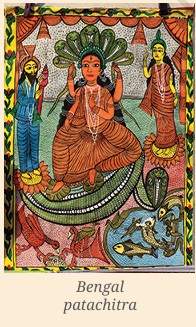
Bengal Patachitra reflects the creativity, traditions, beliefs, and cultural heritage of the people of Bengal. It continues to inspire artists and audiences today.
4. Warli painting
Warli painting is a traditional folk art associated with the Warli community of Maharashtra. It is known for its simple forms, geometric patterns, and scenes inspired by everyday life and nature.
Warli artists traditionally paint on mud walls using white pigment, often made from rice paste, against an earthy background. Human figures are commonly drawn using triangles, circles, and lines. Despite their simplicity, these shapes create lively scenes of dancing, farming, hunting, festivals, animals, trees, and village life.
One of the most recognisable features is the Tarpa dance, in which people are shown holding hands and moving in a circle around a musician playing the tarpa, a traditional wind instrument.
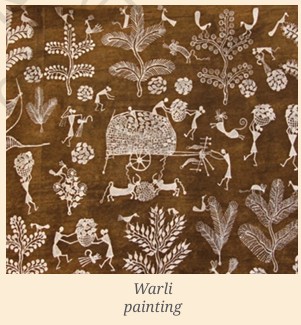
Warli painting shows how artists can communicate stories and ideas using simple shapes, lines, rhythm, and patterns. It reflects the community’s close relationship with nature, social life, celebrations, and traditions. Today, Warli art is also used on paper, cloth, and other surfaces while continuing to preserve its distinctive visual style.
5. Galaxy of musicians by Raja Ravi Varma
Galaxy of Musicians is a famous painting by the Indian artist Raja Ravi Varma. Created in the late 19th century, the painting brings together women musicians from different regions and communities of India.
The women are shown wearing different traditional costumes, jewellery, and hairstyles, reflecting the cultural diversity of India. Each musician is associated with a musical instrument, such as the veena, tanpura, mridangam, and other instruments. Their graceful poses and expressions create a calm and harmonious atmosphere.
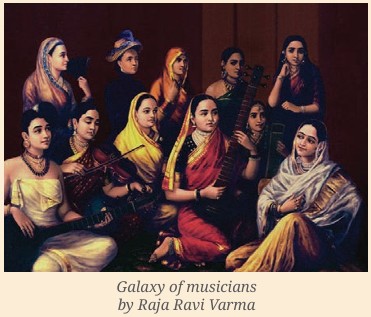
Raja Ravi Varma used realistic forms, detailed clothing, natural-looking figures, and careful use of light and shade. He combined European academic painting techniques with Indian subjects and traditions.
The painting is important because it celebrates India’s rich musical and cultural diversity. By bringing women from different regions into one composition, Ravi Varma presents a visual idea of unity within diversity.
Galaxy of Musicians helps us observe how clothing, instruments, body posture, facial expressions, and composition can communicate ideas about culture, identity, music, and harmony.
CONCLUSION
How You Feel helps us understand that art is a powerful way to express and communicate emotions. Through facial expressions, colours, lines, shapes, body movements, and gestures, artists can show feelings such as happiness, sadness, anger, fear, love, and wonder. By observing artworks and creating our own, we learn to recognise different emotions and understand the feelings of others. Art also encourages imagination, empathy, confidence, and self-expression. Most importantly, it reminds us that every person experiences and expresses emotions differently. When we explore our feelings through art, we discover new ways to understand ourselves and connect with the world around us.