
INTRODUCTION
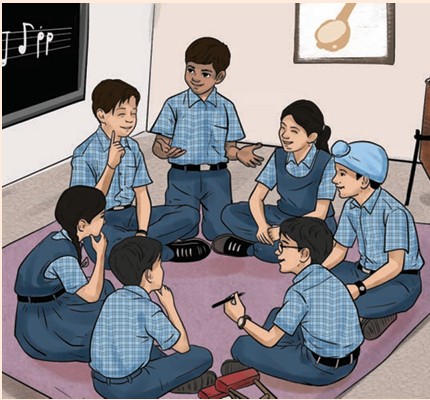
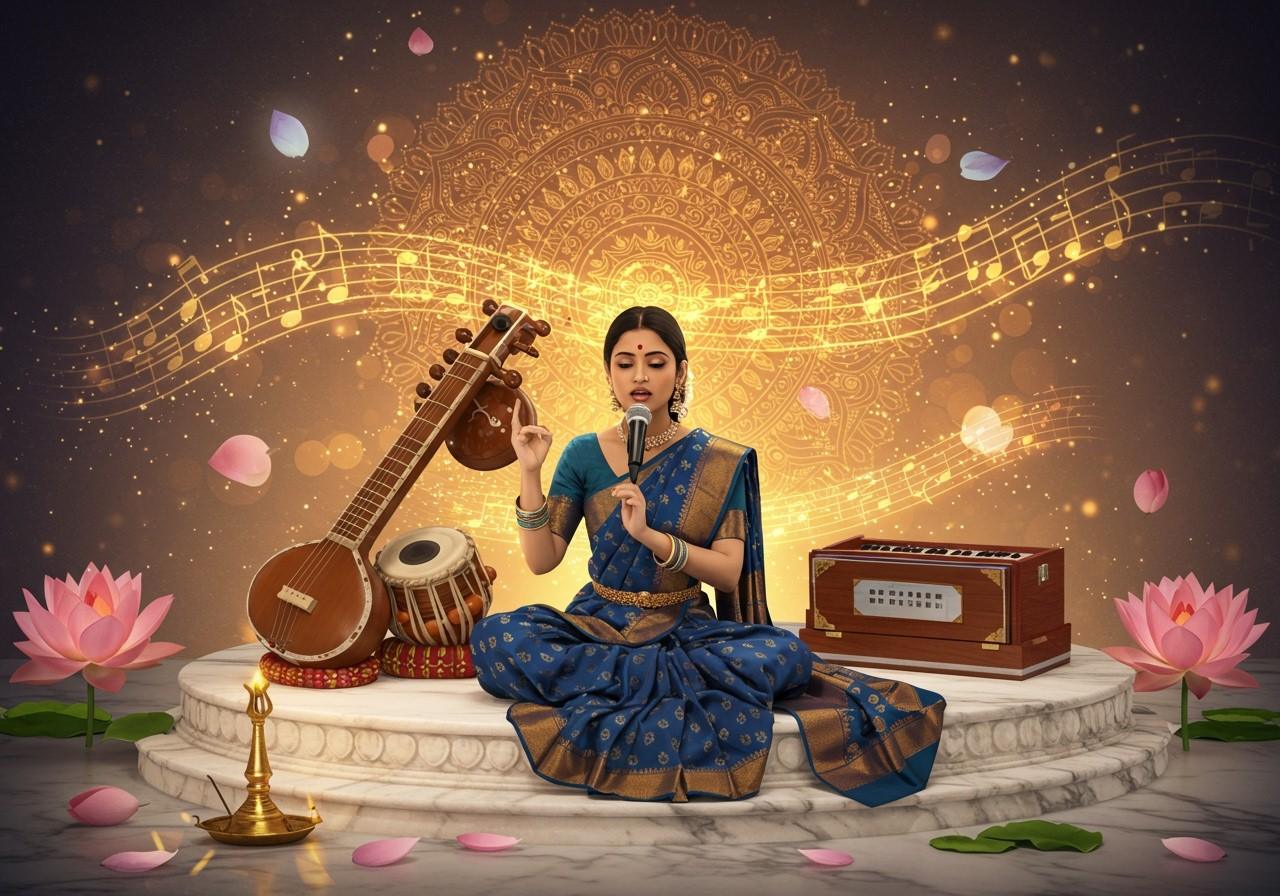
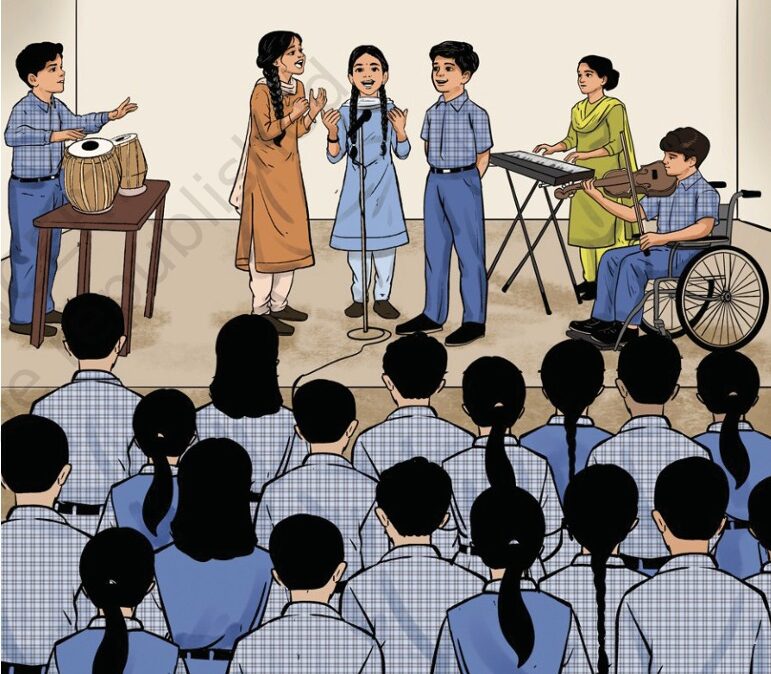
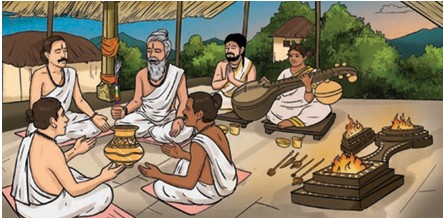
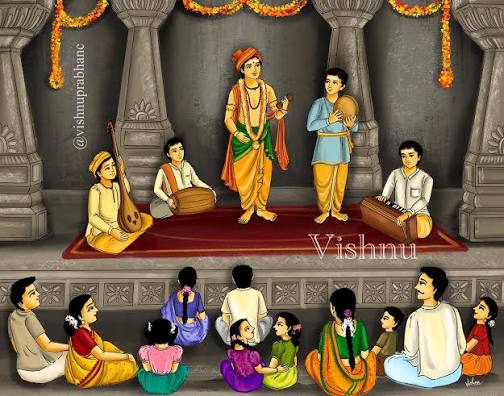
Our country’s music is incredibly diverse, reflecting the unique cultural heritage of each state, shaped by the creativity of its people.
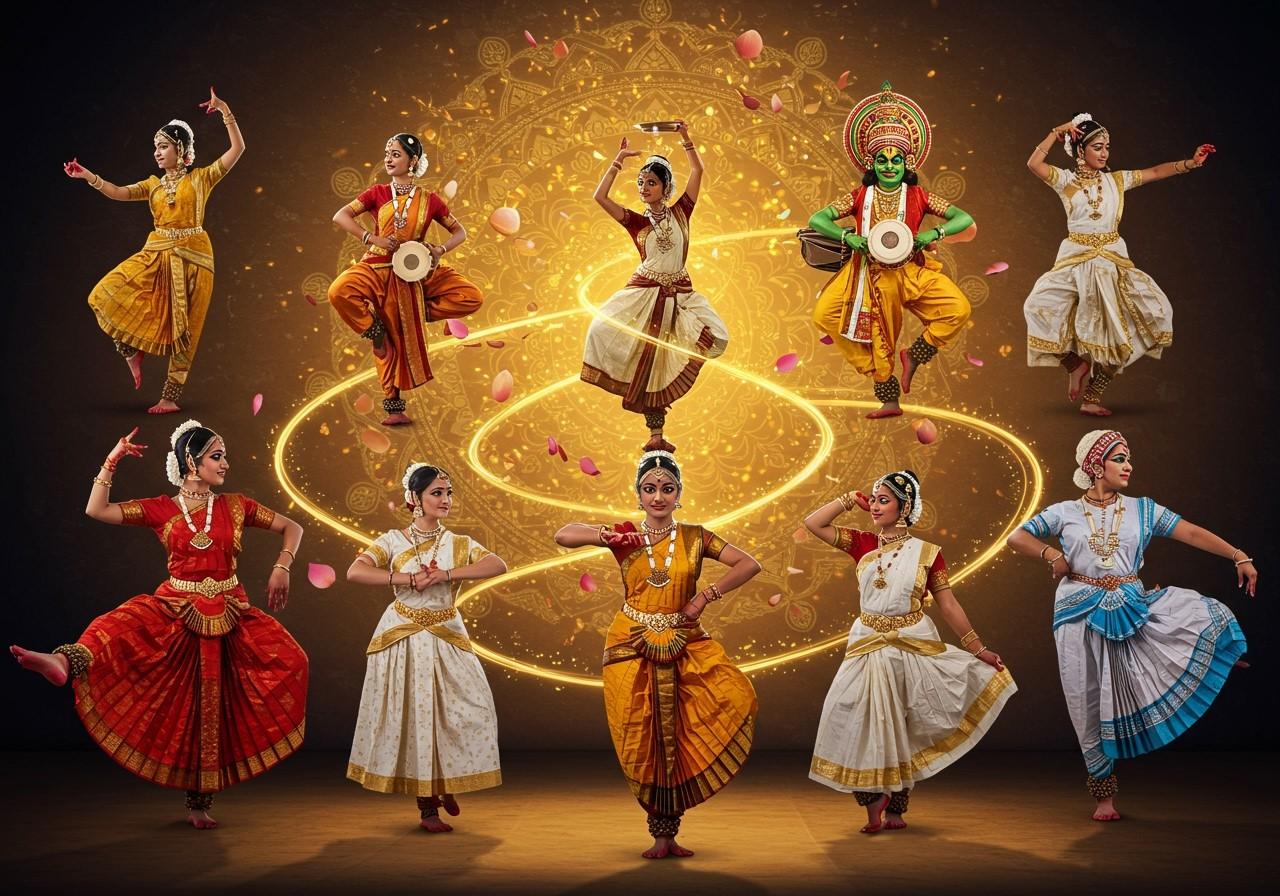
This diversity also exists in other art forms like visual arts, dance and theatre.
The Music of the People refers to the rich tradition of folk and community music created and performed by ordinary people. It reflects their daily lives, emotions, customs, beliefs, celebrations, occupations, struggles, and cultural identity.
Examples from India
India has many diverse folk-music traditions, including:
- Baul — Bengal
- Bihu songs — Assam
- Lavani — Maharashtra
- Maand — Rajasthan
- Pandavani — Chhattisgarh
- Bhatiali — Bengal
- Kajri — Uttar Pradesh and Bihar
Folk Instruments
Different communities use instruments suited to their local traditions, such as:
Ektara, Dhol, Dholak, Algoza, Ravanhatta, Flute, Manjira, and Khartal.
Importance
Folk music is an important form of cultural heritage. It gives communities a way to express their identity and preserve their language, memories, stories, values, and traditions.
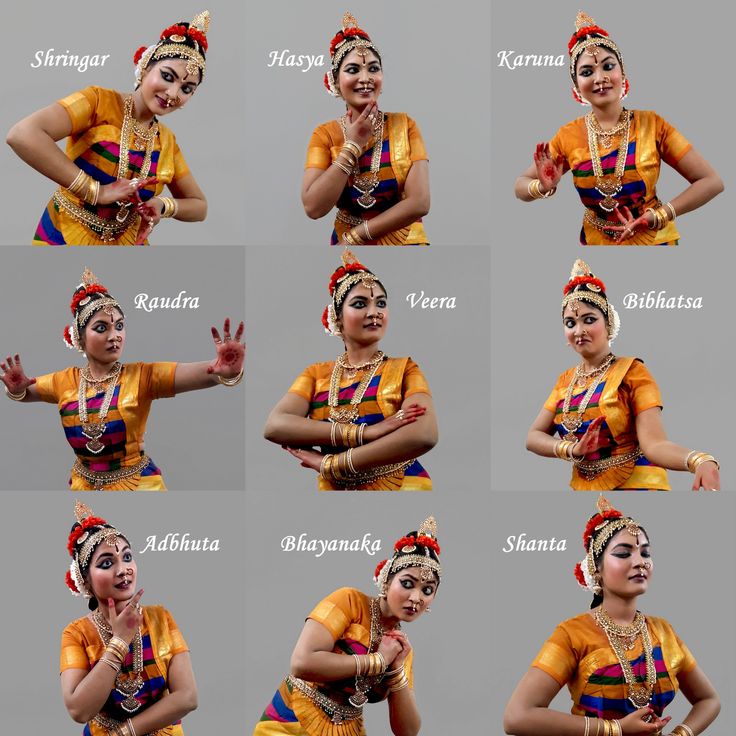
Lok means the people. Hence, lok sangeet is the music of and by the people of our country. Lok sangeet expresses different emotions or rasas and informs you about festivals, rituals, traditions, occupations, beliefs, faith, etc., through the lyrics.
Traditional Musical Instruments
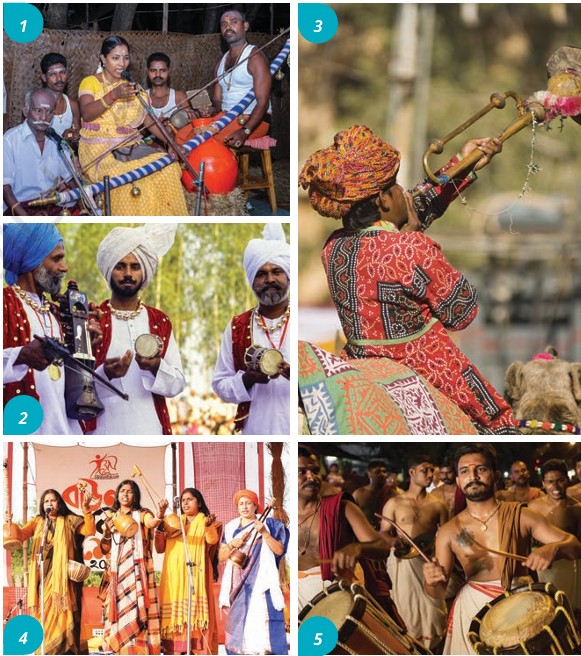
These are examples of Indian folk and traditional musical instruments, each associated with different regional musical traditions.
In Short
Vilavel → Folk tradition
Sarangi → Bowed string instrument
Damru → Percussion instrument
Desi Saxophone → Wind instrument
Ektara → One-string folk instrument
Gopi Jantra → Folk string instrument
Chenda → Kerala percussion instrument
FOLK SONGS AND COMMUNITY
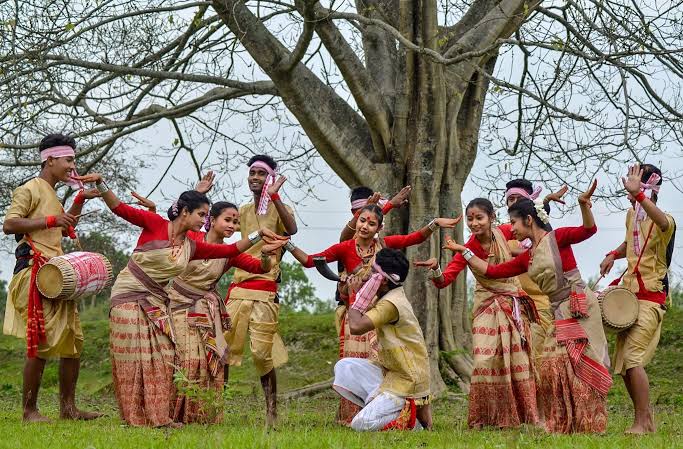
A form in music refers to the style of singing or playing musical instruments. Sing the song but first of all, try to read all the words properly. Clap while singing, this will help you understand the rhythm of the song. You can all stand and dance in Bihu style.
Song: Bihu bihu lagise gaat
Assamese song by Bhupen Hazarika
Bihu bihu lagise gaat bihu maro ahana
Uru uru korise mon epak naso ahana
Sinu sinu lage tomar naam ki tomar kuana
Bihu maro ahana epak naso ahana
Naam ki tomar kuana jaan
O …nasani ye naasi jaa
Bihu geet epaki gaa bihu epaki gaa
Chiyuri mahare pepaki gateelo
Ahotor talate roy ukhal makhal lohalo
Nasaniye naasi jaay bihu geet epaki gay
O …Bohagare akakhote naase
Korekoye bijuri ulahere
Meghore aare aare
O …Daore jen dhol bojaye taale taale
Botajoke bihure geet gaare
ohol paare paare
Hurr runjhun moina gun gun moina guri
guri jaa naasana
SONG SUMMARY
This Bihu geet, captures the spirit of Bohag Bihu, a popular festival. The lyrics express joy, celebration, and a deep connection to nature, rhythm and tradition.
Bhupen Hazarika
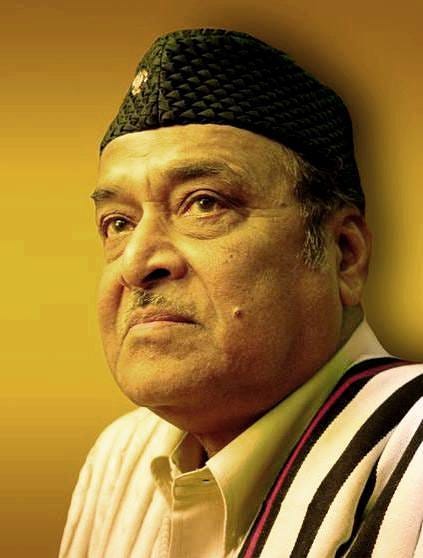
Bhupen Hazarika (1926–2011) was a celebrated Indian singer, composer, lyricist, filmmaker, and cultural icon from Assam. He is popularly known as the “Bard of Brahmaputra” because of his deep connection with the river, the people, and culture of Assam.
Contribution to Music
- He composed and sang songs in Assamese, Bengali, and Hindi, among other languages.
- His music often focused on humanity, social equality, peace, nature, love, and the lives of ordinary people.
- He drew inspiration from Assamese folk traditions, particularly the musical heritage of the Brahmaputra valley.
- His songs connected folk music with modern musical forms, making regional traditions accessible to wider audiences.
- His powerful voice and meaningful lyrics made him one of India’s most influential cultural figures.
ACTIVITY 8.1 People of Jharkhand playing the Nagada
The Nagada is a large drum-like percussion instrument. It generally has a rounded or bowl-shaped body with a stretched membrane on the top. The membrane is struck with sticks to produce sound.
The size and construction of Nagadas can vary according to the local tradition and the purpose for which they are used. Because of its large body and tight drumhead, the instrument can produce a strong sound that carries over a considerable distance.
The Nagada does not produce melodies like a flute or a string instrument. Instead, it provides rhythm and beats, making it especially useful for traditional dances and group performances.
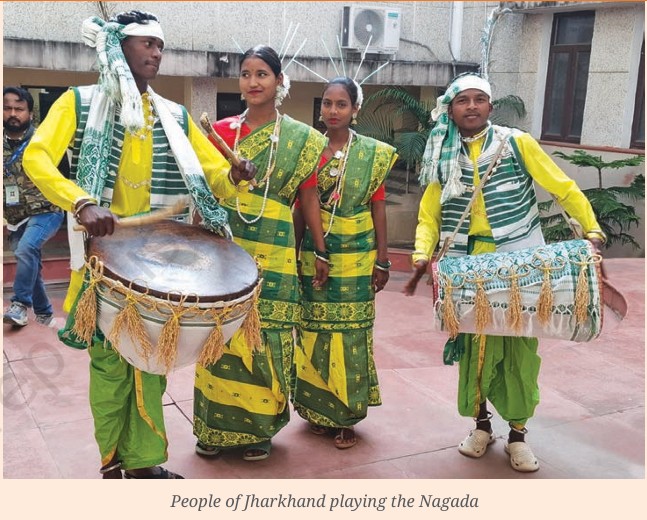
Nagada in Jharkhand’s Folk Culture
Jharkhand has a rich cultural heritage consisting of many tribal and regional communities. Music, dance and festivals form an important part of social life. Traditional instruments are often played collectively rather than as isolated musical instruments.
The Nagada is particularly useful for creating a strong rhythmic foundation. During a cultural performance, the beats of the Nagada may be combined with other drums and instruments. This creates a lively musical atmosphere in which dancers and singers can participate.
The instrument is also associated with the idea of community participation. Its powerful sound can attract people to a gathering and announce the beginning of a celebration or performance.
Use During Festivals and Celebrations
Traditional drums such as the Nagada are commonly associated with celebrations and public gatherings. In Jharkhand, folk music can accompany occasions such as:
- Traditional festivals
- Village celebrations
- Religious and cultural gatherings
- Folk-dance performances
- Community events
- Cultural programmes
- Ceremonial occasions
UNIQUE VOICES
Listen carefully to the voices of your friends in the classroom. Are they all unique, or do some sound similar? Probably not! You will hear a variety of tones —
sharp and clear, rich and deep, and soft and gentle. Just like our appearances, each voice is unique and distinct. No two people look exactly alike and similarly, no two voices sound exactly the same.
Every person has a different and unique voice. If we listen carefully to our classmates, we can notice that some voices are sharp and clear, some are deep and rich, while others are soft and gentle.
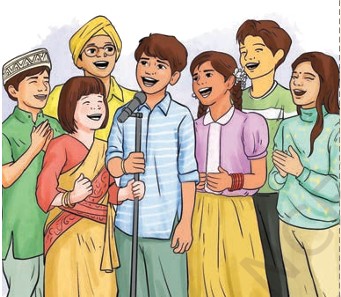
Just as no two people have exactly the same appearance, no two people usually have exactly the same voice. Our voices differ because of differences in our vocal organs, especially the vocal cords, as well as the way we speak.
We often think that male voices are low-pitched and female voices are high-pitched. This is a common generalization, but it is not always true. Some males may have relatively high voices, while some females may have relatively low voices.
By listening to our classmates, we can identify different qualities of voices and understand that every voice has its own character and identity.
Key Points
- Every person’s voice is unique.
- Voices can be high, low, soft, loud, clear, deep, or gentle.
- People of the same gender can also have very different voices.
- Male voices are not always low-pitched.
- Female voices are not always high-pitched.
- Listening carefully helps us recognize different tones and pitches.
ACTIVITY 8.2: UNCONVENTIONAL SINGERS
Here are some examples of male and female voices that are unconventional or unusual. Many renowned artists have unconventional voices, and this is what makes them unique and special. Listen to their music online.
1. Usha Uthup
Usha Uthup is a famous Indian singer known for her deep, powerful, distinctive and energetic voice. She is especially recognized for her ability to sing in different languages and for her unique style of performance.
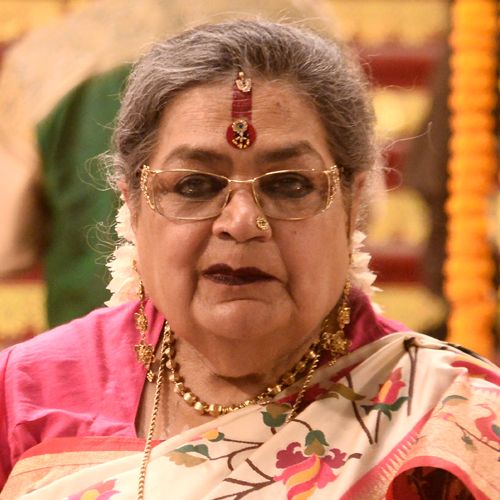
Why is Usha Uthup an example of a “Unique Voice”?
Usha Uthup is a good example of the idea that every voice is different. Her voice has a rich and deep quality that makes it easily recognizable. She developed a distinctive singing style that combines Indian musical traditions with pop, jazz and other influences.
She has sung in several Indian languages, including Hindi, Bengali, Tamil, Telugu, Malayalam and Kannada, as well as English and other languages.
2. Teejan Bai
Teejan Bai is a famous Indian folk singer and performer known for her powerful Pandavani singing style. She comes from Chhattisgarh and is one of the most celebrated performers of this traditional storytelling art.
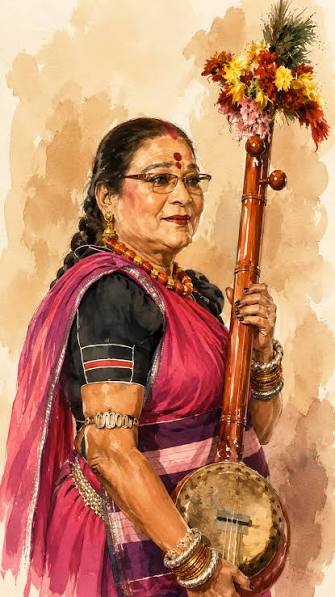
Her Unique Voice
Teejan Bai is an excellent example of “Unique Voices.” Her voice is strong, deep and highly expressive. She can change her tone and style while portraying different characters and emotions from the Mahabharata.
Her powerful voice allows her to hold the attention of an audience even during long storytelling performances. She combines her voice with facial expressions, gestures and movements to make the story come alive.
3. Kumar Gandharv
Kumar Gandharva was one of India’s most innovative and influential Hindustani classical vocalists. His original singing style, distinctive voice and creative approach to music made him an excellent example for the topic “Unique Voices.”
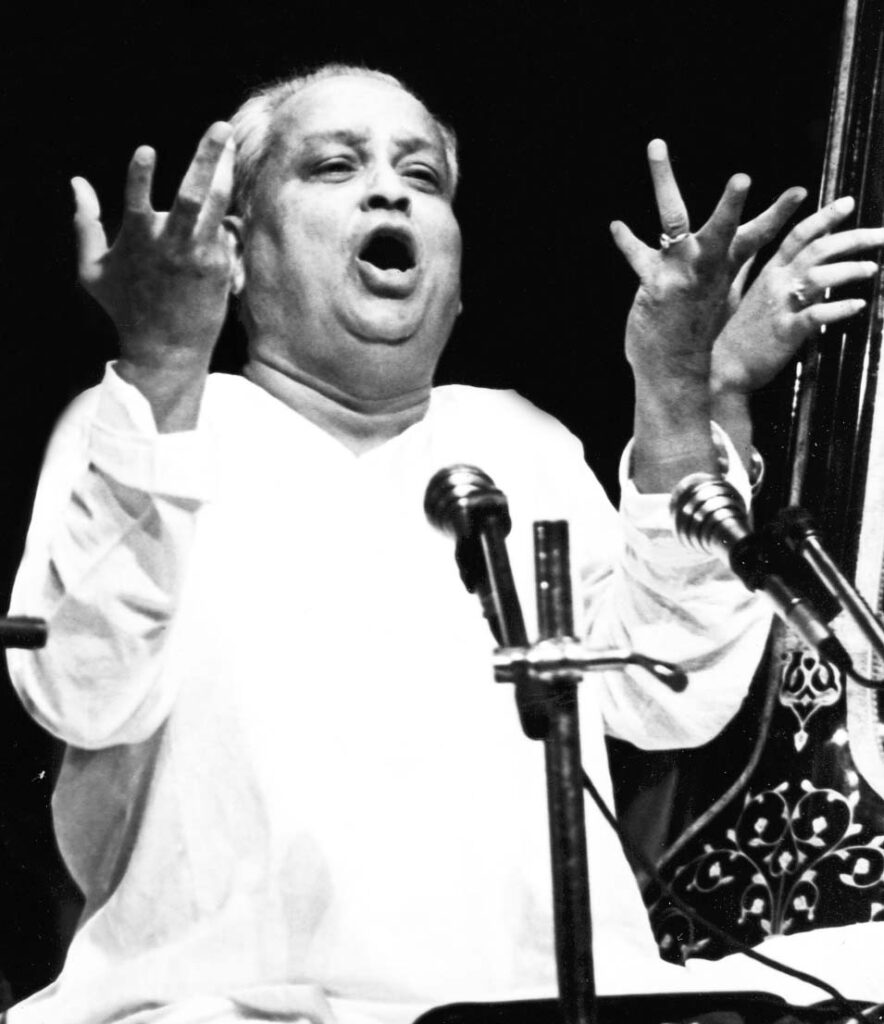
His Unique Voice
Kumar Gandharva’s voice had a distinctive, powerful and expressive quality. His singing was easily recognizable because of his unusual approach to melody, rhythm and pronunciation.
He believed that music should be connected with life and human emotions. His performances often combined the discipline of classical music with the natural simplicity and emotional power of folk traditions.
4. D K Pattammal
D. K. Pattammal, popularly known as D. K. Pattammal, was one of the greatest Carnatic classical vocalists of India. She was admired for her powerful, clear and disciplined singing style and made an important contribution to Indian classical music.
She was popularly known as “Pattamma” and became an important figure in South Indian classical music.
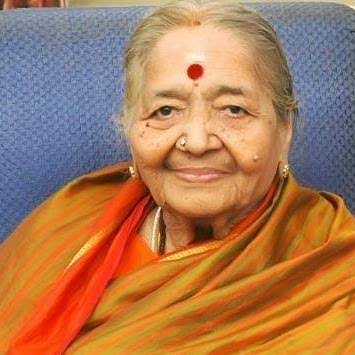
Her Unique Voice
D. K. Pattammal is an excellent example of “Unique Voices.” Her singing was known for its clarity, strength, precision and emotional depth. She had a distinctive style of presenting difficult Carnatic compositions with excellent control over melody and rhythm.
Her voice was not simply used to produce beautiful sounds; she used it to communicate the structure, emotion and beauty of Carnatic music.
BREAKING STEREOTYPES
Now let us sing another type of song — A lullaby or a lori. A lullaby is a song sung to help a child fall asleep. While a lullaby is usually sung by a mother.
A lullaby, also called a lori, is a soft and soothing song sung to help a baby or young child fall asleep. Lullabies are usually sung in a gentle and slow voice.
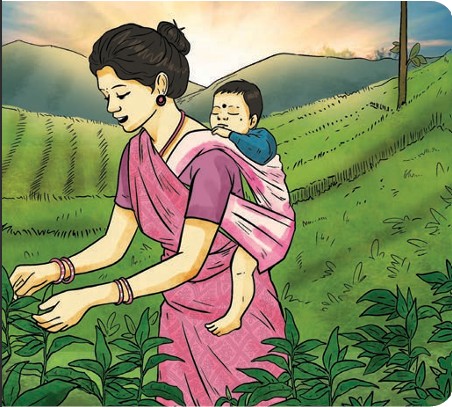
Traditionally, mothers often sing lullabies to their children, but fathers, grandparents, brothers, sisters, and other family members can also sing them. This shows that caring for and comforting a child is not limited to one person.
Lullabies may contain loving words, simple melodies, repetitive lines, and gentle rhythms. They are an important part of family and cultural traditions because many lullabies are passed from one generation to another.
Simple Example
“सो जा, नन्हे बच्चे,
मीठे सपने आएँ,
चाँद सितारे आकाश में,
तुझको गीत सुनाएँ।”
Main Idea
A lori is more than just a song—it expresses love, affection, care and comfort for a child.
ACTIVITY
Let us listen to a qawwali. A qawwali is a form of devotional music that is related to the Sufi Islamic tradition. Traditionally, qawwalis have been performed by a group of male musicians, however today, many female musicians perform qawwali, showing how musical forms can evolve and adapt over time.
Some famous female qawwali singers include Roshanara Begum, who was born in Kolkata.
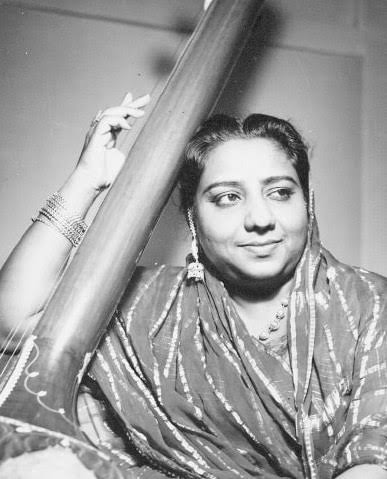
1. Roshanara Begum
Roshanara Begum, also known as Roshan Ara Begum, was a renowned Hindustani classical singer of the 20th century. She was born in 1897 in Calcutta (now Kolkata) and later became an important figure in the classical music tradition of the Indian subcontinent.
Breaking Stereotypes
Roshanara Begum is relevant to the theme “Breaking Stereotypes” because she became a highly respected professional classical musician at a time when opportunities for women in public musical performance were much more restricted than they are today.
She established herself through her musical talent and dedication, demonstrating that women could achieve great recognition in the demanding world of Hindustani classical music.
Contribution to Music
Roshanara Begum made a significant contribution to the Kirana gharana and helped popularise Hindustani classical music through her performances. After the Partition of India in 1947, she settled in Pakistan and became one of the country’s most respected classical vocalists.
She continued performing and teaching music and influenced later generations of singers.
WOMEN IN MUSIC
Several Indian women have left an indelible mark on music through their poetry and compositions.
1. MIRABAI
Mirabai was a poet and devotee of Shree Krishna who lived in the 15th century CE. She was born a princess in a royal family of Rajasthan and married prince Bhojraj of Mewar.
From a young age, she was devoted to Lord Krishna, and later on, travelled to many places associated with Krishna like Dwarka and Vrindavan.
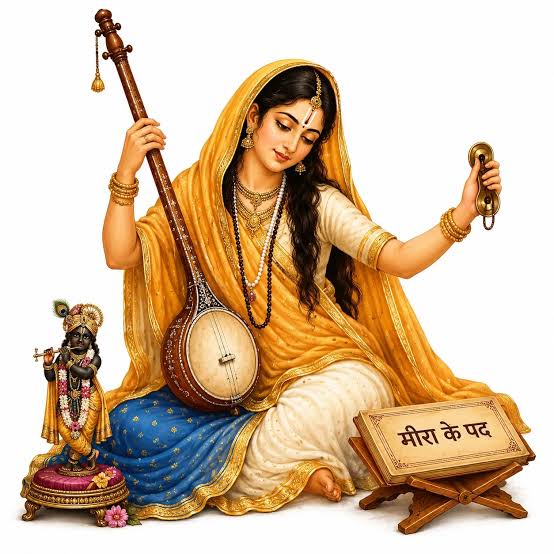
She was a celebrated poet, and composed hundreds of bhajans (devotional songs) in praise of Krishna.
She is remembered today as a great saint of the Bhakti movement, and her bhajans are still sung in both classical and devotional music styles. Let us learn a popular Mira Bhajan.
SONG: BHAJAN — PAYOJI MAINE
Payoji maine ram ratan dhan paayo (2)
Vastu amolik dee mera sataguru, kripaa
kar apnaayo (Payoji)
Janam janam ki punji payee, jag mein
sabhi khovayo (Payoji)
Meera ke prabhu giridhar nagar, harash
harash jas gaayo (Payoji)
Song Summary
The song expresses Meera’s deep devotion and love for Lord Krishna. She feels that she has found the most precious treasure in her guru (spiritual teacher), who has shown her kindness and guided her on the path of devotion.
Meera says that although she may have lost worldly possessions, her devotion to Krishna has given her a spiritual treasure that is more valuable than material wealth and will remain with her for many lifetimes.
She considers Shree Krishna her beloved Lord and says that she will happily sing his praises. The song highlights the importance of devotion, faith, spiritual knowledge and love for God over worldly possessions.
ACTIVITY
1. Lal Ded
Lal Ded, also known as Lalleshwari or Lal Didi, was a famous Kashmiri mystic, poet and spiritual teacher who lived during the 14th century. She is regarded as one of the most important figures in the literary and spiritual history of Kashmir.
Lal Ded and Her Poetry
Lal Ded expressed her spiritual experiences through short poems called vaakhs. These poems were traditionally passed from one generation to another through oral tradition.
Her poetry explores ideas such as:
- Devotion and spirituality
- Self-knowledge
- Search for truth
- Inner peace
- Love for the Divine
- Freedom from material attachments
Her verses were written in a simple and direct style, making them accessible to ordinary people.
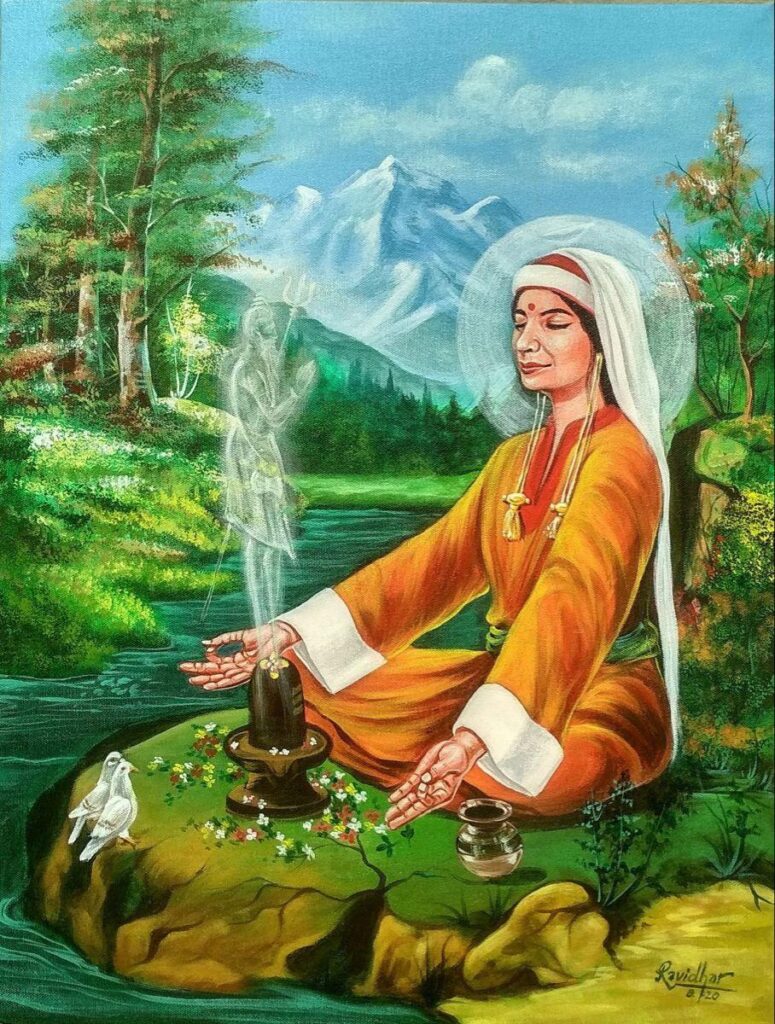
Her Unique Voice
Lal Ded is an excellent example of a “Unique Voice” because she expressed profound spiritual ideas in her own distinctive poetic style. Her words challenged social conventions and encouraged people to look within themselves rather than simply follow external rituals.
Her poetry became an important part of Kashmiri cultural heritage and continues to be remembered and recited today.
Lal Ded and Music
Many of Lal Ded’s vaakhs have been sung or recited over generations. Her words therefore connect poetry, spirituality and oral musical traditions.
Core Philosophy and Teachings
- Kashmiri Shaivism: Her poetry is deeply rooted in the non-dualistic philosophy of Kashmir Shaivism, seeing the individual soul and Shiva (universal consciousness) as one.
- Rejection of Dogma: She strongly opposed idol worship, empty ritualism, animal sacrifice, and external religious orthodoxy.
- Social Equality: She rejected caste discrimination, gender inequalities, and social barriers, making spiritual wisdom accessible to common people in their native tongue.
- Universal Appeal: Bridging Hindu and Sufi thought, she inspired diverse traditions; Muslims affectionately called her Lalla Aarifa, Hindus revered her as Lalla Yogishwari, and Sufi saints like Nund Reshi (Nand Rishi) were deeply influenced by her teachings.
1. Which century did Lal Ded live in?
Lal Ded lived during the 14th century, around the period of 1320–1392, according to commonly cited traditional dates.
She belonged to the tradition of Kashmir Shaivism and became known as a spiritual teacher and mystic.
2. What were her poems about?
Lal Ded’s short poems are called Vaakhs (Vakh). The word is associated with speech or sayings. Her poems express her spiritual experiences, search for truth and self-realisation.
Her poetry deals with ideas such as:
- Search for God and spiritual truth
- Self-knowledge and understanding one’s inner self
- Devotion and meditation
- Freedom from material attachments
- The importance of inner experience rather than outward appearances
- Human life, suffering and spiritual liberation
Her poetry also reflects the cultural and religious environment of medieval Kashmir, including interaction between Shaivite and Sufi traditions.
3. How did she contribute to poetry?
Lal Ded’s Vaakhs are among the earliest important compositions in the Kashmiri language and played a major role in the development of Kashmiri literature.
Her poems were transmitted orally for centuries. People remembered, recited and passed them from one generation to another. Because of this oral tradition, her poetry became deeply connected with the language, culture and spiritual traditions of Kashmir.
Her style was simple, direct and philosophical. She could communicate deep spiritual ideas through short verses that ordinary people could remember and recite.
MUSIC AND SOCIAL REFORM
Music and social reform are closely connected because music can communicate ideas, question unfair practices, and inspire people to bring positive changes to society. Songs are often easier to remember and share than long speeches, so they can reach large numbers of people.
Throughout history, poets, singers and musicians have used songs, poems, folk performances, devotional music and public performances to speak about social issues.
1. ANNAMACHARYA
Annamacharya was musician, composer a and Telugu saint who lived in the 15th century. He is said to have composed 32,000 sankirtanas (devotional songs) in praise of Lord Venkateshwara of Tirupati.
Annamacharya is important to the theme “Music and Social Reform” because some of his compositions expressed ideas about equality and the dignity of human beings.
He used simple and accessible language to communicate spiritual ideas to ordinary people. His songs emphasized that devotion and spiritual worth are not determined by wealth, social position or outward status.
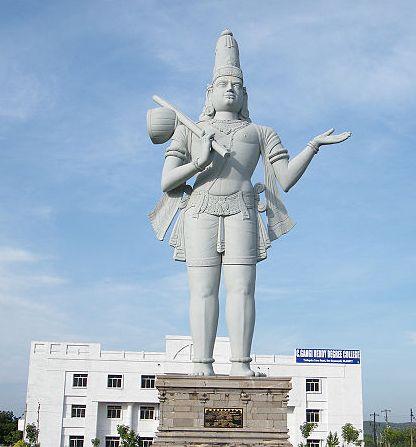
His music therefore reached beyond the boundaries of social class and made devotional expression accessible to a wider community.
His Contribution to Music
Annamacharya is traditionally credited with composing thousands of devotional songs. His compositions became an important part of the musical and devotional traditions associated with Tirumala and Lord Venkateswara.
His songs cover many themes, including:
- Devotion to Lord Venkateswara
- Spirituality
- Love and devotion
- Human values
- Equality
- Social observations
- Everyday life
His compositions continue to be performed by Carnatic musicians and devotional singers.
SONG: BRAHMAM OKATE
Tandanana ahi tandanana pure
Tandanana ahi tandanana pure
Tandanana bhala tandanana
Brahmam okate para brahmam okate para
Brahmam okate para prahmam okate..
Kanduvagu heenadhikamulindu levu
Andariki shri hare antharaathma
Indulo jantukulamintanokate
Andariki shri hare antharaathma
Hare antharaathma
Shri hare antharaathma..
Kadagi enugu meeda kaayu endokate
Pudami shunakamu peeda polayu yendokate
Kadu punyalanu papa karmulanu sarigaava
Jadiyu sri venkateshvaru namamokate
Venkateshvaru namamu okate
SONG SUMMARY
This song describes how God is one. There are no class distinctions like high or low, as God dwells in all beings.
2. CHARANKAVI MUKUNDA DAS
In Bengal, Charankavi Mukunda Das, also known as Jogeshwar Datta, who lived in the 19th or 20th century, preached objectives of the movement Swadeshi through his songs and plays in villages.
Charan Kavi Mukunda Das (1878–1934), whose birth name was Yajneshwar De, was a famous Bengali poet, singer, composer, playwright and patriot. He became popularly known as “Charan Kavi”, meaning a poet who travelled among the people and spread his message through songs and performances.
Music and Social Reform
Mukunda Das is an important example for the topic “Music and Social Reform.” He used songs, folk theatre and Jatra performances to communicate powerful messages about society, patriotism and freedom.
During the Swadeshi movement, he travelled with his theatrical group and performed songs and plays that encouraged people to oppose British rule and support indigenous goods. His famous play Matripuja became particularly popular, but the British government considered his performances politically threatening and eventually arrested him.
Here is a composition by him—
SONG: BAAN ESHECHEY
Baan eshechey maura gange khulte haube
nao tomra ekhono ghumao
Kauto Joog Gaichey ketey dekhecho kauto
shaupon Ebaar badar boley dhauro boithaa
jibon mauron paun Daumkaa hawaar kaal
kaal giyaachey Phagun boiche paal khaatao
Kaandtey haube sharaa jibon joog joogantor
tauposhshatey eshechey ei laugon Parer
maajhi haal dhorechey michey paurer mukh
takao
SONG SUMMARY
The song says, “A tide has risen, a flood swells in the river”, symbolising the flow of life. “Do not sleep — arise! Much time has already slipped away. If you do not take the oars into your own hands and steer the boat, all opportunities will be lost, and you will be left with only regret for your inaction”.
INSTRUMENTS AND REGIONS
MEANING
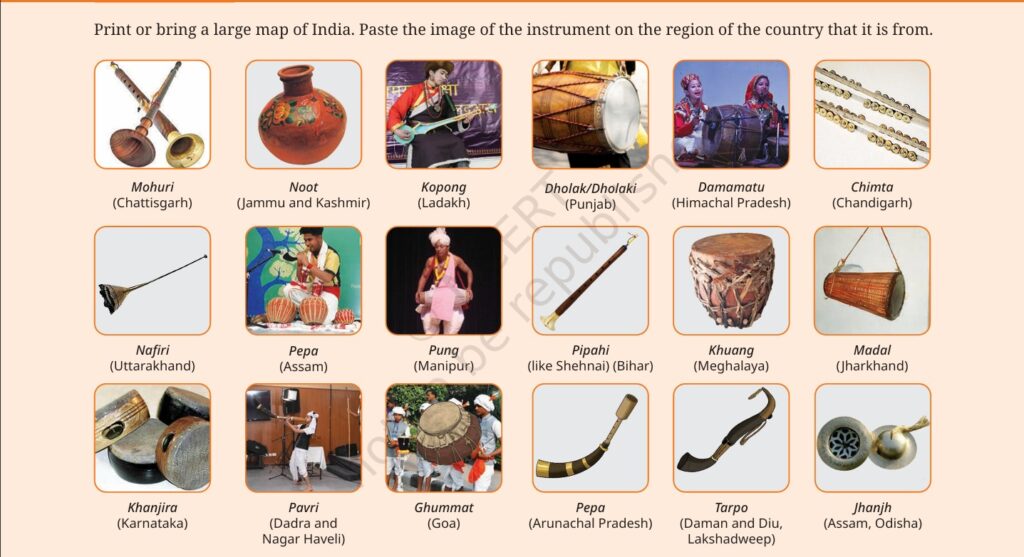
The diverse tastes and choices of people across different regions of India reflect the country’s rich cultural mosaic. This diversity inspires a variety of art forms, including music, musical instruments and dance, creating expressions that resonate with local traditions, beliefs and ways of life.
NOTES:-
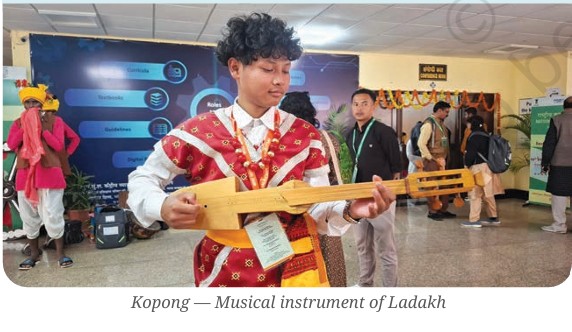
1. Kopong — Musical instrument of Ladakh
Kopong is a traditional musical instrument associated with the folk and cultural traditions of Ladakh, a high-altitude region of the Indian Himalayas. Traditional instruments such as the Kopong reflect the distinctive musical heritage of Ladakhi communities.
Features of the Kopong
The Kopong is used as part of traditional musical practices and performances. Like many regional folk instruments, its design and method of playing are closely connected with the local culture and environment.
It may be used during community gatherings, traditional celebrations, cultural performances and folk music. The instrument contributes to the distinctive sound of Ladakhi music.
“Kopong — a traditional musical instrument associated with the rich folk and cultural heritage of Ladakh.”
ACTIVITY
Conclusion
Music is an important part of the life, culture and traditions of people. Every region of India has its own songs, voices, instruments and musical styles that reflect its history and way of life. From the powerful beats of the Nagada in Jharkhand to the folk traditions of different states, music brings people together and gives them a way to express their feelings and beliefs.
The examples of Usha Uthup, Teejan Bai, Kumar Gandharva, D. K. Pattammal, Lal Ded and Annamacharya show that every voice can have its own identity. Musicians have also used music to break stereotypes, preserve traditions and bring social change.
Traditional music is therefore not merely entertainment. It is a living heritage passed from one generation to another. By listening to, learning and respecting the music of different communities, we can better understand India’s unity in diversity.