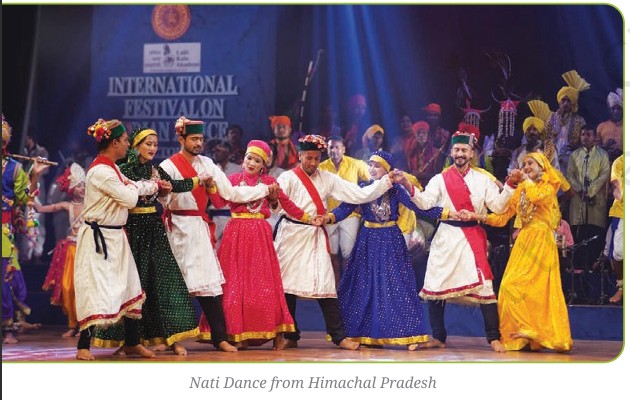

Introduction
Music is all around us. We hear it in songs, celebrations, festivals, films, performances, and everyday life. It can make us feel happy, peaceful, excited, thoughtful, or emotional. But have you ever wondered what makes a piece of music sound the way it does?
Every musical composition is created using different elements of music. Rhythm, melody, pitch, tempo, dynamics, harmony, timbre, and texture work together to shape the character and expression of music. Understanding these elements helps us listen more carefully and recognise how musicians create different moods and musical experiences.
In this section, we will explore the basic elements of music and discover how they work individually and together. We will also learn how these elements are used in different musical traditions and performances. By listening, observing, singing, playing instruments, and experimenting with sounds, we can develop a deeper appreciation of music.
Most importantly, learning about musical elements is not only about understanding technical terms. It is about listening, feeling, creating, and expressing ourselves through music.
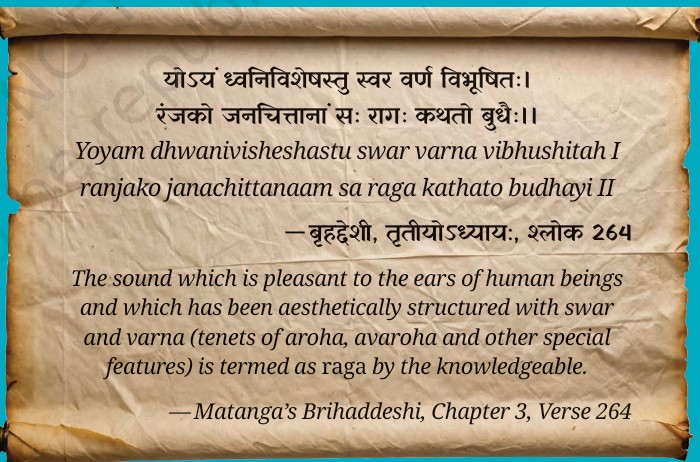
Welcome back, students! When we listen to music or sing a song, we can observe that it is made up of different musical elements. Some of the main elements of Indian music are melody (Raga), rhythm (Tala), and lyrics (Sahitya).
In this chapter, we will explore these elements in greater detail. We will learn more about melody, rhythm, and lyrics, and understand how they work together to create a musical composition. Through listening, singing, and practical activities, we will discover how these elements combine to make a song expressive and meaningful.

Vocal Exercises
Vocal exercises help singers warm up and strengthen the voice. They improve breathing, pitch, voice control, pronunciation, and confidence.
Begin with gentle breathing exercises and humming. Practise the swaras Sa, Re, Ga, Ma, Pa, Dha, Ni, Sa slowly, both upwards and downwards. You can also practise akar by sustaining an “Aa” sound on different notes.
Practise regularly, but avoid straining your voice. These simple exercises help develop a clear, steady, controlled, and expressive voice.
ACTIVITY 5.1: RANGE
Range refers to the distance between the lowest and highest notes that a singer can comfortably sing. A good vocal range allows singers to sing different melodies and express music effectively.
Vocal exercises can gradually help develop and strengthen the range. Singers should practise notes from low to high and back down, without forcing the voice. Regular and gentle practice improves pitch, flexibility, control, and confidence.
Earlier, we learnt that vocal range is the span between the lowest and highest notes a person can comfortably sing. Developing this range can help improve singing ability and vocal control.
The following exercises focus on the lower register (Mandra Saptak). Practise the notes gently and steadily without forcing your voice.
While practising, keep your head and neck in a neutral position. This helps prevent unnecessary strain on the throat and neck muscles. Regular, comfortable practice can gradually improve your vocal flexibility and confidence.
Mandra Saptak Practice
S
S Ṇ S
S Ṇ Ḍ Ṇ S
S Ṇ Ḍ P Ḍ Ṇ S
S Ṇ Ḍ P Ṃ P Ḍ Ṇ S
Tara Saptak
Tara Saptak refers to the higher register of notes in Indian music. It consists of the same seven basic swaras—Sa, Re, Ga, Ma, Pa, Dha, Ni—but they are sung or played at a higher pitch than the Madhya Saptak.
Practising Tara Saptak helps singers develop their upper vocal range, pitch control, flexibility, and confidence. The notes should be practised gradually and comfortably, without forcing the voice.
While practising, maintain a relaxed posture and avoid unnecessary strain on the throat. Regular practice of suitable vocal exercises can help singers reach higher notes with greater ease and control.
ACTIVITY 5.2: FLEXIBILITY
Flexibility in singing refers to the ability to move smoothly and comfortably between different notes, pitches, and musical patterns. It helps singers sing ascending and descending notes, quick passages, changes in pitch, and different melodic patterns with greater ease.
Regular vocal exercises, such as practising Sa, Re, Ga, Ma, Pa, Dha, Ni in different patterns, can gradually improve vocal flexibility. Singers should practise slowly at first and increase the speed only when they can sing the notes clearly and comfortably.
Good flexibility allows the voice to become smooth, controlled, responsive, and expressive.
These vocal exercises help you develop flexibility in your voice. Sing them slowly and increase the tempo of practice as you get comfortable.
Sargam in Teentala
| SRSG | RGMG | SGEG | SRGM |
| RGRM | GMPM | RMGM | RGMP |
| GMGP | MPDP | GPMP | GMPD |
| MPMD | PDND | MDPD | MPDN |
| PDPN | DNSN | PNDN | PDNS |
| X | 2 | 0 | 3 |
| SNSD | NDPD | SDND | SNDP |
| NDNP | DPMP | NPDP | NDPM |
| DPDM | PMGM | DMPM | DPMG |
| PMPG | MGRG | PGMG | PMGR |
| MGMR | GRSR | MRGR | MGRS |
| X | 2 | 0 | 3 |
ACTIVITY 5.3: WARMUPS IN HARMONY
Warm-ups in harmony are vocal exercises in which two or more singers practise different notes together while maintaining a sense of pitch and balance. They help singers prepare their voices for group singing and harmonised musical passages.
Begin with simple patterns, such as one group singing a note while another group sings a different, complementary note. Gradually practise short melodic patterns together, listening carefully to maintain the correct pitch and rhythm.
Harmony warm-ups develop pitch awareness, listening skills, vocal control, coordination, and confidence. Singers learn to listen not only to their own voice but also to the voices of others. Regular practice helps the group produce a balanced, blended, and pleasant sound.
In Grade 8, we learnt to sing canons, which are a first step in learning to sing harmony. Now, let us sing these vocal warmups.
- First sing the lines together as a group.
- Then divide into two groups, with each group singing one part (simultaneously).
Try singing this in two groups at the same time:
Warmup in thirds
| GROUP 1 | SRG DNṠ | RGM PDN | GMP MPD | MPD GMP | PDN RGM | DNṠ SRG |
| GROUP 2 | GMP SRG | MPD NSR | PDN DNS | DNS PDN | NSR MPD | SRG GMP |
Harmony
Different notes can be sung at the same time to produce a pleasant effect. This is called harmony.
Singing in harmony is a wonderful example of collaboration. Playing a duet or a jugalbandi is another example. Can you think of how you can carry forward these principles of harmonious collaboration to other areas of your life?
ACTIVITY 5.4: SANSKRIT VERSES AND RHYTHM
There are many verses in Sanskrit composed by various poets and philosophers. These verses are set in a particular metre or pattern. This is referred to as chhandas in Sanskrit. Thus, while Sanskrit verses are chanted as a devotional offering, they can also give us an understanding of rhythm.
Shloka and Chhand (Metre)
There are many verses in Sanskrit composed by different poets and philosophers. These verses are often written according to a particular metre or rhythmic pattern, known as Chhandas in Sanskrit.
Chhandas gives a verse a structured pattern of syllables, making it suitable for recitation, chanting, and singing. Sanskrit verses are often chanted as a devotional offering, but they also provide a wonderful way to understand and experience rhythm and rhythmic patterns in music.
One commonly used metre is Anushtup Chhand, which follows a specific pattern of syllables. By reciting a shloka in Anushtup Chhand, students can observe how the arrangement of syllables creates a rhythmic flow.
Here is a shloka that you can recite in Anushtup Chhand and experience its rhythmic pattern.
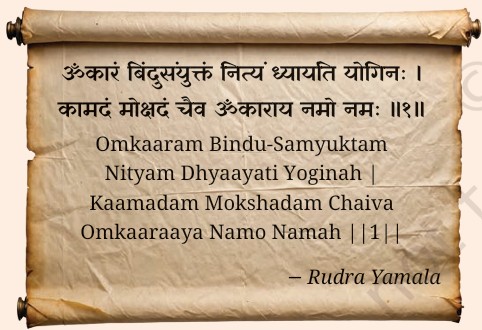
Meaning
The verse offers salutations to Lord Shiva, who resides in the spiritual heart centre in the form of Omkara (Om) and upon whom yogis constantly meditate. He is described as the one who grants devotees their desires as well as liberation (moksha). The verse concludes by offering salutations to Shiva, who is represented by the sacred syllable “Om.”
Experiencing the Rhythm
When you recite these verses several times, you may notice that the syllables naturally follow a pattern of four. This rhythmic arrangement is associated with Anushtup Chhand.
You can also clap your hands while reciting the verse to experience and understand its underlying rhythmic pattern. Try to maintain a steady flow as you recite, and notice how the syllables and claps work together.
This activity helps you understand that rhythm is not limited to songs or instrumental music; it can also be experienced through the patterns of syllables in Sanskrit verses.
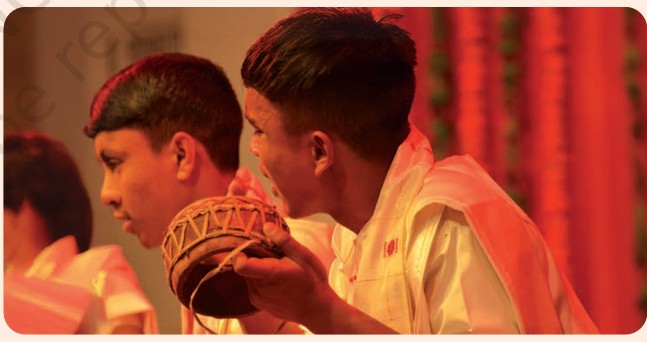
TALA, KONNAKKOL AND SWARAS
Indian music has a rich rhythmic and melodic system. Tala, Konnakol, and Swaras help musicians understand, practise, and express rhythm and melody.
Tala is a rhythmic cycle used in Indian music. It organises beats into a repeating pattern and provides a rhythmic framework for singing and playing instruments. Different talas have different numbers of beats and patterns. Performers use hand gestures or other movements to keep track of the cycle.
Konnakol is a traditional system of rhythm syllables used mainly in Carnatic music. Syllables such as ta, ki, ta, ta-ka-dhi-mi, and other combinations are spoken to represent rhythmic patterns. Konnakol helps students develop a strong sense of beat, rhythm, timing, coordination, and rhythmic memory. It can be practised by speaking the syllables while keeping a steady tala.
Swaras are the basic musical notes used in Indian music. The seven principal swaras are Sa, Re, Ga, Ma, Pa, Dha, and Ni. They form the foundation of melodies and are combined in different ways to create musical patterns and ragas.
While practising, students can keep a steady tala, speak Konnakol syllables to explore rhythmic patterns, and sing swaras to develop pitch and melody. Together, these practices help learners understand how rhythm and melody work together in Indian music.
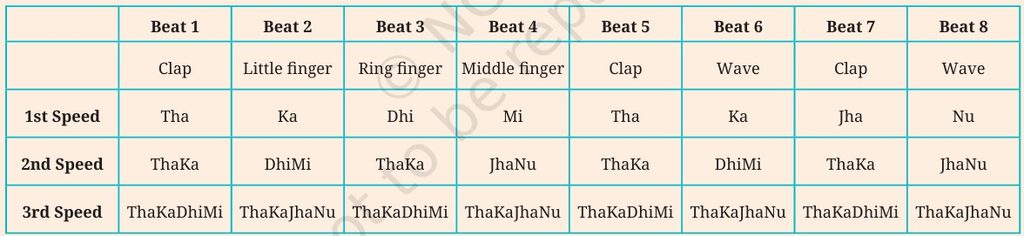
ACTIVITY 5.5: KONNAKKOL IN ADI TALA
Konnakol is the practice of speaking rhythmic syllables in Carnatic music. It helps students understand and perform different rhythmic patterns while maintaining a steady beat.
Adi Tala is one of the commonly used talas in Carnatic music. It has eight beats (aksharas) arranged in the pattern 4 + 2 + 2.
While practising Konnakol in Adi Tala, students can maintain the tala with hand movements and recite rhythmic syllables such as Ta-Ka-Dhi-Mi. The four syllables can be evenly placed across four beats, helping students develop a clear sense of pulse and timing.
Regular practice of Konnakol in Adi Tala helps improve rhythmic accuracy, coordination, concentration, listening skills, and confidence. It also helps students understand how spoken syllables can represent and communicate rhythmic patterns in music.
1st speed: 1 count per beat
2nd speed: 2 counts per beat
3rd speed: 4 counts per beat
8 akshara phrase: ThaKaDhiMi ThaKaJhaNu (4 + 4 = 8 akshara)
ACTIVITY 5.6: SWARAS IN ADI TALA
Swaras are the basic musical notes used in Indian music: Sa, Re, Ga, Ma, Pa, Dha, and Ni. When swaras are practised within a Tala, they help students develop both pitch and rhythmic awareness.
Adi Tala consists of eight beats (aksharas) arranged in the pattern 4 + 2 + 2. Students can sing a sequence of swaras while keeping the Adi Tala with hand movements.
For example:
Sa – Re – Ga – Ma | Pa – Dha | Ni – Sa
The swaras can be sung one per beat, while the tala is maintained steadily. Students can also practise different swara patterns within the same eight-beat cycle.
Practising swaras in Adi Tala helps develop pitch accuracy, rhythmic coordination, concentration, and confidence. It also helps students understand how melody and rhythm work together in Indian music.
Now, let us repeat the same exercise, but instead of using konnakkol patterns, we will use swaras.
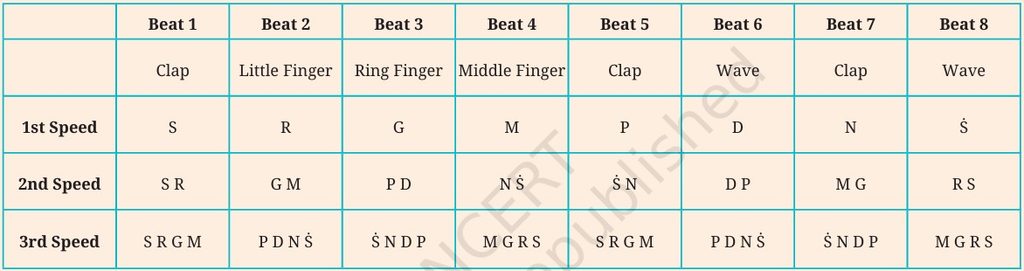
Similarly, can you make your own patterns in adi tala using swaras?
TABLA PATTERNS IN HINDUSTANI MUSIC
Many renowned tabla maestros have created beautiful and intricate rhythmic patterns within different talas. Some important types of tabla compositions include Paran, Chakradhaar, Uthaan, Fard, and Palta. Each has its own rhythmic structure and style.
These compositions demonstrate how rhythm can be organised, developed, repeated, and presented creatively within a tala. By learning and reciting their bols, students can improve their understanding of rhythm, timing, beat patterns, and rhythmic cycles.
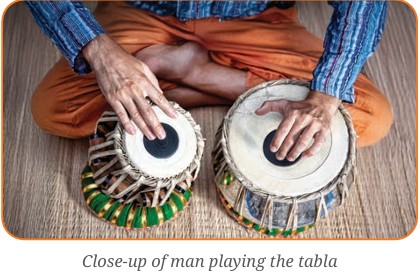
First, let us recall the bols of Ektaal. Listen carefully to the pattern, maintain the tala, and recite the bols with a steady rhythm. Once you are comfortable with the Ektaal pattern, try reciting the Paran given on the next page.
As you practise, pay attention to the beat cycle, placement of bols, repetition, and rhythmic flow. You can clap or use appropriate hand movements to keep track of the tala while reciting.
ACTIVITY 5.7: SARASWATI PARAN
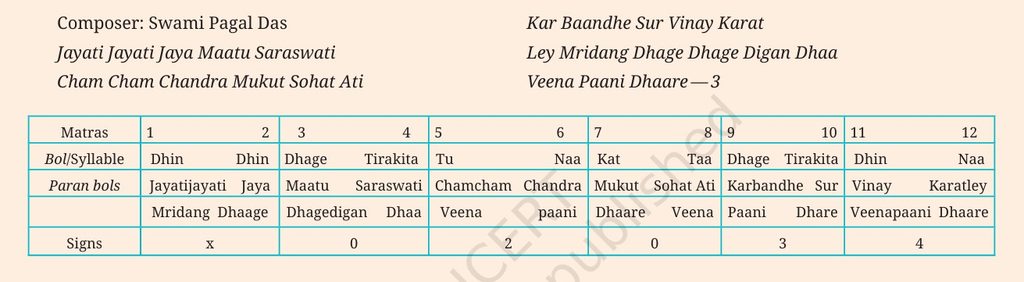
Saraswati Paran is a traditional rhythmic composition associated with the tabla repertoire. Like other compositions such as Paran and Chakradhaar, it uses rhythmic bols arranged in a structured pattern and is performed within a tala cycle.
The composition is traditionally associated with Saraswati, the goddess of knowledge, music, and the arts. Its rhythmic character provides an opportunity for students to explore the relationship between tala, bols, repetition, and rhythmic expression.
To practise the Saraswati Paran, first recall the bols and the structure of the tala being used. Recite the bols clearly while maintaining a steady beat. You may clap or use appropriate hand movements to keep track of the tala cycle.
As you practise, listen carefully to the rhythmic grouping, accents, pauses, and flow of the bols. Repeating the composition helps develop a stronger sense of rhythm, concentration, coordination, and confidence.
Saraswati Paran shows how rhythmic compositions can combine musical discipline, creativity, and cultural expression in Hindustani music.
ACTIVITY 5.8: TAAL PATTERNS
Taal is a rhythmic cycle in Indian music that organises beats into a regular pattern. Different talas have different numbers of beats (matras) and divisions.
Taal patterns can be practised through clapping, counting, hand gestures, bols, and percussion instruments. Regular practice helps students develop rhythm, timing, concentration, coordination, and listening skills.
By learning different taal patterns, students can understand how rhythm provides structure to melody and musical performance.
When reciting bols, follow these patterns:
Ek gun — 1 bol per beat
Dugun — 2 bols per beat
Tigun 2 10 0 — 3 bols per beat
Chaugun — 4 bols per beat

ACTIVITY 5.9: LEADING AND PARTICIPATING IN AN ENSEMBLE
An ensemble is a group of singers or musicians performing together. Successful ensemble performance requires teamwork, coordination, listening, and discipline.
The leader guides the group by maintaining the tempo, rhythm, entries, and overall flow of the music. Participants should listen carefully, follow the leader, maintain their parts, and stay in tune with the group.
Everyone has an important role. By respecting one another, practising regularly, and working together, an ensemble can create a balanced, coordinated, and expressive musical performance.
In Grade 7, you have practised chorus singing and canons, try to incorporate what you have learnt into any group song.
Learn any song.
Form groups of 15 – 20 students.
Assign roles to each team member. Some possible roles —
- Conductor: the one who ensures the whole performance is synchronised
- Lead singer
- Chorus singers
- Instrument players
- Providing support by clapping or body percussion
Now, work together to ensure that each team member has a clearly defined role and is aware of it.
Rehearse the song multiple times.
Present it before the class.
You can also repeat the activity by shuffling the roles.
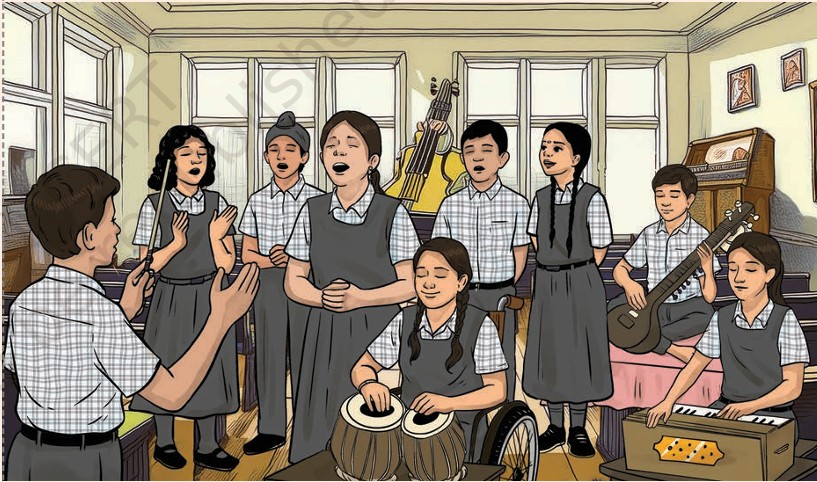
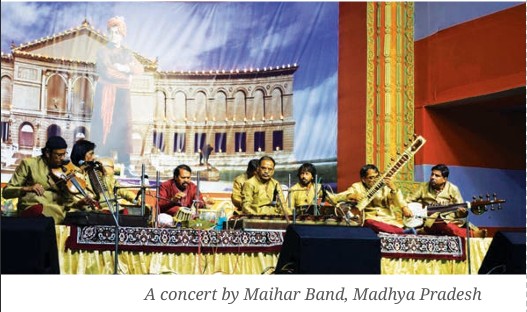
A music ensemble or band is like a team in which each member has a different role. Some members may be lead singers, while others sing in the chorus. Some members may play different musical instruments, while others may help maintain the rhythm or support the overall performance.
Although the roles may be different, every member is important to the success of the ensemble. A good performance depends on everyone listening to one another, following the rhythm, and working together.
When each member performs their role with confidence, cooperation, and responsibility, the group can create a balanced and enjoyable musical performance.
PATRIOTIC SONG
A patriotic song expresses love, respect, and a sense of belonging towards one’s country. Such songs often celebrate the nation’s people, culture, heritage, unity, and values.
Patriotic songs are commonly performed during national celebrations, school programmes, cultural events, and important occasions. Singing them together in an ensemble encourages teamwork, confidence, unity, and respect.
When performing a patriotic song, singers should pay attention to clear pronunciation, correct pitch, rhythm, expression, and coordination. A well-coordinated group performance can communicate the spirit and message of the song effectively.
Jayati Jayati Bharata Mata
Bharatam, Jayati Jaya Jaya Mama Bharatam, Mama Bharatam
Jayati Jaya Jaya, Jayati Jaya Jaya, Jayati Jaya
Mama Bharatam, Mama Bharatam
Ho teri jaya, jaya teri jaya, Teri Jaya mama bharatam (3)
Devbhoome namoh namah, Vedbhoomeh namoh namah,
tyaagbhoomey namoh namah
Matribhoomey namoh namah, Gungaan teraa namoh namah,
karoon gaan teraa namo namah
shatta baar teraa namo namah, samman teraa namo namah,
namo namah (3)
Jayati jaya jaya, Jayati jaya jaya …
Terey ang ang bharey rang rang, naari shakti kay sung sung
sanskriti, udyog, shiksha, kridaa, arogya, samriddhi kaa ley beeda
Urjaa, krishi ko ley karkey sung, harit kraanti bhar daaley rung
vikaas path par datey hooe, unnat unnat jeeney kaa dhang
Hongey anathak sab prayas, naa rukengey baaromaas
swarnim bharat meri maa, hum phir tumhey banayengey
Vishwa guru kaa taaj terey maathey pey sajayengay, sajayengay
Jayati jaya jaya, Jayati jaya jaya …
jaya, jaya jaya jaya jaya jaya, Jayati jaya …
Jayati jaya jaya Mama Bharatam …
Credit: Sangeet Natak Akademi
Conclusion
Discovering the Elements of Music helps us understand how different musical elements come together to create a complete musical experience. We explored melody, rhythm, lyrics, swaras, tala, vocal range, flexibility, and warm-up exercises, and learned how each contributes to singing and musical performance.
Through practices such as Konnakol, swara exercises, taal patterns, tabla patterns, and Sanskrit verses in Chhand, we experienced how rhythm can be heard, spoken, clapped, and performed. We also explored different registers of the voice, including Mandra Saptak and Tara Saptak, and understood the importance of developing the voice gradually and comfortably.
Working in an ensemble showed us that every singer and musician has an important role. Listening carefully, maintaining rhythm, following the leader, and cooperating with others help create a balanced performance.
Most importantly, this chapter encourages us to listen carefully, practise regularly, work together, and enjoy music creatively. By understanding and experiencing its elements, we can become more confident performers and thoughtful learners of music.