

Introduction:
Music is a beautiful combination of art, creativity, and science. We experience music through sounds, rhythms, melodies, and harmonies that can express emotions and influence our feelings. However, have you ever wondered how musical sounds are produced, why different instruments create different tones, or how music affects our minds and bodies? The answers to these questions lie in the science of music.
Sound is produced when an object vibrates. These vibrations travel through a medium, such as air, in the form of sound waves and reach our ears, allowing us to hear music. Different sound waves have different properties that influence how we perceive sounds. Frequency determines the pitch of a sound, while amplitude is related to its loudness. The duration and arrangement of sounds and silences create rhythm, while melodies are formed by arranging musical notes in meaningful sequences.
Musical instruments demonstrate these scientific principles in different ways. A flute produces sound when air vibrates inside it, while a tabla creates sound through the vibration of its stretched membrane. In string instruments, such as the sitar and violin, vibrating strings produce musical sounds. The shape, size, material, and playing technique of an instrument influence its unique sound quality.
The science of music also explores how our brains respond to sounds and how music can influence our emotions, concentration, memory, and relaxation. By understanding these principles, we can develop better listening skills and appreciate the connection between scientific knowledge and musical creativity.
Studying the science of music encourages curiosity, observation, and experimentation. It helps us understand that behind every beautiful melody lies a fascinating world of vibrations, patterns, and sound. Thus, music becomes not only an enjoyable art form but also an exciting way to explore the scientific principles that surround us in everyday life.

Music is both an art and a science. We enjoy music for the emotions it evokes and the entertainment and relaxation it provides. At the same time, we can study how music works and understand the science behind its sounds and rhythms. Music is connected to many aspects of our daily lives and to subjects we learn in school. In this chapter, we will explore how physics explains sound and vibrations, biology helps us understand how we hear and respond to music, and mathematics reveals the patterns, rhythms, and relationships between musical notes.
Do you know?
C. V. Raman and the Science of Indian Drums
C. V. Raman (1888–1970) was a renowned Indian physicist who made important contributions to the study of light and sound. He received the Nobel Prize in Physics in 1930 for his discovery of the Raman Effect. His scientific curiosity also led him to investigate the sounds produced by Indian musical instruments, including the mṛidaṅgam and the tabla. His work demonstrated how scientific principles can help us understand the beauty and uniqueness of traditional Indian music.
The mṛidaṅgam and the tabla are important percussion instruments used in Indian classical music. Unlike many ordinary drums, they can produce rich, sustained tones with clearly recognisable pitches. Raman studied their sound-producing mechanisms and explored how the construction and preparation of their membranes influenced their vibrations.
One of the most distinctive features of these instruments is the karaṇai or syāhī, a dark patch applied to the centre of the drum membrane. Traditionally, this patch is made using a carefully prepared mixture containing starch and other materials, including iron-bearing compounds. Its composition and placement influence the way the membrane vibrates, helping produce the characteristic tonal quality of the instrument.
When a drum is struck, its membrane vibrates and creates sound waves. The pattern of these vibrations determines important characteristics of the sound, including its pitch and tone. The special construction of the tabla and mṛidaṅgam enables them to produce complex vibration patterns that contribute to their distinctive musical sounds.
Raman’s investigations reveal the fascinating connection between physics and music. They also highlight the scientific knowledge embedded in India’s traditional musical craftsmanship. By studying musical instruments scientifically, we can better understand how sound works while appreciating the skill and creativity of the artisans who make them. Thus, the science of music brings together scientific discovery, cultural heritage, and artistic expression.

C.V. Raman
The Science of Sound
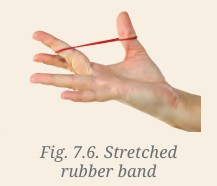
In Grade 8, we learned that sound is produced by vibrations and travels through a medium, such as air, water, or solids. We can understand these concepts more clearly by observing everyday objects and musical instruments. For example, when we pluck a stretched rubber band, it vibrates and produces sound. If we stretch it more tightly, the sound may become higher in pitch. Similarly, when we strike a tabla, its membrane vibrates and produces sound that travels through the surrounding air to our ears.
Two important properties of sound are frequency and amplitude. Frequency refers to the number of vibrations per second and determines the pitch: higher frequencies generally produce higher-pitched sounds. Amplitude is related to the loudness of a sound: stronger vibrations generally produce louder sounds. We can also observe that a flute produces sound when air vibrates inside it, while a guitar produces sound through vibrating strings.
Through simple activities like these, we can explore how vibrations create sound and understand the scientific principles behind music.
Activity: Making a Stringed Instrument Model
Aim: To understand how the tension, thickness, and vibration of a string affect the sound produced.
Materials:
- Rubber bands of different thicknesses
- An empty tissue box or small cardboard box
- Threads or strings of different thicknesses
Steps:
- Hold a rubber band between your fingers and pluck it gently. Listen carefully to the sound it produces.
- Stretch the rubber band across the hollow opening of the tissue box or cardboard box. Pluck it again and observe how the loudness changes.
- Stretch the rubber band more tightly and pluck it gently. Notice whether the pitch becomes higher or lower.
- Place several rubber bands of different thicknesses around the box. Pluck each one and compare the sounds.
- Replace a rubber band with a piece of thread or string and observe how the sound changes. Do not pull the string too tightly, as it may break.
Observations:
- The box helps amplify the sound by making the air inside it vibrate.
- A tighter rubber band generally produces a higher-pitched sound.
- Rubber bands of different thicknesses produce different pitches.
- A thread or string may produce a weaker sound depending on its material, tension, and thickness.
Conclusion: The sound produced by a string depends on its tension, thickness, and vibrating length. The hollow box helps make the sound louder, demonstrating the basic principle behind stringed instruments such as guitars and sitars.
How Strings Produce Different Sounds
Sound is produced when a string vibrates. We can change the sound in three main ways:
- Changing the tension: Tightening the string generally increases the pitch, while loosening it decreases the pitch.
- Using a hollow box: A hollow box helps amplify the sound, making it louder and easier to hear.
- Changing the thickness or material: Strings of different thicknesses and materials produce different pitches and sound qualities.
These principles are used in making and playing musical instruments. For example, a guitar produces sound through vibrating strings, while its hollow body helps amplify the sound. Similarly, musicians adjust string tension in instruments such as the sitar and violin to produce different musical notes. Understanding these principles helps us discover the fascinating connection between vibrations, sound, and music.
Activity
Connecting to Musical Instruments
Stringed instruments such as the guitar, sitar, and violin use vibrating strings to produce sound. Observe a stringed instrument in your classroom and explore how its different parts affect the sound.
1. Hollow body: The hollow body helps amplify the sound produced by the vibrating strings, making it louder and easier to hear.
2. Tuning pegs: Observe what happens when the tuning pegs are tightened or loosened. Handle them gently to avoid breaking the strings.
- When the strings are tightened, the pitch increases.
- When the strings are loosened, the pitch decreases.
3. Thickness of strings: Thicker strings generally produce lower-pitched sounds, while thinner strings generally produce higher-pitched sounds when their length and tension are comparable.
4. Exploring musical tone: Play a note and listen carefully. Describe the sound using words such as high-pitched, low-pitched, soft, loud, short, or sustained.
Discuss in class: How do the hollow body, string thickness, and tension work together to create the distinctive sounds of musical instruments?

Sitar
Do you know?
The Concepts of Sound in India
Ancient Indian scholars studied sound and music in great detail. They developed concepts that helped musicians understand how sounds are produced, heard, and organised into melodies. Important texts, such as the Nāṭyaśāstra, traditionally attributed to Bharata Muni, and the Saṅgīta-ratnākara, written by Śārṅgadeva, explain various aspects of music through theory and practical examples.
Some important concepts include dhvani, which means sound; nāda, which refers to sound considered in the context of music; śhruti, which describes subtle distinctions in musical pitch; and svara, which means a musical note. These concepts form an important foundation for understanding Indian classical music.
Through singing, listening, and experimenting with musical instruments, students can explore how different sounds relate to one another and how notes are combined to create melodies. These traditional ideas demonstrate the depth of India’s musical knowledge and the close connection between musical practice and the study of sound.
Biology of the Human Voice
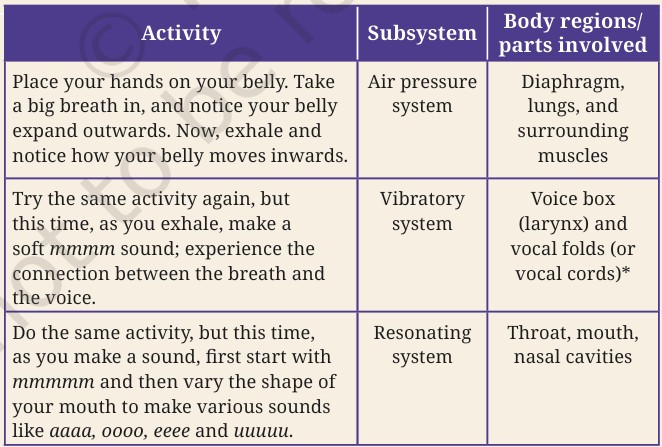
The human vocal system is a remarkable part of our body that allows us to speak, sing, laugh, and express emotions through sound. It works through the coordinated action of three main systems: the respiratory system, the phonatory system, and the articulatory system.
- Respiratory system: The lungs, diaphragm, and breathing muscles provide the airflow needed to produce the voice.
- Phonatory system: The larynx, or voice box, contains the vocal folds. When air passes through them, they vibrate and produce sound.
- Articulatory system: The tongue, lips, teeth, jaw, and palate shape the sound into words and help us produce different speech sounds.
For example, when we sing a musical note, air flows out of our lungs and causes the vocal folds to vibrate. The mouth and throat then shape and modify the sound, helping us produce the desired pitch and tone. By controlling our breathing and adjusting the vocal folds, we can sing high or low notes and create variations in loudness.
The human vocal system therefore acts like a natural musical instrument, combining airflow, vibration, and resonance to produce a wide range of sounds.

The human vocal system
Activity
Experiencing the human vocal system

How to care for our voices
How to Care for Our Voices: Caring for our voices means following healthy habits, such as drinking enough water, avoiding shouting, warming up before singing, practising proper breathing, and giving the voice sufficient rest to keep it healthy and strong.
1. Drink sufficient water: This keeps your vocal cords hydrated and enables them to vibrate efficiently.
2. Eat a healthy diet: Oily or very acidic foods can irritate the vocal cords. Also, a diet rich in fruits and vegetables boosts immunity. This keeps you from falling ill with colds and coughs, which can affect voice quality.
3. Speak at a moderate volume: At times, we get overexcited when we are with friends, and we tend to shout and raise our voices. Ensure you speak at a moderate volume to protect your voice.
Vocal Warm-ups: Vocal warm-ups are gentle exercises performed before singing or speaking for a long time to prepare the vocal folds, improve breath control, and help produce a clear, comfortable sound without straining the voice.
Activity
Daily Vocal Warm-up Routine
A daily vocal warm-up routine consists of gentle breathing and voice exercises that prepare the voice for singing. Practise each exercise 5–6 times without straining your voice.
1. Breathing and Diaphragm Exercise
- Stand or sit straight.
- Inhale slowly through your nose, allowing your lungs to expand.
- Hold your breath comfortably for 2–3 seconds, then exhale slowly through your mouth.
Benefits: Helps develop breath control and supports singing long musical phrases.
2. Humming (Bhrāmarī Prāṇāyāma)
- Hum a note at a comfortable pitch, feeling gentle vibrations around your lips and face.
- Slowly move your voice up and down in pitch while humming “mmm”.
Benefits: Gently warms up the voice and improves resonance.
3. Lip Trills or Bubbles
- Blow air through loosely closed lips while making a gentle “brrr” sound, like a motorbike.
- Glide your voice up and down in pitch while continuing the lip trill.
Benefits: Relaxes facial muscles, reduces tension, and encourages smooth airflow.
4. Sargam Exercises
Sing simple alankāra patterns at different speeds to improve vocal control.
- Pattern A: Sa Ga Re, Re Ma Ga, Ga Pa Ma — continue the pattern.
- Pattern B: Sa Re Ga Ma, Re Ga Ma Pa, Ga Ma Pa Dha — continue the pattern.
Try singing the phrases in one comfortable breath without rushing.
Benefits: Improves voice flexibility, pitch control, and breath management.
Remember: Practise gently and regularly. Never force high or low notes, and stop if you feel pain or discomfort.

Mathematics in Tāla: Making Patterns in Rhythm
Rhythm is built using patterns, just like numbers in mathematics. In Indian music, tāla refers to a rhythmic cycle, while an akṣhara represents a unit of rhythmic count in this context. Different syllables are used to express rhythmic patterns and help musicians maintain a steady beat.
Some basic rhythmic building blocks are:
- 1 akṣhara: Ta
- 2 akṣharas: Taka
- 3 akṣharas: Takita (Ta-kita)
- 4 akṣharas: Tha-ka-di-mi
By combining these basic units, we can create rhythmic phrases of different lengths, just as numbers can be combined to form different sums.
Examples of rhythmic patterns:
- 5 akṣharas = 2 + 3: Taka takita
- 6 akṣharas = 3 + 3: Takita takita
- 6 akṣharas = 2 + 2 + 2: Taka taka taka
- 7 akṣharas = 3 + 4: Takita tha-ka-di-mi
- 8 akṣharas = 4 + 4: Tha-ka-di-mi tha-ka-di-mi
These examples show that the same total count can be organised in different ways. For instance, six akṣharas can be divided into two groups of three or three groups of two.
Connection with mathematics: Creating rhythmic patterns involves counting, addition, grouping, and recognising sequences. By clapping, reciting syllables, and repeating patterns, we can explore how mathematics and music work together to create rhythm.
Activity
Making Your Own Rhythmic Phrase
Create rhythmic phrases by combining the basic units of 1, 2, 3, and 4 akṣharas. Add the units together to make the required total count.
Examples:
| Total akṣharas | Mathematical pattern | Rhythmic phrase |
| 7 | 3 + 4 | Takita tha-ka-di-mi |
| 7 | 2 + 2 + 3 | Taka taka takita |
| 8 | 4 + 4 | Tha-ka-di-mi tha-ka-di-mi |
| 8 | 2 + 3 + 3 | Taka takita takita |
| 9 | 4 + 3 + 2 | Tha-ka-di-mi takita taka |
| 9 | 3 + 3 + 3 | Takita takita takita |
Activity: Clap each phrase while reciting its syllables. Count the akṣharas carefully and create your own patterns for 7, 8, and 9 akṣharas.
Think and explore: How many different rhythmic phrases can you create for each total? Notice how different combinations can produce the same number of akṣharas, just as different addition sums can have the same total.
Applying Lowest Common Multiple (LCM) in Rhythm
The Lowest Common Multiple (LCM) is the smallest positive number that is a multiple of two or more numbers. In music, it helps us understand when rhythmic cycles of different lengths come together again.
For example, suppose Group 1 claps a rhythmic cycle of 3 beats, while Group 2 claps a rhythmic cycle of 4 beats. After 12 beats, both groups will complete their cycles together:
- Group 1: 12 ÷ 3 = 4 cycles of 3 beats each.
- Group 2: 12 ÷ 4 = 3 cycles of 4 beats each.
Therefore, the LCM of 3 and 4 is 12. This demonstrates how mathematics helps musicians understand repeating rhythmic patterns and coordinate different cycles.
Conclusion:
The science of music helps us understand how sounds are produced, how they travel, and how they influence our minds and bodies. Music is not only an art form but also a fascinating combination of physics, biology, and mathematics. By studying sound, we learn that vibrations produce musical notes, frequency determines pitch, and amplitude influences loudness. These scientific principles help us understand how instruments such as flutes, tablas, guitars, and sitars create their unique sounds.
The human voice is another remarkable natural instrument. The lungs, diaphragm, vocal folds, and resonating spaces work together to produce speech and singing. Regular vocal warm-ups, proper breathing, sufficient hydration, and adequate rest help us maintain a healthy voice and improve our singing abilities.
Mathematics also plays an important role in music. Counting beats, creating rhythmic patterns, and arranging musical syllables help us understand rhythm and tāla. Concepts such as addition, multiplication, and the Lowest Common Multiple (LCM) explain how different rhythmic cycles can come together. For example, Teen Tāla has 16 beats and Ektāla has 12 beats, and their cycles align after 48 beats.
Indian musical traditions beautifully combine scientific knowledge with creativity and cultural heritage. Ancient musical concepts, traditional instruments, and rhythmic practices demonstrate how observation, experimentation, and artistic expression work together.
By listening carefully, singing, playing instruments, and exploring rhythmic patterns, we can discover the fascinating connections between music and science. Music is much more than a combination of sounds; it is a wonderful harmony of science, mathematics, culture, and creativity that enriches our lives and deepens our understanding of the world around us.