

Introduction:
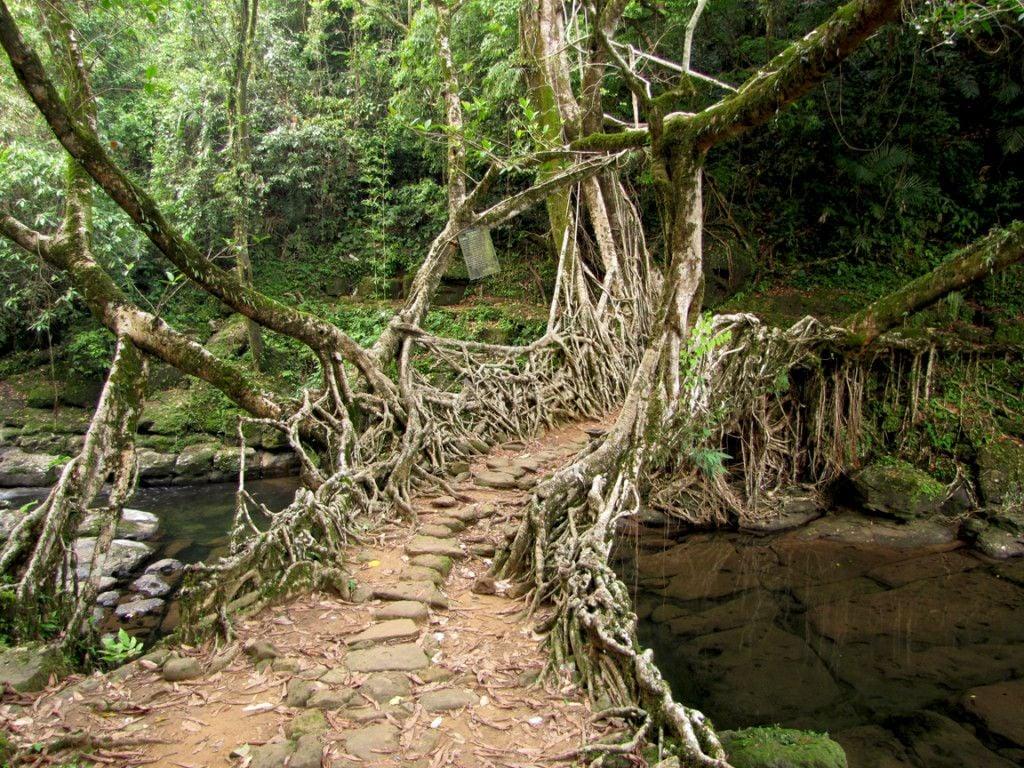
Dance is one of the oldest and most expressive art forms through which human beings communicate emotions, ideas, stories, and experiences. Like the mighty River Ganga, which has flowed through India for thousands of years while continuing to nourish life, the knowledge of dance is an ever-flowing tradition. Its foundations are ancient, yet they remain fresh and meaningful through regular practice, learning, and creative exploration.
In dance, every movement has a purpose. A gesture of the hand, a movement of the eyes, a turn of the body, or a rhythmic step can communicate feelings and tell a story. These movements are not simply physical actions; they are part of a rich vocabulary developed and refined over generations. By understanding and practising the basic components of dance, we can develop better control, coordination, expression, rhythm, and creativity.
Indian dance traditions offer a wonderful combination of movement, music, rhythm, expression, and storytelling. The concepts we have learnt earlier provide a strong foundation for exploring these elements in greater depth. Revisiting them helps us understand how individual movements come together to create a meaningful and beautiful performance.
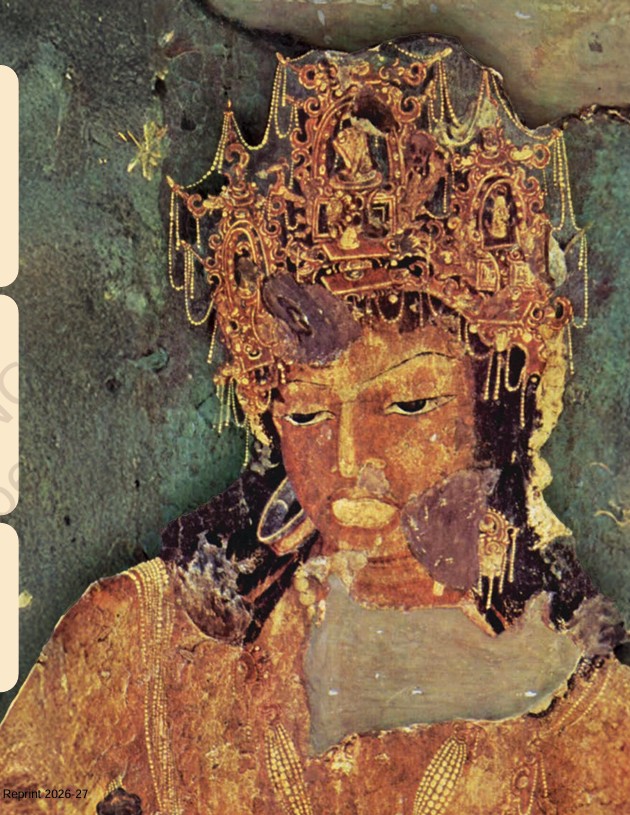
Dance is therefore both Purātana (ancient) and Nitya Nūtana (ever-new). It preserves the wisdom of the past while allowing every dancer to bring personal imagination and fresh ideas to each performance.
The phrase “Nitya Nūtana aur Purātana” beautifully expresses the timeless nature of dance. Purātana means ancient or traditional, while Nitya Nūtana means ever-new or continually renewed.
Together, they convey that dance preserves the wisdom, techniques, and traditions of the past while allowing every generation of dancers to explore fresh ideas and creative expressions.
In simple words, dance remains rooted in ancient traditions, yet becomes new and exciting through every dancer’s imagination, practice, and performance.
Elements of dance
Where there is a body, there is dance. Dance begins not with perfection, but with sensitivity to the body. Thus, it is dance itself that awakens the dancer.
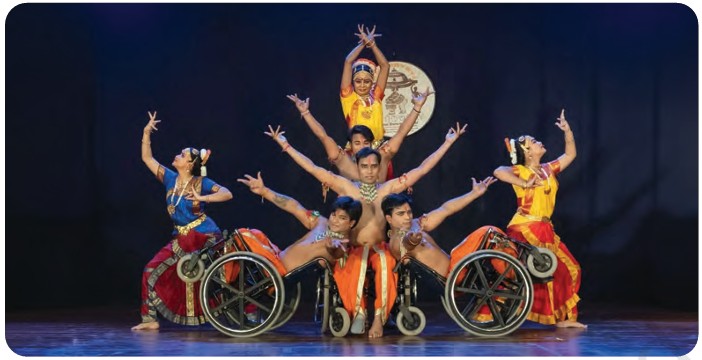
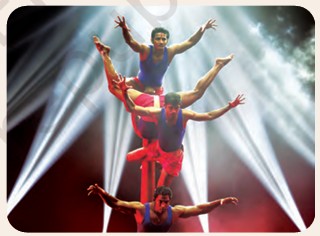
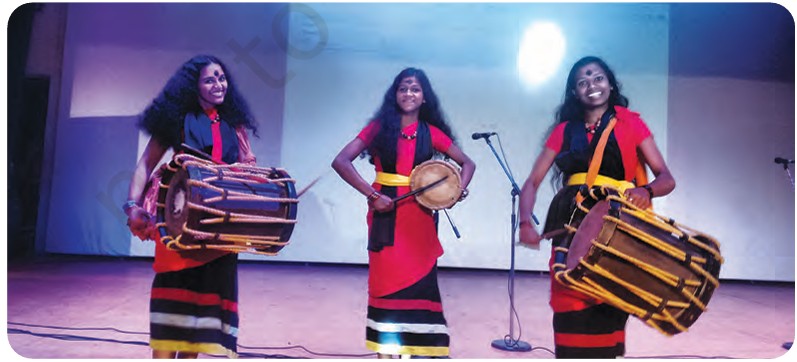
A dance performance by the students
What Constitutes a Dance Movement?
A dance movement is more than simply moving the body. It is a controlled and expressive action through which a dancer communicates emotions, ideas, stories, and experiences. The human body is the primary medium of dance, and every movement becomes meaningful through proper alignment, balance, coordination, and graceful control.
Body alignment refers to the correct positioning of different body parts while standing, sitting, or moving. It provides a strong foundation for dance techniques, improves stability, and helps reduce the risk of injuries caused by incorrect posture. Balance enables dancers to maintain control while performing steps, turns, jumps, and other movements. Coordination ensures that different parts of the body work together smoothly and harmoniously.
Warming up is also an essential part of dance practice. Gentle exercises prepare the muscles and joints for movement, improve flexibility, and help the body perform safely. Dancers must also develop awareness of their breathing, as a natural rhythm of breath supports concentration, stamina, and fluid movement.
In Indian dance traditions, the connection between the body and breath is especially important. Similar to the principles practised in yoga, conscious breathing helps dancers become more aware of their bodies and movements. This awareness supports physical control and allows emotions to be expressed through gestures, facial expressions, and body movements.
A simple action can become a beautiful dance movement when performed with correct posture, rhythm, intention, and expression. The dancer transforms an ordinary movement into a stylised form of artistic expression, almost like a sculpture coming to life.
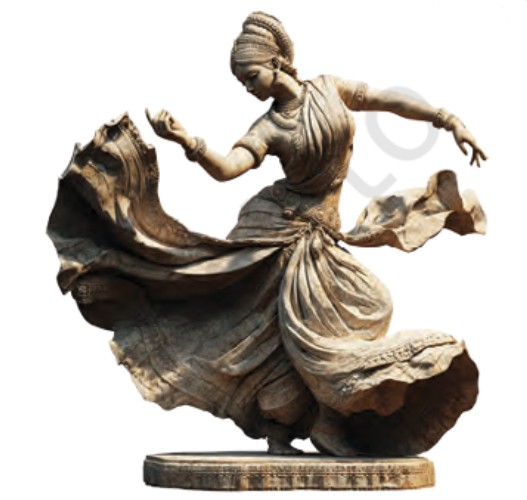
Flow in dance
Activity
Explore geometry through your body
1.) Sauṣhṭhava Pose (Body Alignment)
Stand upright with poise, stability, and proper body alignment. Imagine an invisible vertical line, called the central meridian, passing through the centre of your body from head to feet. Gently align your ears, shoulders, and waist along this imaginary line. Keep your spine naturally straight, shoulders relaxed, and weight evenly distributed on both feet. Avoid stiffness; the aim is to maintain a balanced and graceful posture.
This pose helps develop body awareness, stability, and control, providing a strong foundation for graceful dance movements.
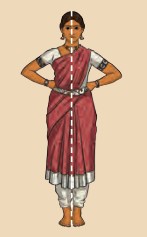
Fig. 10.4. Sauṣhṭhava pose
2.) Standing Position: Stand upright with your feet together and keep your body relaxed. Distribute your weight equally between both feet. Notice whether your body is leaning slightly forward or backward. Gently adjust your posture until you feel balanced and stable. Keep your head upright and shoulders relaxed.
3.) Hand and Upper-Body Position: Place both hands gently on your waist, with your elbows pointing naturally outward. Keep your shoulders relaxed and your head upright. Avoid raising or tightening your shoulders. Maintain a comfortable and balanced posture, as shown in Fig. 10.4.
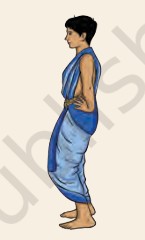
Fig. 10.5. Improper Sauṣhṭhava pose
4.) Sauṣhṭhava (Poised Standing Posture): Keep your torso upright and gently lifted. Stand with your body balanced, alert, and erect, while keeping your muscles relaxed. Maintain a natural posture that allows you to move with control, stability, and grace. This poised and well-aligned stance of a dancer is known as Sauṣhṭhava.
5.) Practising Movements with Sauṣhṭhava: Now, try performing simple dance movements such as walking, turning, jumping, and moving your arms and legs while maintaining Sauṣhṭhava. Keep your torso upright, shoulders relaxed, and body balanced throughout each movement. Focus on maintaining proper alignment and graceful control as you move. Notice how this poised posture helps make your movements more stable, coordinated, and elegant.
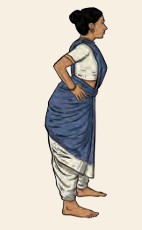
Fig. 10.6. Improper Sauṣhṭhava pose
Activity
Visual Composition in Dance: Exploring Shapes and Emotions
Visual composition in dance refers to the way dancers use their bodies, movements, gestures, and positions to create attractive patterns and meaningful images on stage. Just as an artist arranges colours and shapes on a canvas, a dancer creates visual designs through body movements and spatial arrangements.
Dancers can form different shapes using their arms, legs, and torso. For example, stretching both arms upwards may create a vertical line, joining the hands above the head may form a circular shape, and bending the body sideways may create a curved line. When dancers perform together, they can arrange themselves in circles, triangles, straight lines, or other geometric patterns. These formations make a performance visually interesting and help communicate its theme.
Shapes in dance can also express different emotions. Open and expansive movements may suggest joy, freedom, or confidence, while closed and contracted movements may communicate sadness, fear, or hesitation. Slow, gentle gestures can create a feeling of peace, whereas sharp and energetic movements may express excitement, anger, or determination.
Through the thoughtful use of body shapes, directions, levels, and expressions, dancers transform simple movements into powerful visual storytelling. Understanding visual composition helps dancers develop creativity, stage awareness, and the ability to communicate emotions without words.
- Create lines and shapes with different parts of your body — a diagonal line with your arms, a quadrangle with your lower body, or an arc with your torso, etc.
- Try forming shapes with your entire body — stretching, balancing, creating curves, and arcs through bends, etc.
- These linear or curved forms, created through the coordination of your body parts, are called rekhā in dance.
- With bright, expressive eyes and a pleasant face, reflect your joy, or any emotion. This is your disposition or rūpa.
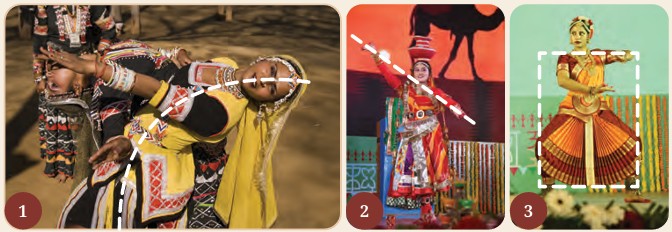
Fig. 10.7. (1) Curve; (2) Diagonal; (3) Quadrangle
Developing proper body alignment (Sauṣhṭhava), creating clear and graceful lines (Rekhā), and maintaining a pleasing body disposition (Rūpa) help dancers perform movements with better balance, control, and expression.
These elements give dance movements clarity, beauty, and confidence. With regular practice and creative exploration, every dancer learns to apply them in their own unique way, developing an individual style while respecting the foundations of dance.
Body in Motion: Revisiting the Basics of Dance
The body is the primary instrument of a dancer. Every step, gesture, turn, and expression begins with body awareness and develops through practice. Revisiting the basics of dance helps dancers strengthen their posture, balance, coordination, flexibility, and control. These foundations make movements more graceful, precise, and expressive.
In Indian dance traditions, body movements are organised through well-established techniques and movement vocabulary. Dancers use different parts of the body, including the head, eyes, neck, hands, torso, and feet, to communicate emotions and convey stories. Each movement has its own purpose and contributes to the overall beauty of a performance.
Practising basic movements also helps dancers understand how the body works in different directions, levels, and rhythms. Simple actions such as walking, bending, stretching, turning, and shifting weight can become meaningful dance movements when performed with proper alignment and expression.
Revisiting body movements in dance
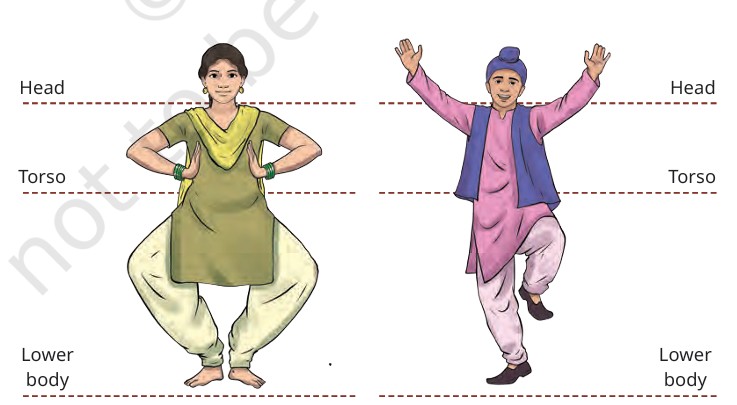
Dancing bodies
| Let Us Recall Let us revisit the fundamental concepts of dance that you have explored in your earlier textbooks, Bansuri and Kriti. Recall the different body postures (sthāna) and the dynamic movements of the lower limbs, known as chārī and gati. Also, refresh your understanding of jumps (utplavana) and spins or circular movements (bhramarī). Next, revisit the karaṇa you learnt in your Grade 8 Kriti textbook. Remember how these coordinated movements combine different body positions, hand gestures, and footwork to create expressive dance sequences. |
Revisiting Rhythm (Tāla) and Tempo (Laya)
Have you ever noticed the rhythmic beating of your heart? It follows a regular pattern that continues naturally throughout your life. This repeating pattern is an example of rhythm. When you run or exercise, your heartbeat becomes faster, while it generally slows down when you rest or sleep. This change in speed is related to tempo, known as Laya in Indian music and dance.
Rhythm (Tāla) and tempo (Laya) are closely connected and play an essential role in every dance performance. Tāla provides the organised rhythmic pattern or cycle, while Laya determines the speed at which the movements are performed. Together, they give dance its structure, flow, energy, and coordination.
Indian dance forms use a variety of rhythmic patterns, often organised into cycles of 3, 4, 5, 7, and 9 beats, as well as combinations of these patterns. The three basic tempos are:
- Vilambit Laya: Slow tempo, allowing movements to unfold gradually.
- Madhya Laya: Medium tempo, providing a balanced flow of movement.
- Drut Laya: Fast tempo, creating energy and excitement.
In some regional dance styles, the tempo gradually increases, building excitement and energy towards the end of the performance.
Think and Discuss: Have you noticed any regional dance style in which the tempo progressively increases and reaches an energetic peak at the end? Can you name the dance form and describe how the changing speed affects the performance?
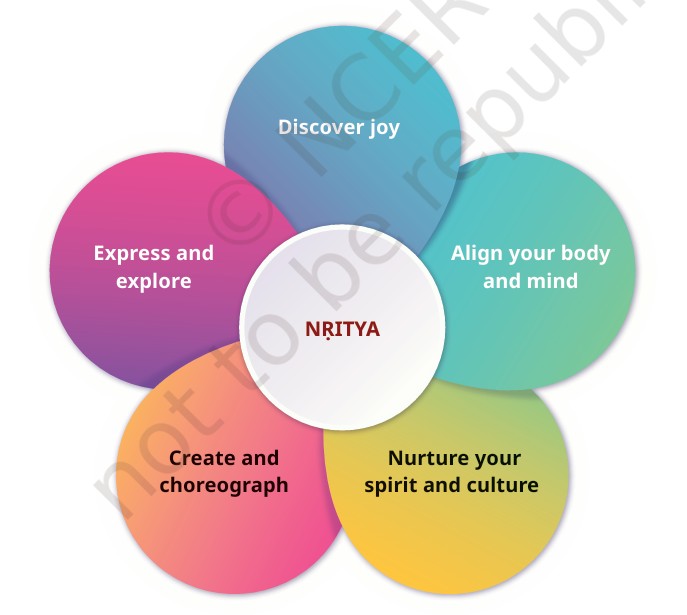
Revisiting Nṛitta and Nṛitya
According to the Abhinaya Darpaṇam, a classical Indian text on dance that you explored in the chapter Introduction to the History of Art, Indian dance has two important aspects: Nṛitta and Nṛitya.
Nṛitta refers to pure, non-narrative dance that consists of rhythmic movements, steps, and patterns. It focuses on the beauty, grace, coordination, and rhythm of movements without communicating a specific story or meaning. It is often considered an expression of joy through movement.
Nṛitya, on the other hand, is expressive dance that communicates a story, idea, or emotion. It combines the movements of Nṛitta with Abhinaya, the art of expression through facial expressions, hand gestures, eye movements, and body language. Through Abhinaya, dancers convey feelings and meanings, making their performances more expressive and meaningful.
Together, Nṛitta and Nṛitya bring beauty, rhythm, emotion, and storytelling to Indian dance. In some dance forms and performances, these two elements are so closely integrated that there is no clear distinction between them. They flow naturally into one another, creating a harmonious and complete dance experience.
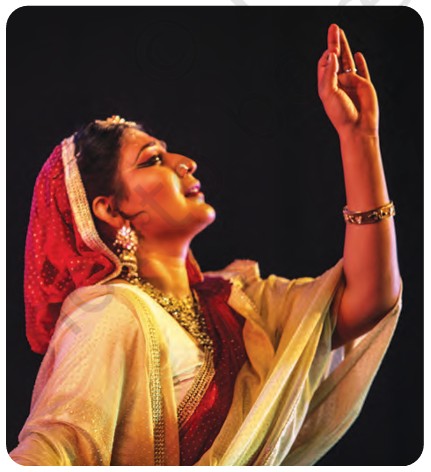
Abhinaya by a dancer
Chaturvidha Abhinaya — The Four Forms of Expressive Communication:
In Indian classical dance and theatre, Abhinaya refers to the art of communicating emotions, ideas, stories, and meanings through expressive techniques. The Nāṭyaśāstra, an ancient Sanskrit treatise on performing arts, describes four forms of Abhinaya, collectively known as Chaturvidha Abhinaya.
These four forms work together to make a performance expressive, meaningful, and engaging.
The four forms are:
- Āṅgika Abhinaya: Expression through body movements, including gestures of the hands, movements of the eyes and head, facial expressions, and postures.
- Vācika Abhinaya: Expression through speech, dialogue, songs, music, and spoken words.
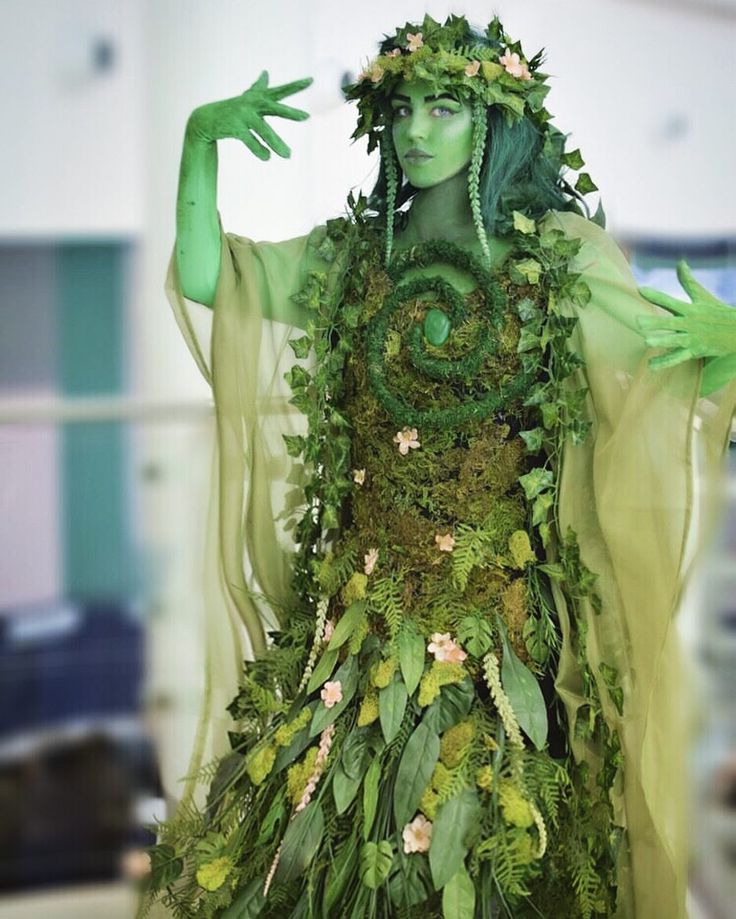
- Āhārya Abhinaya: Expression through external elements such as costumes, makeup, jewellery, hairstyles, and stage decorations.
- Sāttvika Abhinaya: Expression of inner emotions through subtle responses such as tears, trembling, changes in voice, perspiration, and changes in facial expression.
These four forms complement one another. For example, when a dancer portrays sadness, body gestures and facial expressions (Āṅgika), music or lyrics (Vācika), costume and appearance (Āhārya), and genuine emotional expression (Sāttvika) can combine to communicate the feeling effectively.
Through Chaturvidha Abhinaya, performers bring characters and stories to life, allowing audiences to understand and experience the emotions behind a performance.
1.) Āṅgika Abhinaya — using the body –
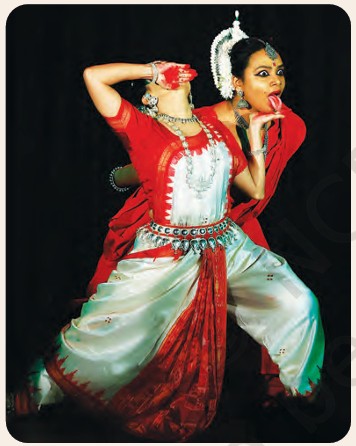
Severed head of the Goddess Chhinnamastā
depicted in Odissi by two dancers
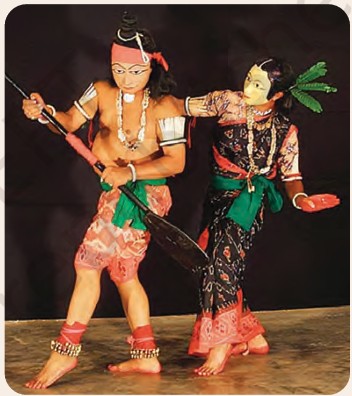
The Boat Man (Nabik) in Seraikela Chhau, Jharkhand
Observe how the stance accentuates the act of rowing of the boat.
Gambhir Singh Mura (Padma Shri) was a prolific artist and teacher of the Purulia Chhau (a UNESCO recognised masked dance-drama from West Bengal), who worked extensively on organising indigenous and animal movements to develop the movement vocabulary of Chhau.
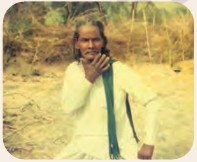
Gambhir Singh Mura
(1930–2002)
Three Styles of Chhau Dance
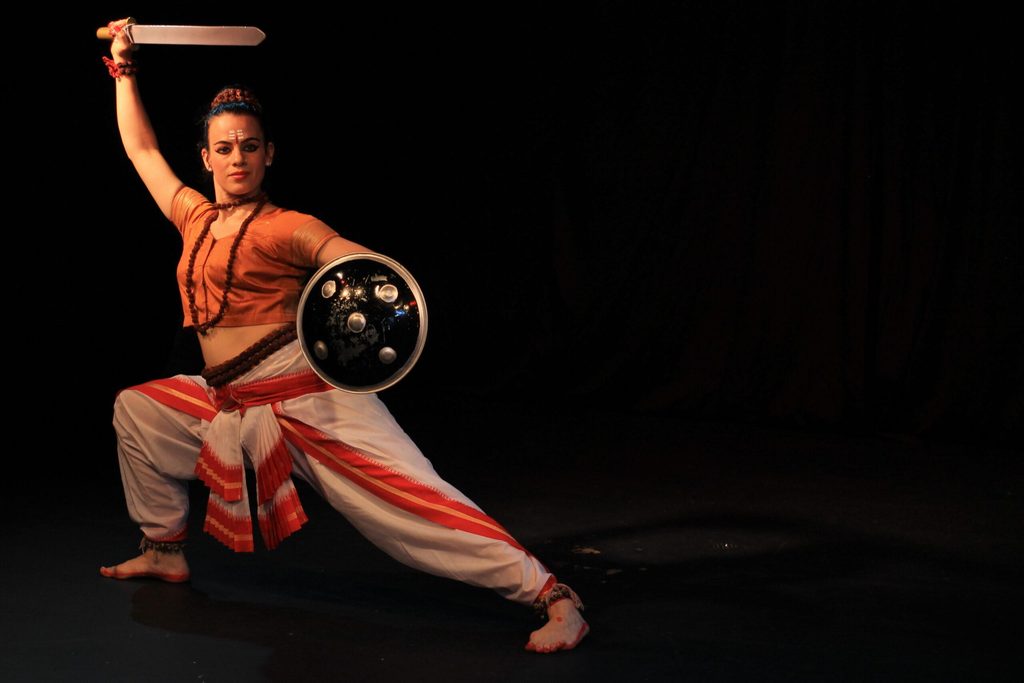
Chhau is a traditional dance form of eastern India, known for its energetic movements, martial arts-inspired techniques, and dramatic storytelling. It has three major styles: Mayurbhanj Chhau, Seraikella Chhau, and Purulia Chhau.
Mayurbhanj Chhau, practised in Odisha, is performed without masks. Dancers use stylised body movements, gestures, and facial expressions to communicate ideas, emotions, and stories. In contrast, Seraikella Chhau, from Jharkhand, and Purulia Chhau, from West Bengal, are famous for their colourful and impressive masks. These masks help portray different characters, including gods, demons, animals, and other figures from traditional stories.
Although all three styles share a connection with martial traditions and dramatic performance, they have distinct movement techniques, costumes, and visual characteristics. Together, they demonstrate the rich diversity of Chhau dance.
Mayurbhanj Chhau
Mayurbhanj Chhau is a traditional masked-free dance form that originated in the Mayurbhanj district of Odisha. It is one of the three major styles of Chhau dance, the other two being Seraikella Chhau of Jharkhand and Purulia Chhau of West Bengal.
Unlike Seraikella and Purulia Chhau, Mayurbhanj Chhau is performed without masks. Dancers use expressive body movements, facial expressions, gestures, and energetic footwork to portray characters and communicate stories. Its movements are strongly influenced by traditional martial arts techniques, giving the dance a powerful and dynamic character.
The performances often depict episodes from the Ramayana and Mahabharata, stories from mythology, and themes from nature and everyday life. Dancers combine leaps, turns, jumps, and rhythmic movements with graceful transitions to create a visually engaging performance.
Mayurbhanj Chhau is an important part of Odisha’s cultural heritage. It reflects the region’s artistic traditions, discipline, physical skill, and storytelling abilities. Through its combination of strength, rhythm, and expression, this dance form brings traditional stories and characters to life.
2.) Vācika Abhinaya — Using Verbal Elements
Vācika Abhinaya is the form of expressive communication in which a dancer or performer uses verbal elements to convey stories, emotions, and ideas. These elements include spoken dialogue, sung words, poetry, music, and rhythmic syllables (bols). They support the movements and expressions of the performer, helping the audience understand the meaning and mood of a presentation.
In traditional Indian performing arts, music and singing have often been closely connected with dance. For example, the Mahārīs associated with the Śrī Jagannātha Temple in Odisha traditionally performed devotional dance and music as part of temple rituals. Historical temple traditions also connected music, singing, and dance with worship at important temples such as Somnath in Gujarat and Brihadīśvara in Tamil Nadu.
Storytelling traditions also demonstrate the importance of Vācika Abhinaya. During the annual Sāvan Jhūlā festival in Ayodhya, Kathākārs (traditional storytellers) narrate episodes from the Purāṇas through singing, narration, and expressive performance. They may include humorous anecdotes to hold the audience’s attention while sharing spiritual and moral messages.
Thus, Vācika Abhinaya adds a verbal and musical dimension to performance. When combined with gestures, facial expressions, and body movements, it makes storytelling more engaging and meaningful.
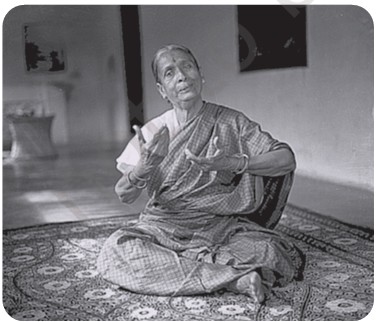
Abhinaya by Mylapore Gouri Amma
(1892–1971)
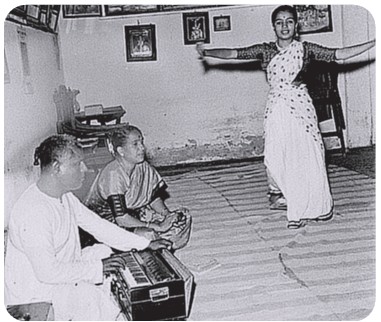
Archival image of Sadir artists singing live while dancing
3.) Āhārya Abhinaya — Using Appearance
Āhārya Abhinaya is the form of expression in Indian dance and theatre that uses external appearance to portray a character, setting, and mood. It includes costumes, jewellery, makeup, hairstyles, and props. These elements help the audience recognise the character and understand their role in the performance.
For example, a dancer portraying a king may wear a crown, rich clothing, and ornaments, while a character representing a sage may wear simple clothes and carry a staff. Similarly, colours, facial makeup, and accessories can help show whether a character is divine, royal, heroic, or ordinary. Stage decorations and other visual elements also contribute to the atmosphere of a performance.
Thus, Āhārya Abhinaya enhances the visual appeal of dance and theatre and supports storytelling by bringing characters and situations to life.
i.) Kolī Dance — Depicting the Life of Fisherfolk Through Movement
The Kolī dance is a traditional folk dance of the fishing community of Maharashtra. Its movements are inspired by the everyday activities and experiences of fisherfolk. Dancers imitate actions such as rowing boats, casting fishing nets, and responding to the movement of ocean waves.
Oars and fishing nets are used as props to make these actions more realistic and expressive.
Through rhythmic movements and coordinated group performances, the dance beautifully portrays the community’s close relationship with the sea and its traditional way of life.
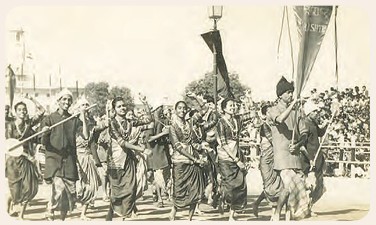
Kolī was presented at the first Republic
Day Parade on 26 January 1950
ii.) Javārā-nṛitya — Celebrating Harvest Traditions
Javārā-nṛitya is a traditional folk dance of Madhya Pradesh, associated with agricultural and harvest celebrations. Women perform graceful movements while balancing pots containing young millet shoots on their heads.
The dance reflects the importance of farming, fertility, and nature in rural life. Balancing the pots while moving rhythmically requires concentration, coordination, and skill. Through this performance, the community expresses gratitude for the harvest and celebrates its rich cultural traditions.
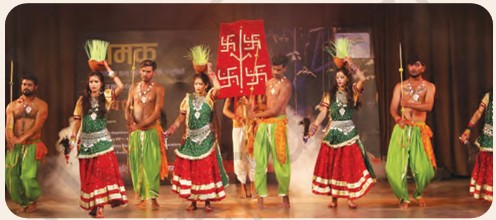
Javārā-nṛitya
iii.) Pulikaḻi — The Vibrant Tiger Dance of Kerala
Pulikaḻi, also known as the Tiger Dance, is a lively folk performance from Kerala, traditionally associated with the Onam celebrations. Performers paint their bodies with striking tiger-like patterns and wear masks to resemble tigers.
They use energetic and ferocious movements to imitate the actions of tigers, creating an exciting and colourful spectacle. Body painting, masks, gestures, and rhythmic movements bring the animal characters to life and make the performance visually engaging.
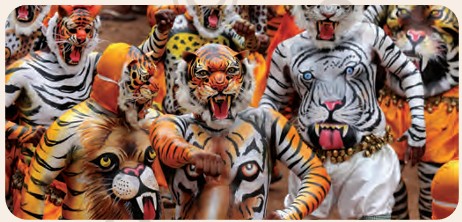
Pulikaḻi
iv.) Chathunni Asan — A Veteran Performer of Pulikaḻi
Chathunni Asan, regarded as a pioneer of Pulikaḻi, was a celebrated performer who participated in the famous Pulikaḻi celebrations during the Onam festival in Thrissur, Kerala, for around 60 years. His long association with this traditional art form reflects his dedication to preserving and promoting Kerala’s vibrant folk-dance heritage.
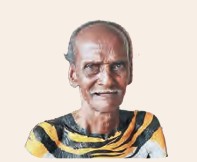
Chathunni Asan (1941–2019)
v.) Kathakali — The Art of Elaborate Makeup and Costumes
Kathakali, a classical dance-drama tradition of Kerala, is renowned for its elaborate makeup, colourful costumes, and distinctive headgear. Different face colours and makeup patterns help identify the nature and role of male characters, such as noble heroes, divine figures, and fierce or demonic beings.
A striking feature of Kathakali makeup is the raised white border, known as chutti, which is traditionally made using a paste prepared from rice flour and other materials.
Together, the makeup, costumes, and headgear transform performers into expressive characters and enhance the visual impact of the performance.
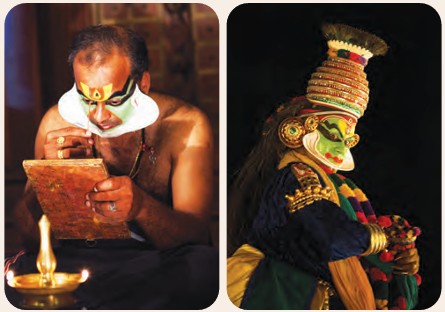
Kathakali make-up
vi.) Astad Deboo — Exploring Creativity Through Masks and Stilts
Astad Deboo, a pioneer of contemporary dance in India and a recipient of the Padma Shri, was known for his innovative approach to movement and performance. He creatively used masks and stilts as props to explore new ways of expressing ideas, emotions, and characters through dance.
By combining these elements with distinctive movements, he expanded the possibilities of physical expression and challenged conventional ideas of stage performance. His work demonstrated how props can become an integral part of choreography, adding imagination, visual interest, and meaning to a dance presentation.
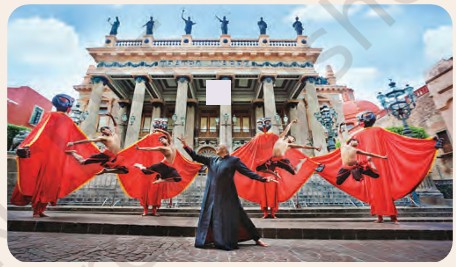
Astad Deboo (1947–2020)
4.) Sāttvika Abhinaya — Expressing Inner Emotions
The term Sāttvika is derived from sattva, which is associated with purity, clarity, and harmony. In Indian dance and theatre, Sāttvika Abhinaya refers to the expression of deep inner emotions through a performer’s focused mind and genuine feelings.
It brings an emotional depth to a performance, making the character’s feelings appear natural, believable, and heartfelt.
A dancer develops this form of expression through concentration, imagination, observation, and experiences from everyday life. Inner emotions may become visible through subtle changes in facial expressions, tears, trembling, perspiration, or changes in the voice and body. These responses help communicate the emotional state of a character to the audience.
Accomplished Indian dancers have used Sāttvika Abhinaya to express bhāvas (emotional states) and evoke rasa (aesthetic experience) among spectators. Through sincere and powerful expression, the dancer enables the audience not merely to observe an emotion but also to experience its essence.
Thus, Sāttvika Abhinaya gives life and emotional depth to a dance performance by connecting the dancer’s inner experience with the feelings of the audience.
i.) Ranjana Jhaveri — Expressing Divine Bliss Through Manipuri Dance
Ranjana Jhaveri was a renowned Manipuri dancer known for her graceful movements and expressive performances. Along with her sisters, she was among the early dancers from outside Manipur to learn and promote Manipuri dance, helping introduce this beautiful dance tradition to wider audiences.
Her portrayal of Rādhā dancing with Kṛiṣhṇa captures the joy, devotion, and bliss of their divine relationship. Through delicate gestures, graceful movements, and expressive storytelling, she brought emotional depth and beauty to her performances.
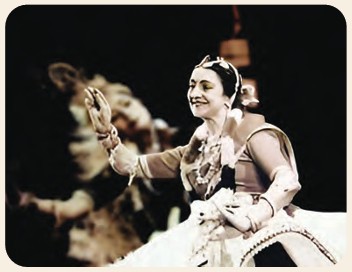
Ranjana Jhaveri (1930–2017)
ii.) Saroja Vaidyanathan — Expressing Anger Through Bharatanatyam
Saroja Vaidyanathan, a renowned Bharatanatyam exponent and recipient of the Padma Bhushan, was known for her innovative choreographies and significant contribution to dance education. Through powerful facial expressions, sharp gestures, and controlled body movements, she portrayed emotions such as anger with great intensity.
Her performances demonstrated how a dancer can communicate strong inner feelings through Sāttvika Abhinaya, making emotions vivid and meaningful for the audience.
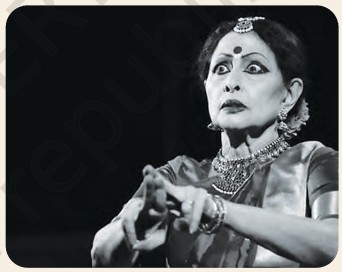
Saroja Vaidyanathan (1937–2023)
iii.) Jatin Goswami — Bringing Sattriya Dance to the World
A Sattriya dancer uses delicate finger movements to depict a bee buzzing around a flower. The eyes follow the bee as it approaches the flower and concentrates on extracting nectar. This graceful combination of hand gestures and eye movements demonstrates how Āṅgika Abhinaya can bring even a small scene from nature to life through dance.
Jatin Goswami, a renowned Sattriya maestro and recipient of the Padma Bhushan, played a pivotal role in bringing Sattriya dance from the Vaishnavite monasteries, known as sattrās, of Assam to the modern stage. Through his performances, teaching, and creative contributions, he helped introduce this traditional dance form to audiences across India and around the world.
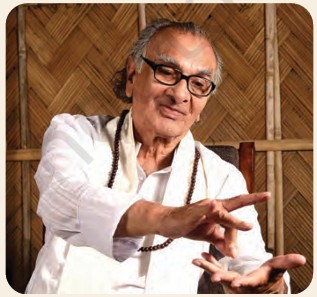
Jatin Goswami (1933–Present)
iv.) Kanak Rele — Expressing Pain and Fear Through Mohiniyattam
Kanak Rele was a renowned Mohiniyattam exponent and a recipient of the Padma Bhushan. She was a pioneer who made significant contributions to the study, teaching, and promotion of this classical dance form. A multifaceted personality, she was not only a dancer but also an academician, scholar, educator, and trained lawyer. Through expressive facial movements, delicate gestures, and graceful body language, she portrayed emotions such as pain and fear with sensitivity and depth.
Her performances demonstrated how Abhinaya can communicate powerful human emotions and create a meaningful connection with the audience.
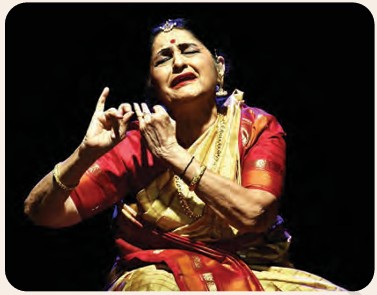
Kanak Rele (1937–2023)
v.) Kelucharan Mohapatra — Expressing Joy Through Odissi
Kelucharan Mohapatra was a legendary Odissi exponent who played a significant role in the revival and popularisation of this classical dance form. He was the first individual from Odisha to receive the Padma Vibhushan. Through graceful movements, expressive facial gestures, and elegant hand movements, he portrayed emotions such as joy with remarkable sensitivity.
His contribution to Odissi choreography, performance, and teaching helped establish the dance form on national and international stages.
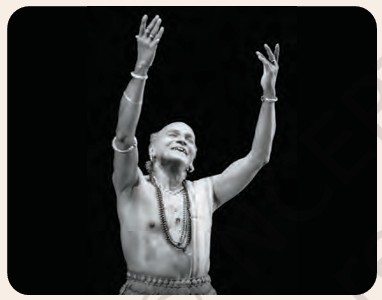
Kelucharan Mohapatra (1926–2004)
vi.) Bipin Singh — Expressing Serenity Through Manipuri Dance
Bipin Singh was a distinguished Manipuri choreographer, teacher, and scholar who played an important role in promoting and popularising Manipuri dance across India and internationally. Through gentle movements, composed facial expressions, and graceful gestures, he conveyed emotions such as serenity and inner peace.
His artistic contributions helped preserve the traditional features of Manipuri while bringing greater recognition to this classical dance form.
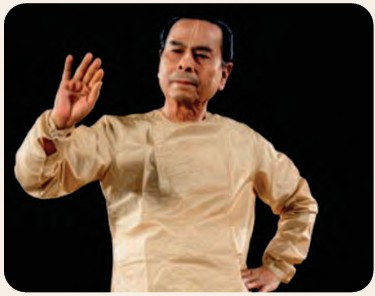
Bipin Singh (1918–2000)
Dance in Cinema — Celebrating India’s Rich Dance Traditions
You may have seen many dance performances in the films you have watched. Have you noticed similarities between the different Indian dance forms introduced in this chapter? From its earliest years, Indian cinema has drawn inspiration from India’s diverse dance traditions. Through films, audiences can experience the beauty of classical, folk, and regional dances, along with their distinctive movements, music, costumes, gestures, and expressions.
Several classic Indian films have presented memorable portrayals of traditional dance. These include the Hindi films Jhanak Jhanak Payal Baaje, Mughal-e-Azam, Pakeezah, and Amrapali; the Tamil film Thillana Mohanambal; the Telugu films Sankarabharanam and Swarnakamalam; the Marathi film Sangte Aika; and the Odia film Maa. These films helped introduce different aspects of Indian dance and music to audiences through engaging stories and performances.
Indian dance traditions have also travelled beyond national boundaries through cinema. The 1957 Indo-Soviet co-production Pardesi, also known by its Russian title Khozhdenie za tri morya (Journey Beyond Three Seas), featured a dance sequence portraying a temple dancer in a style resembling Bharatanatyam. More recent films, such as the Manipuri film Sanabi and the Tamil film Sringaram, have also explored dance as an important part of their storytelling.
Many popular films have featured regional and classical dance forms. Bhangra appears in Jab We Met, Kathak in Devdas, Ghoomar in Padmaavat, Garba in Hellaro, and Lāvaṇī in Natarang. Baahubali: The Beginning also features a performance inspired by the Gussadi dance tradition of the Raj Gond community.
Cinema provides a valuable platform for preserving and sharing India’s cultural heritage. It connects traditional art forms with modern audiences and encourages younger generations to explore the richness of Indian dance. Through the combination of movement, music, storytelling, and visual expression, dance continues to bring India’s diverse cultural traditions to life on screen.
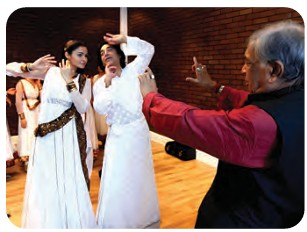
Scenes from the movie Vishwaroopam
Do you know?
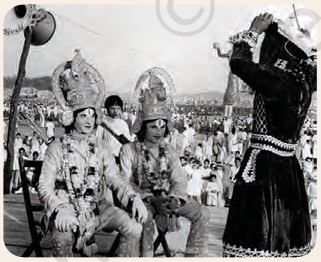
Kalpana (1948) — A Landmark in Indian Dance Cinema
Kalpana, released in 1948, was a pioneering Indian dance film created by the legendary dancer and choreographer Uday Shankar. He wrote, directed, and starred in the film, using dance, music, and imaginative visual storytelling to explore ideas about art, society, and human life.
The film presents a unique blend of Indian classical and folk dance traditions with innovative choreography and theatrical elements. It reflects Uday Shankar’s creative vision and his efforts to develop a distinctive style of modern Indian dance.
Kalpana is widely regarded as a landmark in Indian dance cinema because it placed dance at the centre of the film’s narrative. You can also watch this remarkable film online to experience its imaginative choreography and artistic vision firsthand.
Kumari Kamala — Bringing Bharatanatyam to Indian Cinema
Kumari Kamala, also known as Kamala Lakshman, was a renowned Indian classical dancer and actress who made a significant contribution to the world of dance and cinema. She began her artistic journey as a child performer and gradually became one of the most recognised Bharatanatyam dancers of her time. Her graceful movements, expressive gestures, and impressive command of rhythm made her performances memorable.
During her long career, she appeared in nearly 100 films across Tamil, Hindi, Telugu, and Kannada cinema. Through these performances, she introduced classical dance to a wide audience and demonstrated how traditional art forms could become an important part of cinematic storytelling. One of her notable films was Konjum Salangai (1962), in which Bharatanatyam played a central role. The film is recognised as the first Tamil film made in Technicolor and featured Kamala’s remarkable dancing skills.
Kumari Kamala’s contribution extended beyond films. She helped popularise Bharatanatyam among audiences who might not otherwise have had the opportunity to experience classical dance. Her performances reflected the beauty of Indian dance traditions through carefully coordinated movements, rhythmic footwork, hand gestures, and expressive storytelling.
In recognition of her achievements, she received the Sangeet Natak Akademi Award in 1968 and the Padma Bhushan in 1970. Her artistic journey remains an important example of the relationship between classical dance and Indian cinema. Through her dedication and talent, Kumari Kamala helped bring Bharatanatyam from the traditional stage to the silver screen, inspiring generations of dancers and artists.
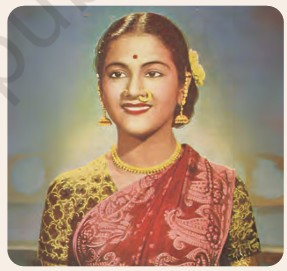
Kumari Kamala (1934–2025)
Conclusion
Dance is a beautiful art form that brings together movement, rhythm, expression, and creativity. Throughout this chapter, we have explored how the human body becomes an instrument of artistic communication through posture, gestures, facial expressions, and coordinated movements. Elements such as Sauṣṭhava (body alignment), Rekhā (clear lines), Rūpa (form), Tāla (rhythmic cycle), and Laya (tempo) help dancers develop balance, control, grace, and precision.
We have also understood the importance of Nṛitta and Nṛitya, which combine rhythmic movement with expressive storytelling. The four forms of Abhinaya—Āṅgika, Vācika, Āhārya, and Sāttvika—show how dancers communicate ideas, characters, and emotions through their bodies, voices, appearance, and inner feelings. Examples from Indian classical and folk traditions demonstrate how dance reflects everyday life, nature, celebrations, and cultural beliefs.
The journey through dance in cinema has further shown how traditional art forms continue to inspire modern creativity and reach audiences across the world. The contributions of celebrated dancers and choreographers remind us that dedication, imagination, and practice keep these traditions alive.
Ultimately, dance is not merely a sequence of movements; it is a powerful language of expression that connects the body, mind, and emotions. It preserves our cultural heritage while allowing every generation to create something new. As we continue to observe, practise, and appreciate dance, we discover its ability to inspire, communicate, and bring people together.