
Introduction
Musical instruments are objects or devices designed to produce and control musical sounds. They are an important part of musical traditions across the world and are used to create melody, rhythm, accompaniment, and musical expression. Instruments differ in their construction, materials, method of playing, and the type of sound they produce.
In Indian music, musical instruments have developed alongside different musical traditions and performance practices. They are used in Hindustani and Carnatic classical music, folk and regional traditions, devotional music, dance, theatre, and contemporary performances. Some instruments accompany singers or other instruments, while others may be used for solo performances.
Indian musical instruments are commonly classified according to how sound is produced. String instruments produce sound through vibrating strings, wind instruments produce sound through vibrating air, and percussion instruments produce sound when their surfaces or bodies are struck, shaken, or played. Instruments such as the sitar, sarod, veena, flute, shehnai, tabla, mridangam, and pakhawaj illustrate the variety of Indian instrument traditions.
Studying musical instruments helps us understand the relationship between sound, materials, technique, rhythm, melody, and performance. It also introduces us to the rich diversity of musical instruments and the cultural traditions in which they are used.
The Science of Sound
Sound is an important part of music, communication, and our everyday lives. We hear sound when an object or source vibrates and produces disturbances that travel through a medium such as air. Our ears detect these vibrations and our brain interprets them as sound.
The pitch, loudness, quality, and duration of a sound help us distinguish one sound from another. In music, these properties are carefully used to create melodies, rhythms, and different musical expressions.
Musical instruments demonstrate the science of sound in interesting ways. Strings can vibrate, stretched membranes can produce sound when struck, and columns of air can vibrate inside wind instruments. The shape, material, size, and method of playing an instrument can affect the sound it produces.
Understanding the science of sound helps us connect music with science and appreciate how voices and musical instruments create the sounds we hear.
1. ) Vibration
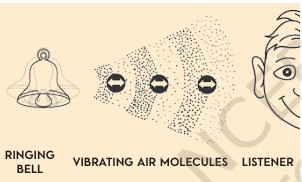
Vibration is the rapid back-and-forth movement of an object around its resting position. It is one of the main causes of sound. When an object vibrates, it creates disturbances in the surrounding medium, such as air, which travel as sound waves.
For example, when a guitar string is plucked, the string vibrates and produces sound. Similarly, when a tabla membrane is struck, it vibrates and produces musical sound. In wind instruments, the air inside the instrument vibrates to produce sound.
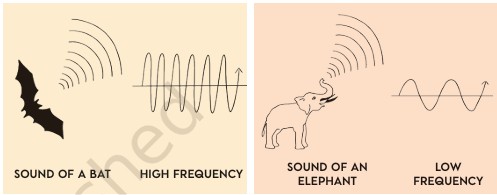
The number of vibrations made in one second is called frequency, and it is measured in hertz (Hz). A higher frequency generally produces a higher-pitched sound, while a lower frequency produces a lower-pitched sound.
Vibration is therefore closely connected with music. By changing the length, thickness, tension, size, or material of a vibrating part, musical instruments can produce sounds with different pitches and qualities.
Understanding vibration helps us see how the science of sound is connected with music and musical instruments.
Sound is produced because of vibrations. When an object vibrates, it creates sound waves, that travel through a medium (air, water, etc.) to reach our ears.
2.) Resonance
Resonance is a phenomenon in which an object vibrates with a much greater amplitude when it is exposed to vibrations of a suitable or matching frequency. It can make a sound louder, fuller, and more sustained.
Resonance plays an important role in musical instruments. For example, when a guitar string is plucked, the string vibrates and produces sound. The hollow body of the guitar also vibrates in response and helps amplify the sound. Similarly, the wooden body of a sitar and the resonating parts of instruments such as the tabla and veena help strengthen and enrich their sound.
The shape, size, material, and construction of an instrument affect its resonant properties. This is why different instruments can produce different qualities of sound even when they produce notes of the same pitch.
Resonance helps us understand how vibration can be transferred and strengthened. It is an important connection between the science of sound and the design of musical instruments.
Through resonance, sound is amplified or made louder. For example, in a percussion instrument, the hollow body or cavity resonates, amplifying the sound.
3.) Frequency
Frequency refers to the number of complete vibrations made by a vibrating object in one second. It is measured in hertz (Hz). For example, a frequency of 100 Hz means that an object makes 100 complete vibrations in one second.
Frequency determines the pitch of a sound. A vibrating object that completes more vibrations per second produces a higher-frequency sound, which is heard as a higher pitch. An object that makes fewer vibrations per second produces a lower-frequency sound, which is heard as a lower pitch.
The relationship between frequency and pitch can be observed in musical instruments. In a sitar, the tension of a string affects its vibration. When the tuning peg is tightened, the string becomes more tense and vibrates at a higher frequency, producing a higher-pitched note. When the tension is reduced, the string vibrates more slowly and produces a lower-pitched note.
The length and thickness of a string also affect its frequency. A shorter or thinner string generally vibrates at a higher frequency, while a longer or thicker string generally vibrates at a lower frequency, when other conditions are kept similar.
Different musical instruments produce different ranges of frequencies. Singers also produce different frequencies when they sing low and high notes. By controlling the frequency of vibration, musicians can produce different pitches and melodies.
Therefore, frequency is an important property of sound that helps us understand why some musical notes sound high or low.
4.) Timbre
Timbre refers to the ‘tone’ or ‘colour’ of a sound. It is the quality that makes one sound different from another, even when the sounds have the same pitch and loudness.
Timbre can vary depending on the material used to make an instrument, its shape and construction, and the technique used to play it. For example, the same musical note played on a sitar, flute, or tabla will have a different sound quality because each instrument produces and shapes vibrations differently.
The player’s technique can also change the timbre of a sound. The way an instrument is plucked, struck, bowed, blown, or played can affect its character and expression.
Timbre adds colour, variety, and richness to music. It helps us recognise different musical instruments and voices and makes musical performances more expressive.
Do you think music is both an art and a science? Discuss in class.
Music is an art because it involves creativity, imagination, expression, emotion, and performance. At the same time, it is also connected with science because sound is produced through vibrations and can be studied in terms of frequency, pitch, loudness, timbre, and resonance.
Discuss examples from musical instruments and singing to explore how artistic expression and scientific principles work together to create music.

Making Musical Instruments
Musical instruments are carefully designed to produce, control, and shape sound. Their materials, size, shape, construction, and method of playing all influence the sound they produce. Understanding these features helps us see how the science of sound is connected with the art of making and playing music.
Different instruments produce sound in different ways. String instruments produce sound through vibrating strings, wind instruments through vibrating air, and percussion instruments through vibrating membranes or solid materials when they are struck, shaken, or played.
The materials used to make an instrument also affect its pitch, loudness, timbre, and resonance. For example, changing the length or tension of a string can change its pitch, while the shape and material of the instrument can influence its timbre and resonance.
Traditional instrument makers use their knowledge, skill, experience, and craftsmanship to create instruments with particular sound qualities. Many Indian musical instruments have developed through generations of such craftsmanship and are closely connected with regional musical traditions.
In this section, we will explore how musical instruments are made and how their materials, structure, vibrations, and playing techniques help create different sounds. We will also discover how scientific principles and artistic craftsmanship come together in the making of musical instruments.
The makers of musical instruments are essential for the survival of traditional art forms. Scientific principles are used in the making of musical instruments.
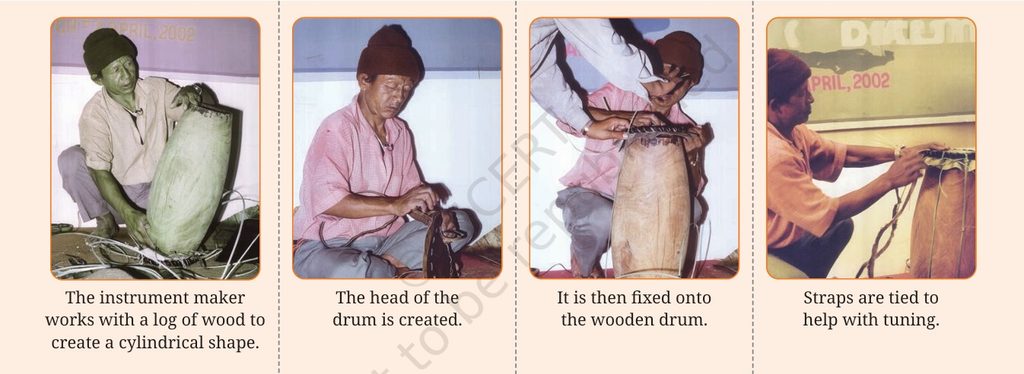
Musicians And Their Instruments
Musicians and musical instruments share a close relationship. Musicians use instruments to express melody, rhythm, emotions, ideas, and creativity. Different instruments require different techniques, skills, and methods of practice.
Indian music has a rich tradition of musicians who perform on instruments such as the sitar, sarod, veena, flute, shehnai, tabla, mridangam, and pakhawaj. Musicians often spend many years learning to play their instruments with accuracy, control, and expression.
Regular practice helps musicians develop pitch, rhythm, coordination, concentration, and musical sensitivity. Their playing techniques also influence the timbre and character of an instrument.
Musicians play an important role in preserving and developing musical traditions. Through performances and teaching, they pass musical knowledge and skills from one generation to another.
Musicians often become synonymous with their instruments. Here are some great musicians and their instruments for you to learn about. If you can, learn about other great musicians from our country!
Annapurna Devi — Surbahar
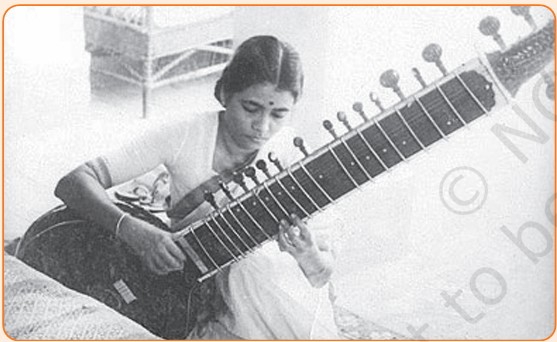
Annapurna Devi (1927 – 2018), born Roshanara Khan, was one of the most influential figures in Indian classical music. She was the daughter of the legendary Baba Allauddin Khan of the Maihar Gharana and played the surbahar, a bass sitar known for its deep, resonant tones.
The surbahar was an uncommon instrument for women as it is considered physically demanding, but she mastered it and her father considered her his finest student. Although she did not perform publicly, Annapurna Devi was known for her commitment to tradition and her mastery over ragas. Her students, including flautist Hariprasad Chaurasia and sitarist Nikhil Banerjee, became some of the most acclaimed musicians of their generation.
Annapurna Devi (1927 – 2018), born Roshanara Khan, was one of the most influential figures in Indian classical music. She was the daughter of the legendary Baba Allauddin Khan of the Maihar Gharana and
About the Surbahar: The surbahar is a plucked string instrument, often called the ‘bass sitar’, used in Hindustani classical music. It has a deeper and lower tonal range than the sitar, making it suitable for elaborate alaap sections.

Pannalal ghosh — flute
Pannalal Ghosh lived from 1911 to 1960 and his name was synonymous to Indian flute (bansuri). He was a bansuri player and also a composer. He was a disciple of Baba Allauddin Khan, and is credited with popularising the flute as a concert instrument in Hindustani classical music. As a child he had picked up a small flute that cowherders usually played and on the basis of the education he was receiving on the sitar from his father, he would try to play musical patterns on the flute
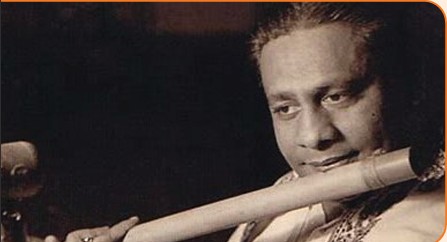
At the age of 18, he started focusing his attention on the flute. Ghosh realised that a bigger flute’s pitch and sonority would be more appropriate for both classical and light music. Ghosh experimented with various materials including metal and different types of wood, and decided on using bamboo. He finally settled on a flute which was 32 inches long. He assisted in music production while he was in Calcutta working with New Theatres Ltd.
In 1940 he came to Bombay, to further expand his music career. Sneh Bandhan (1940) was his debut film as an independent music composer. The popular songs from the film were “Aabroo Ke Kamaanon Mein” and “Sneh Bandhan Mein Bandhe Hue” sung by Khan Mastan and Bibbo.
Pannalal Ghosh jointly scored the background for “Aandhiyan” in 1952 along with Ustad Ali Akbar Khan and Pandit Ravi Shankar. He was the first to introduce the seven-hole flute.
Mysore Doraiswamy Iyengar — Veena
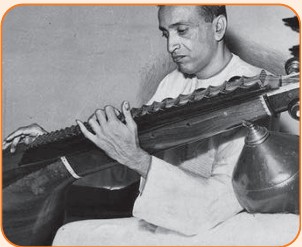
Doraiswamy Iyengar was born into a family of renowned Carnatic musicians in 1920. His father Venkatesh Iyengar served as a Court musician at the Royal court of Mysore, who was efficient equally in flute and Veena. Iyengar started learning the Veena from his father at an early age of 6 years and later went to become the disciple of Veena Venkatagiriyappa. Later, he developed a distinctive style of playing the Veena often referred to as the Mysore Bani. He spent his early years in the village Gaddavalli in Hassan district, Karnataka.
He was nominated for Asthana Vidvan (Royal musician of the court) of the Mysore court, one to receive this honour very young age. Apart from giving performances, he was engaged in imparting musical knowledge to the members of the royal family.
He was appointed as the Music Director at the All India Radio in Bangalore. He was credited with several awards and titles.
The University of Mysore conferred upon him an Honorary Doctorate in 1975, the Prestigious civilian award the Padma Bhushan by the President of India in 1983, the Sangeetha Kalanidhi of the Madras Music Academy in 1984, the Sangeetha Kalasikhamani of the Indian Fine Arts Society Chennai in 1994, the Sangeetha Kalaratna of the Bangalore Gayana Samaj, and the Chowdiah National Memorial Award.
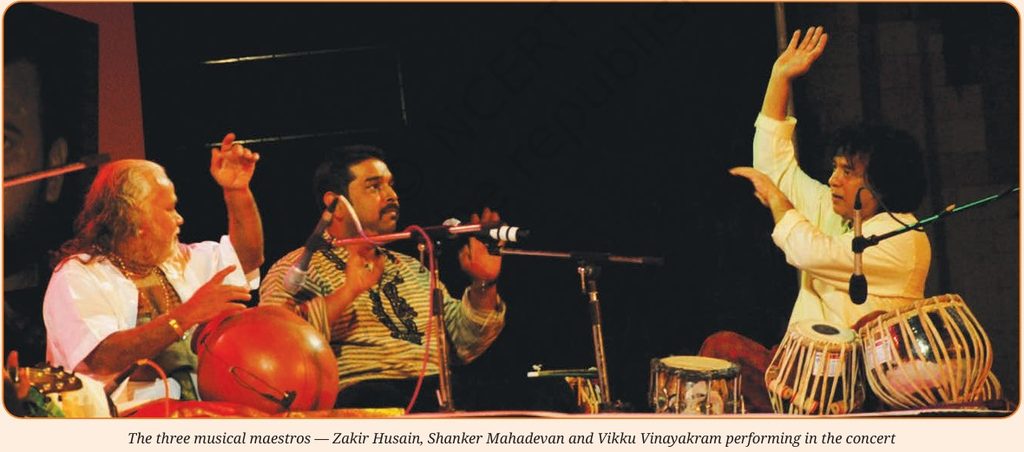
1.) Zakir Husain
Ustad Zakir Hussain (1951–2024) was one of the most internationally recognised Indian tabla players and an important figure in Hindustani classical music. He was the son and disciple of the legendary tabla maestro Ustad Alla Rakha. From an early age, he received intensive training in tabla and developed a highly expressive and technically refined style of playing.
Zakir Hussain became known for his remarkable rhythmic control, improvisation, speed, precision, and ability to communicate with other musicians. He performed extensively in India and around the world and collaborated with musicians from different musical traditions. His work helped introduce the tabla and Indian rhythmic traditions to audiences beyond the classical music world.
He also explored collaborations between Indian classical music and other forms of music. One of his important international collaborations was with the fusion group Shakti, which brought together Indian classical and Western musical traditions.
Zakir Hussain received several major honours for his contribution to music, including the Padma Shri, Padma Bhushan, and Padma Vibhushan. He also won four Grammy Awards, including three at the 66th Annual Grammy Awards in 2024 for This Moment, Pashto, and As We Speak.
Through his performances, teaching, collaborations, and recordings, Zakir Hussain made the tabla an important and widely recognised voice of Indian rhythm. He passed away in December 2024, leaving a significant legacy in Indian and world music.
2.) Shanker Mahadevan
Shankar Mahadevan (born 1967) is a renowned Indian singer, composer, and playback vocalist. He developed an interest in music from childhood and received training in Carnatic and Hindustani classical music. He also learned to play the Veena at a young age. Before pursuing music professionally, he completed a degree in software engineering and worked as a software engineer.
Mahadevan gained wide recognition through his singing and his 1998 album Breathless, whose title song became especially well known for its rapid, continuous vocal delivery. He later became a leading voice in Indian film music, singing in several Indian languages and composing music for films.
He is also a member of the celebrated music-composing trio Shankar–Ehsaan–Loy, along with Ehsaan Noorani and Loy Mendonsa. The trio has created music for many Indian films, including Dil Chahta Hai, Kal Ho Naa Ho, Bunty Aur Babli, and Rock On!!.
Shankar Mahadevan has received several major honours, including the Padma Shri in 2019. He is also a Grammy Award winner as a member of Shakti for the album This Moment, which won Best Global Music Album at the 66th Grammy Awards in 2024.
Through his powerful voice, classical training, compositions, and collaborations, Shankar Mahadevan has contributed significantly to Indian vocal and film music.
3. Vikku Vinayakram
T. H. Vinayakram, popularly known as Vikku Vinayakram (born 1942), is a renowned Indian percussionist and an important exponent of the ghatam, a traditional clay percussion instrument used in Carnatic music. He was born in Chennai into a family with a strong musical background and received early training in percussion from his father, T. R. Harihara Sharma.
The ghatam is a clay pot played with the hands, fingers, palms, and sometimes the nails. Different parts of the pot produce different tones, allowing the performer to create complex rhythmic patterns. Vikku Vinayakram developed a highly distinctive and energetic style of ghatam playing and helped bring the instrument greater recognition in India and abroad.
He has performed with many leading Carnatic musicians and has also participated in innovative collaborations that brought Indian percussion together with other musical traditions. He was a member of the pioneering fusion group Shakti, alongside musicians including John McLaughlin, L. Shankar, and Zakir Hussain.
Vikku Vinayakram received several honours for his contribution to music, including the Padma Shri (2002), Padma Bhushan (2014), and Padma Vibhushan (2022). He is widely respected for his rhythmic creativity, technical skill, and contribution to the recognition of the ghatam as an important percussion instrument.
Through his performances and teaching, Vikku Vinayakram has helped inspire new generations of percussionists and contributed to the global appreciation of Carnatic rhythm and Indian percussion.
ACTIVITY 6.1: FIND THE NAMES OF THE MUSICAL INSTRUMENT
Look carefully at the pictures of the musical instruments given below. Identify each instrument and write its correct name in the space provided.
Try to recognise the instruments by observing their shape, size, materials, strings, membranes, and other distinctive features. Think about how each instrument is played and whether it belongs to the string, wind, or percussion family.
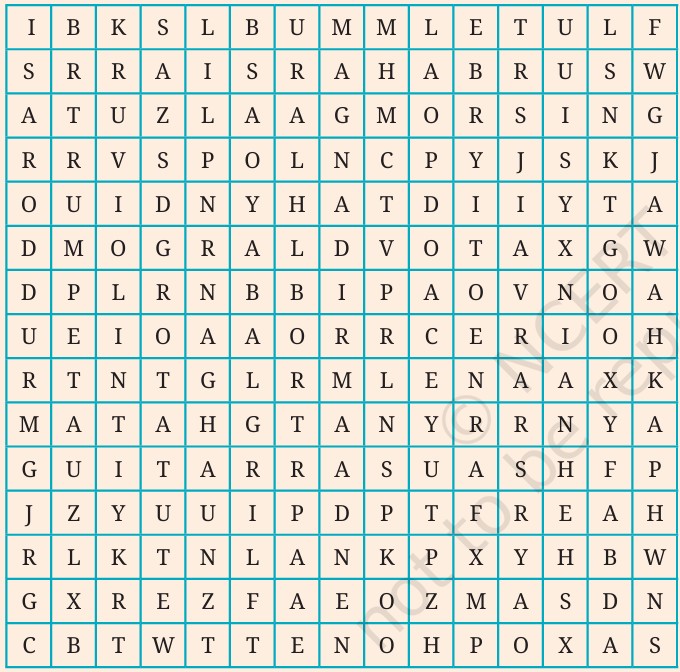
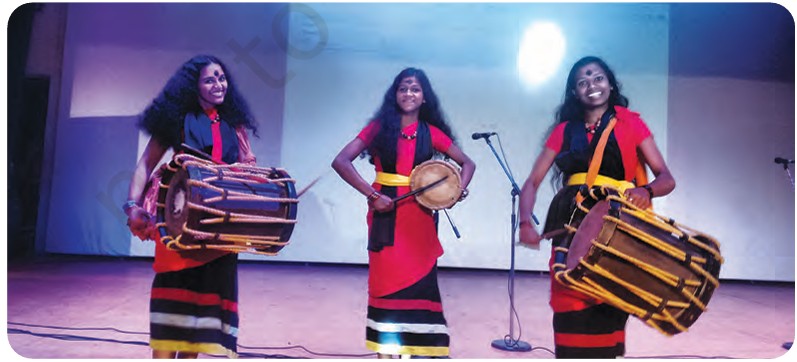
Musical Instruments: Dhol and Kanshi Being Played
Dhol and Kanshi are traditional percussion instruments used in various Indian folk and cultural traditions. The dhol is a large drum that is played by striking its stretched membranes with sticks or hands, producing a strong rhythmic sound. Kanshi is a metal percussion instrument that produces a bright, resonant sound when struck.
Both instruments are often used to provide rhythm, energy, and accompaniment during folk performances, festivals, celebrations, and community gatherings. Their sounds contribute to the lively character of traditional music and help bring people together through rhythm.
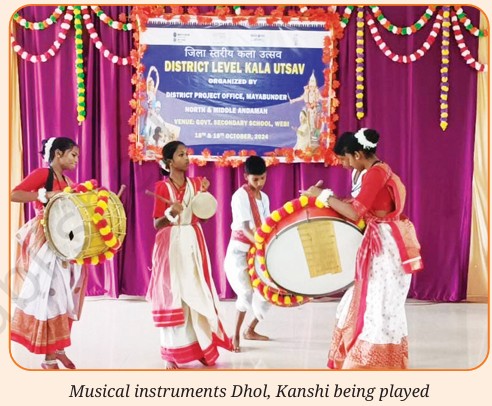
Note:-
Words can go in any direction.
Words can share letters if they cross over each other.
Musical Instruments
Bansuri, Clarinet, Dholak, Ektara, Flute, Ghatam, Guitar, Morsing, Sarod, Saxophone, Shehnai, Sitar.
India has a rich variety of musical instruments. These instruments differ in their shape, size, material, method of playing, and sound. The instruments listed below belong to different families and are used in classical, folk, popular, and regional music.
1. Bansuri
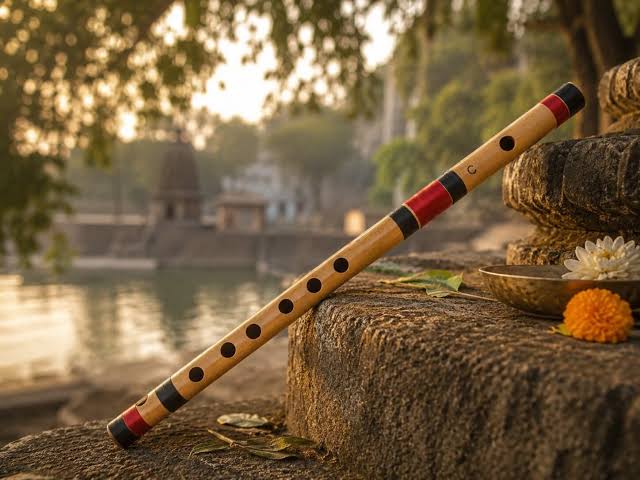
The Bansuri is a traditional Indian bamboo flute. It is a wind instrument played by blowing air through a hole and controlling the pitch with finger holes. It is widely associated with Indian classical and folk music.
2. Clarinet
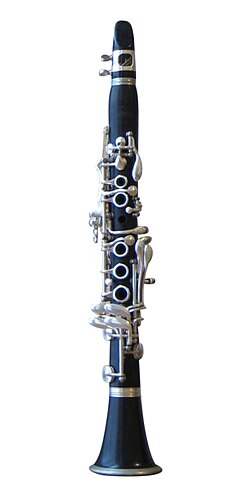
The Clarinet is a woodwind instrument with a single reed. It has a cylindrical body with finger holes and keys. It is used in orchestras, bands, folk traditions, and various Indian musical settings.
3. Dholak
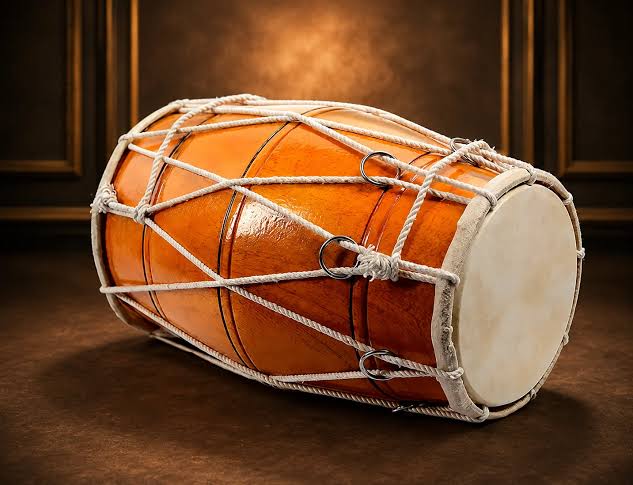
The Dholak is a two-headed hand drum commonly used in Indian folk and devotional music. Its two membranes produce sounds of different pitches. It is played with the hands and fingers.
4. Ektara
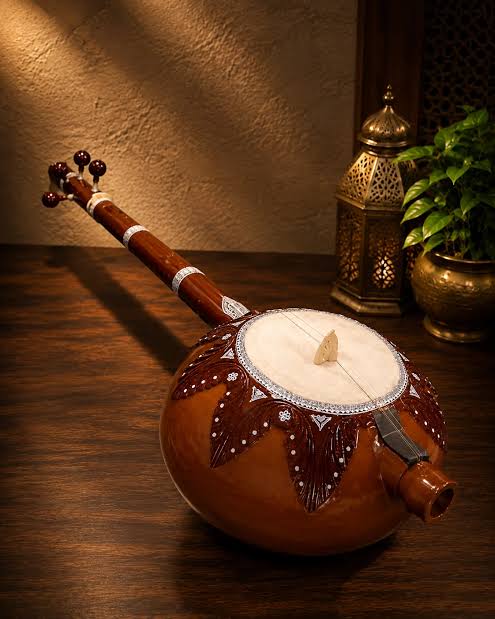
The Ektara is a simple one-stringed instrument traditionally used by folk singers and devotional performers. It consists of a resonating body attached to a neck or handle and produces a distinctive rhythmic drone.
5. Flute
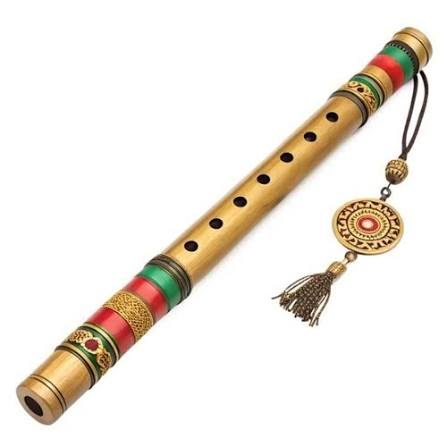
A flute is a wind instrument in which sound is produced by blowing air across an opening. Different notes are produced by opening and closing the finger holes. The flute is used in many musical traditions around the world.
6. Ghatam
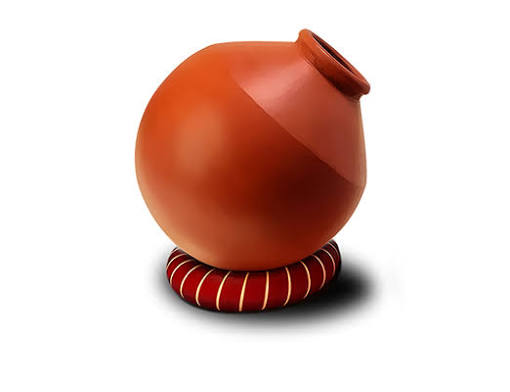
The Ghatam is a traditional South Indian percussion instrument made from specially prepared clay. It is played with the hands, fingers, palms, and sometimes the nails. Different areas of the pot produce different tones.
7. Guitar
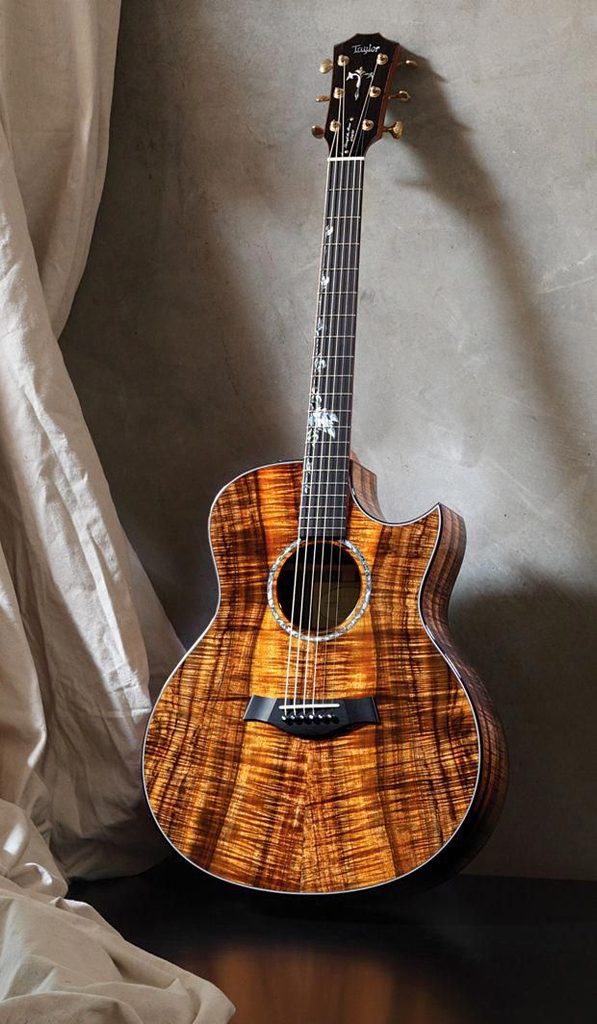
The Guitar is a string instrument usually having six strings. The strings are plucked or strummed, and their vibrations are amplified by the body of the instrument. It is widely used in classical, folk, popular, and contemporary music.
8. Morsing
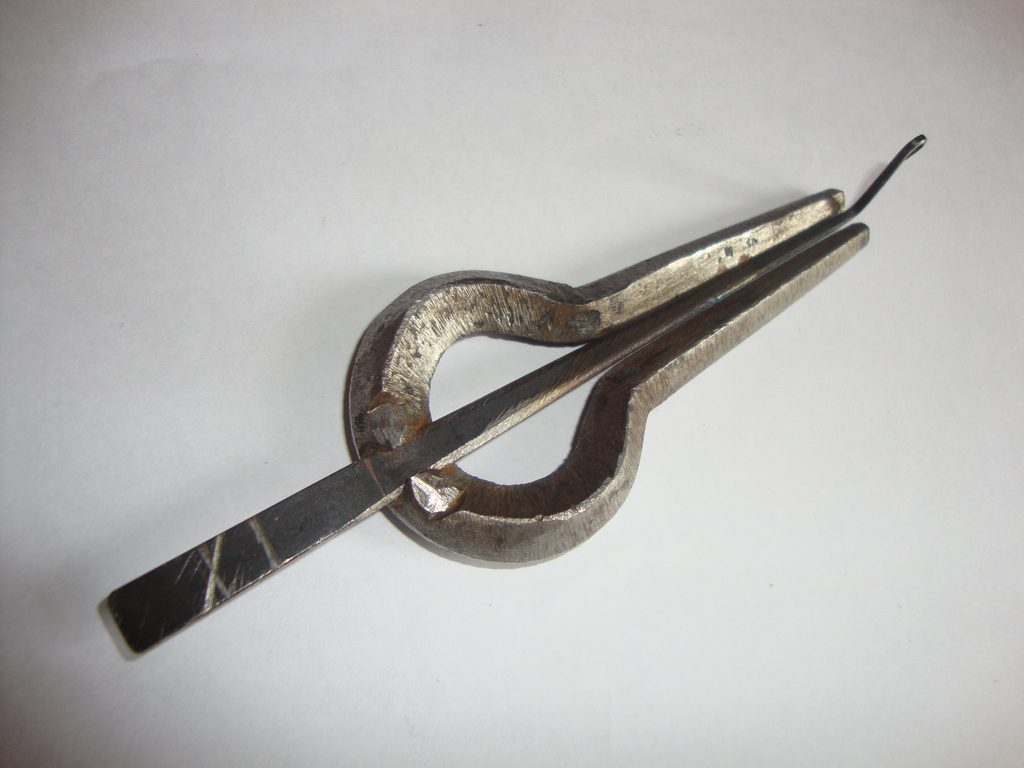
The Morsing is a small metal jaw harp used particularly in South Indian, especially Carnatic, music. It is held against the teeth while a flexible metal tongue is plucked. The mouth cavity helps shape and amplify the sound.
9. Sarod
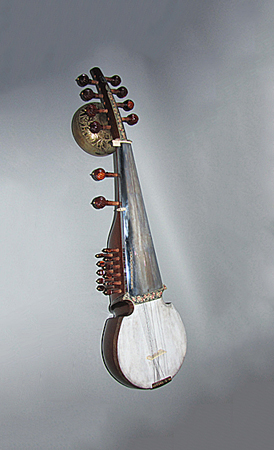
The Sarod is a prominent plucked string instrument of Hindustani classical music. It has a deep, resonant tone and a fretless metal fingerboard. Players use a plectrum, called a java, to pluck its strings.
10. Saxophone
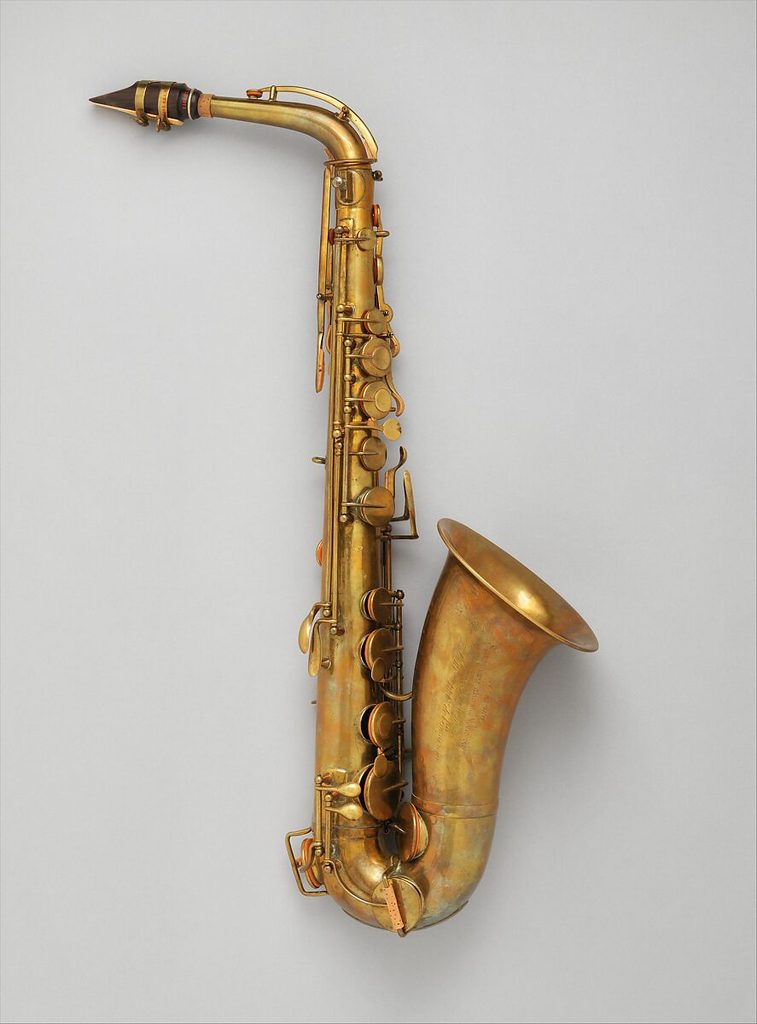
The Saxophone is a wind instrument made mainly of metal and played using a single reed. It has a curved body and a system of keys. Although widely associated with Western music and jazz, it is also used in Indian and contemporary music.
11. Shehnai
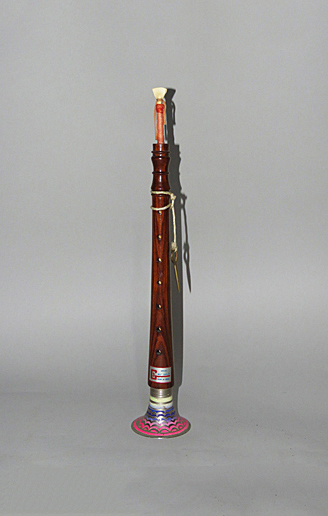
The Shehnai is a traditional Indian wind instrument with a conical body and a double reed. It has a distinctive, powerful sound and is commonly associated with weddings, festivals, religious occasions, and ceremonial music.
12. Sitar
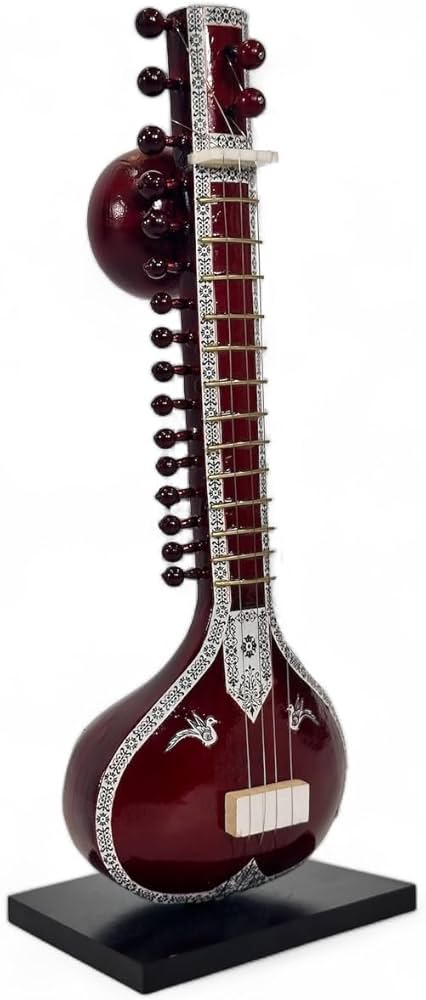
The Sitar is a major plucked string instrument of Hindustani classical music. It usually has a long neck, movable frets, several playing and sympathetic strings, and a resonating body. Its characteristic sound comes from the vibration of its strings and resonating structure.
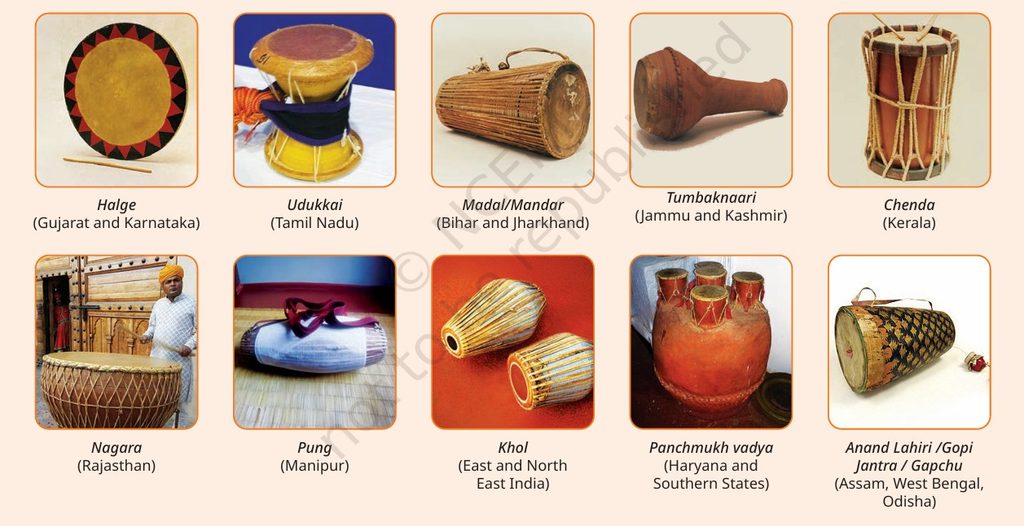
ACTIVITY 6.2: MAP THE INSTRUMENT
Here is a set of percussion instruments from different regions of India. Explore the regions where these instruments are traditionally found and played.
ACTIVITY 6.3: CROSSWORD
Test your knowledge of music, musical instruments, and the science of sound by solving the crossword puzzle.
Solve the crossword of musical instruments
Across
1. A string instrument made of hard wood such as walnut or rose wood, having more than hundred strings.
2. A percussive instrument used to sing the dhrupad style of Indian classical music.
3. An instrument that was played by the Ustad Zakir Hussain (Padam Vibhushan awardee).
4. The string instrument played by Pandit Ravi Shankar (Bharat Ratna awardee).
5. A string instrument with four strings played through a bow.
6. An Indian percussion instrument that looks like a pot and is made of baked clay.
Down
7. A string instrument which is long necked and has four strings and is played by fingers.
8. Wind instrument traditionally made from Bamboo and has 6 or 7 finger holes.
9. Wind instrument with keyboard that produces sound by blowing air through reeds.
10. An percussion instrument that consists of a set of ceramic or metal bowls filled with water.
11. A wind instrument that was played by Ustad Bismillah Khan (Bharat Ratna awardee).
12. A bow instrument which is popular in folk music of Rajasthan and Sindh.

Conclusion
Musical instruments are an important part of India’s rich musical heritage. Through this chapter, we explored different types of instruments, their materials, construction, sound production, playing techniques, and distinctive timbres. We also learned how concepts such as vibration, frequency, resonance, and timbre help us understand the science behind musical sounds.
From the sitar, sarod, and ektara to the bansuri, shehnai, ghatam, dholak, and morsing, each instrument has its own unique character and cultural significance. We also discovered how talented musicians develop their skills through practice, dedication, creativity, and performance.
Understanding musical instruments helps us appreciate both the scientific principles and artistic traditions behind music. It encourages us to listen carefully, explore different sounds, and value the diverse musical traditions of India.