
Introduction
Dance is not only an artistic form of expression but also a joyful way to support physical, mental, emotional, and social well-being. Through regular movement, dance encourages us to become more aware of our bodies, improve coordination, and develop strength, flexibility, balance, and stamina.
Dance also provides an opportunity to express emotions and release tension. Moving with music and rhythm can help us feel relaxed, energetic, confident, and positive. Learning and practising dance requires concentration and awareness, which can strengthen the connection between the body and mind.
Dance can also bring people together. Group dances encourage cooperation, communication, listening, and a sense of belonging. Participating in shared movement can help build confidence and create positive social experiences.
Different dance traditions also connect people with culture, community, and identity. Learning traditional dances allows us to experience music, stories, movements, and customs passed down through generations.
Thus, dance can become a meaningful part of a healthy and balanced life. By enjoying movement and expressing ourselves creatively, we can experience the many ways in which dance contributes to well-being and a joyful life.
Communicating Through Dance
You may recall the different hand gestures you learnt in earlier grades. Each gesture can have one or several meanings and can help a dancer communicate ideas, express emotions, and even tell a story without using words.
In Indian dance traditions, hand gestures are known as hastas or mudras. A gesture made with one hand is called an asamyuta hasta, while a gesture made with both hands together is called a samyuta hasta.
Let us take this learning a step further. The Abhinaya Darpaṇa, an important Sanskrit text on dance and expression, describes hand gestures through Sanskrit ślokas. It presents 28 asamyuta hastas, or single-hand gestures, each with specific forms and meanings.
In addition to these 28 gestures, the text also discusses four additional hand gestures. These gestures expand the vocabulary available to dancers and allow them to communicate a wider range of objects, actions, characters, emotions, and ideas.
By learning and using hastas thoughtfully, dancers can transform simple hand movements into a powerful language of expression and storytelling.
Samyuta Hasta
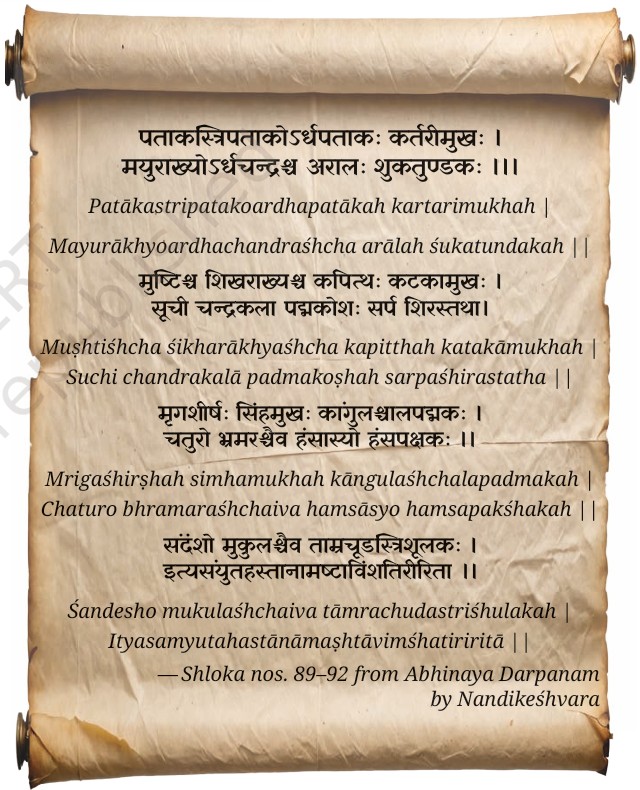
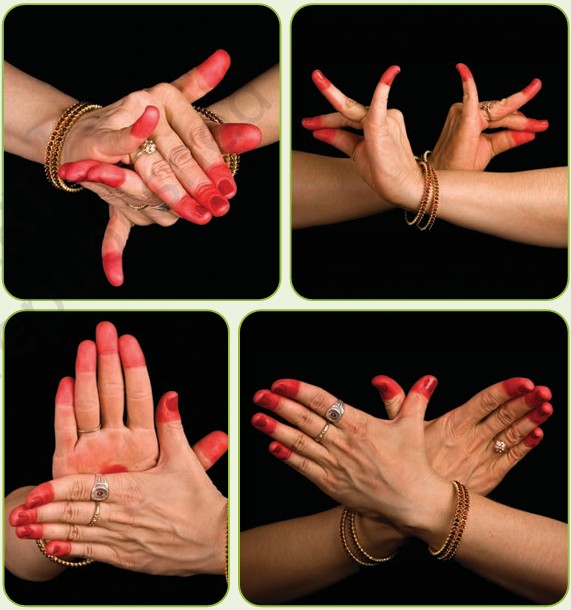
A Samyuta Hasta is a hand gesture made using both hands together. These combined hand gestures form an important part of the expressive vocabulary of Indian dance and can be used to represent objects, actions, characters, emotions, and ideas.
The Abhinaya Darpaṇa describes 23 Samyuta Hastas through a Sanskrit śloka. Each word in the śloka refers to a particular hasta or combined hand gesture. By learning the śloka and understanding the corresponding gestures, dancers can remember and practise the different forms more easily.
Samyuta Hastas allow dancers to communicate meanings visually and contribute to abhinaya, storytelling, and expression. When combined with facial expressions, body movements, rhythm, and appropriate use of space, these gestures help make a dance performance more meaningful and expressive.
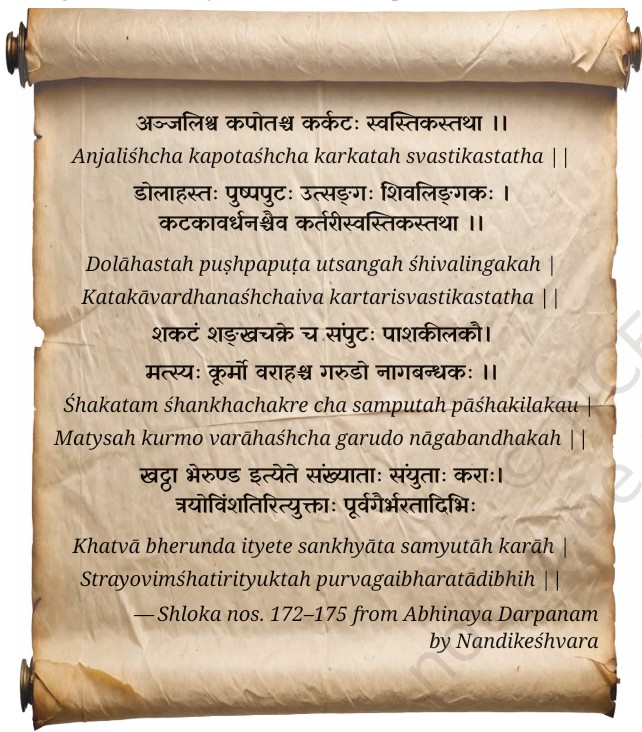
Activity 12.1: Speaking With Hands
In dance, the hands can speak without words. Hand gestures, known as hastas or mudras, are an important part of the expressive language of many Indian dance traditions. A simple movement of the fingers, palms, or hands can represent an object, action, character, emotion, or idea.
Hand gestures may be made with one hand or both hands. Single-hand gestures are known as asamyuta hastas, while combined gestures made with both hands are called samyuta hastas. These gestures form an important vocabulary through which dancers can express and narrate stories.
By observing the hands carefully, we can learn to understand the visual language of dance. Learning hastas not only develops coordination and concentration but also helps us discover how movement can become a powerful form of communication, creativity, and storytelling.
Recite the Hasta Shloka
Recite the hasta śloka while performing the corresponding hand gestures with your hands. Coordinate each word of the śloka with the appropriate hasta and maintain the correct sequence.
Practise slowly at first, paying attention to the shape and position of your hands and fingers. Gradually increase the pace while keeping the gestures clear and accurate. Work in pairs or small groups and observe one another to improve coordination, memory, rhythm, and expression.
Exploring Hastas as a Sign Language
Before spoken and written languages developed, people communicated using gestures, facial expressions, and body movements. Even today, when we watch dance performances, we can see how music, movement, and gestures are used to communicate thoughts and feelings.
You have learnt that hastas can also be used as a means of communication. Now, observe the people around you and notice how they naturally use hand gestures while conversing. Can you recognise what these gestures mean? How do they help make communication clearer? Try creating your own simple sign language using some of the hastas you have learnt.
Assign meanings to selected gestures and prepare a chart showing the hasta and the meaning it represents. Discuss your ideas with your classmates and explore how hand gestures can become a visual language for communication.
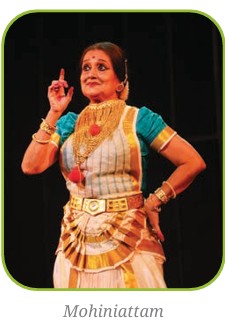
1.) Mohiniyattam
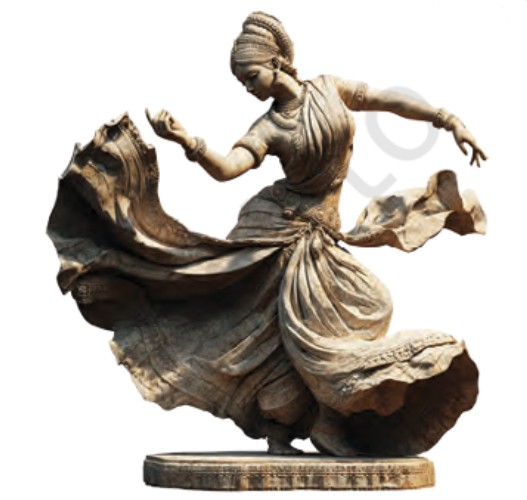
Mohiniyattam is a classical dance tradition of Kerala, known for its graceful, gentle, and flowing movements. The name comes from Mohini, the enchanting form of Lord Vishnu, and attam, meaning dance. The dance traditionally explores themes of love, devotion, and emotion through expressive movements and storytelling.
A distinctive feature of Mohiniyattam is the graceful movement of the torso, hips, arms, eyes, and head, combined with delicate footwork. The movements are generally rounded and continuous, creating a soft and lyrical quality. Dancers use hastas, facial expressions, and eye movements to communicate emotions and tell stories.
Mohiniyattam is traditionally performed to Carnatic music, with Malayalam and Sanskrit compositions forming an important part of its repertoire. The dancer’s movements are coordinated with rhythm and music to create a harmonious performance.
The traditional costume is usually a white or off-white saree with a golden border, known as kasavu. It is complemented by traditional jewellery, ornaments, and flowers worn in the hair.
Through its combination of graceful movement, abhinaya, rhythm, music, and devotional expression, Mohiniyattam represents the rich classical dance heritage of Kerala.
2.) Kuchipudi
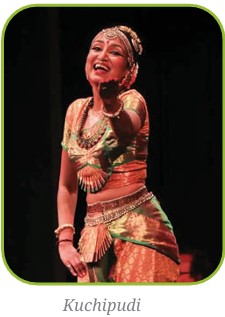
Kuchipudi is a classical dance tradition associated with Andhra Pradesh in South India. It takes its name from the village of Kuchipudi, an important centre of the tradition. Kuchipudi combines dance, drama, music, gestures, facial expressions, and storytelling.
It is known for graceful movements, lively footwork, expressive abhinaya, and dramatic poses. Many performances present stories from Indian mythology and devotional traditions.
A distinctive feature is Tarangam, in which the dancer performs rhythmic movements while balancing on the edge of a brass plate. Traditional costumes, jewellery, and expressive makeup enhance the visual beauty of the performance. Kuchipudi beautifully combines rhythm, expression, acting, and storytelling.
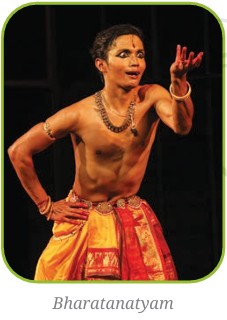
3.) Bharatanatyam
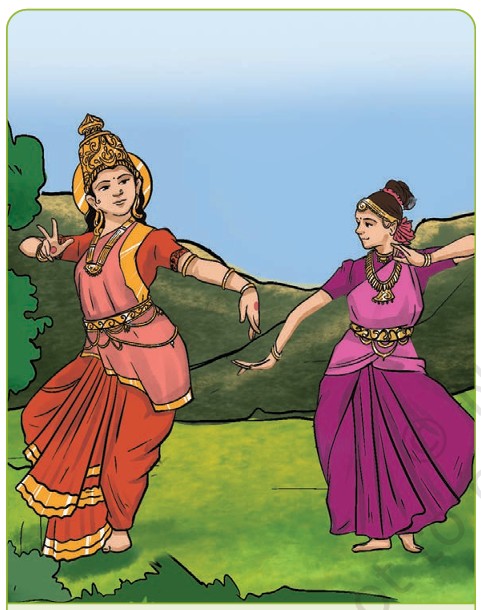
Bharatanatyam is a classical dance tradition from Tamil Nadu in South India. It is known for its precise movements, rhythmic footwork, graceful gestures, expressive facial expressions, and strong postures. Dancers use hastas, body movements, and abhinaya to communicate stories, emotions, and ideas.
A characteristic feature is the aramandi, a half-sitting posture that provides stability and supports rhythmic movements. Bharatanatyam performances combine dance, music, rhythm, and storytelling, often presenting themes from Indian mythology and devotional traditions. Dancers traditionally wear colourful silk costumes with pleats, along with temple jewellery and ornaments.
Through its combination of technique, rhythm, expression, and storytelling, Bharatanatyam remains an important part of India’s classical dance heritage.
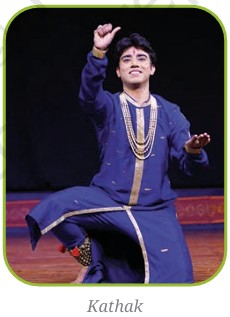
4.) Kathak
Kathak is a classical dance tradition of North India, particularly associated with Uttar Pradesh and Rajasthan. The word Kathak is derived from kathā, meaning story, reflecting its tradition of storytelling through dance.
Kathak is known for intricate footwork, graceful movements, rhythmic patterns, expressive gestures, and swift spins called chakkars. Dancers coordinate their movements with music and percussion to create complex rhythmic compositions. Facial expressions and hand gestures are also used to communicate emotions and stories.
Kathak has developed through several gharanas, including Lucknow, Jaipur, Banaras, and Raigarh. Its elegant costumes, rhythmic movements, and expressive storytelling make Kathak an important part of India’s rich classical dance heritage.
Activity 12.2: The Language Of Silence
Silence can communicate powerful thoughts, feelings, and emotions without the use of spoken words. In dance, a pause, a still posture, a movement of the eyes, or a simple gesture can convey a message to the audience. A dancer can express joy, sadness, fear, love, anger, surprise, or peace through the body and face, even when no words are spoken.
The eyes, facial expressions, hand gestures, posture, breath, and body movements work together to create this silent language. A moment of stillness can be as meaningful as an energetic movement. The meaning of a gesture or posture also depends on the context, character, music, and emotions being presented.
Indian dance traditions make extensive use of this expressive language through abhinaya. Dancers communicate stories and ideas by combining gestures, expressions, movements, and rhythm.
Thus, dance teaches us that communication does not always require words. Sometimes, silence and movement can speak more powerfully than language.
(a) In Storytelling
(b) In Communication
Expressing emotions through Dance
Dance is a powerful way of expressing emotions, thoughts, and feelings without depending only on spoken words. A dancer uses facial expressions, eyes, hand gestures, body movements, posture, rhythm, and breath to communicate different emotions to the audience.
In Indian dance traditions, the concept of rasa plays an important role in expressing and experiencing emotions. Dancers use abhinaya, or expressive representation, to bring emotions and stories to life. A gentle movement and soft expression may suggest love or peace, while strong movements and intense expressions may communicate anger, courage, or excitement.
The same movement can convey different meanings depending on the context, character, music, and quality of movement. A dancer therefore needs awareness and control to make emotions clear and believable.
By exploring emotions through dance, students can develop empathy, confidence, creativity, body awareness, and expressive skills. Dance allows us to understand our own feelings while also experiencing the emotions of characters and stories.
Thus, dance becomes a bridge between the body, mind, emotion, and imagination, allowing feelings to be transformed into meaningful artistic expression.
Activity 12.4: Dance Of Motivation (Utsāha Bhāva)
Utsāha Bhāva represents enthusiasm, motivation, energy, confidence, and courage. It is the feeling that inspires a person to take action, overcome challenges, and move forward with determination. In dance, Utsāha can be expressed through strong body movements, energetic steps, confident postures, expressive eyes, and a lively rhythm.
A dancer may use upright posture, powerful gestures, purposeful movements, and changes in speed to communicate a sense of enthusiasm and determination. The facial expression should show confidence, alertness, and positive energy.
Think of a situation in which you felt motivated to achieve something difficult. How did your body respond? Did you feel energetic, confident, or excited? Try expressing this feeling through a short dance sequence using Utsāha Bhāva.
Choose a patriotic song and choreograph a short dance based on its theme and emotions. As you create the choreography, think about how the body and breath respond to different feelings.
For example, when you are scared, your breathing may become rapid and shallow. This change in breathing can affect the body and may be accompanied by trembling, perspiration, changes in facial expression, and a sense of tension. Breath therefore plays an important role in making emotions visible and expressive.
As you choreograph the dance, experiment with changes in breath, movement, posture, rhythm, and facial expressions to communicate feelings of patriotism, courage, pride, hope, or determination. Notice how changes in breathing can influence the quality and intensity of your movements.
Present your choreography to the class and discuss how breath and movement work together to express emotions through dance.
That is the beauty of the arts; while interconnected, each form has its own distinct language and mode of expression.
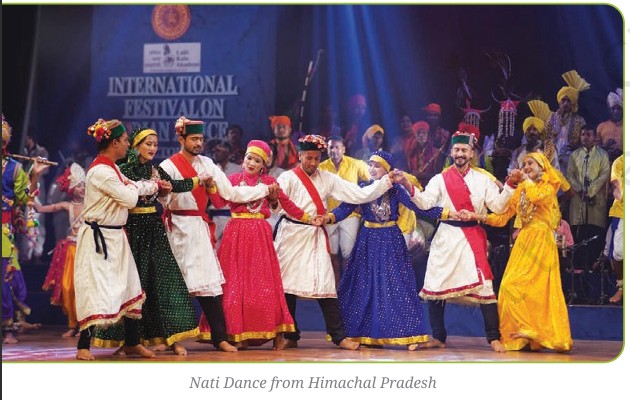
1.) Nati Dance from Himachal Pradesh
Nati is a popular traditional folk dance of Himachal Pradesh, especially associated with the hill communities of the state. It is commonly performed during festivals, fairs, weddings, and community celebrations. The dance brings people together in groups, creating a strong sense of community, joy, and togetherness.
Nati is generally performed in lines, semicircles, or other coordinated formations. Dancers move together through rhythmic steps, gentle turns, coordinated arm movements, and changes in formation. The movements are often simple but require rhythm, coordination, and group awareness.
Traditional Nati performances are accompanied by local folk music and instruments, creating a lively atmosphere. Dancers traditionally wear colourful Himachali clothing and ornaments, adding to the visual beauty of the performance.
Different regions of Himachal Pradesh have developed their own variations of Nati, reflecting local customs and traditions. The dance is therefore an important expression of the state’s cultural identity, community life, and festive spirit.
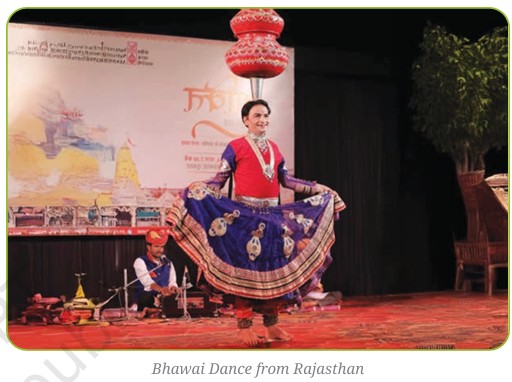
2.) Bhawai Dance from Rajasthan
Bhawai is a traditional folk dance of Rajasthan, known for its remarkable balance, skill, and graceful movements. It is traditionally associated with the Bhavai/Bhawai performance tradition of Rajasthan and is often performed during cultural events, festivals, and celebrations.
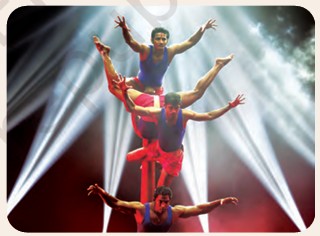
A distinctive feature of the dance is the dancer’s ability to balance several earthen pots or brass vessels on the head while performing controlled movements. The dancer may turn, bend, or move across the performance space while maintaining balance. In some presentations, performers may also demonstrate their skill by dancing on unusual surfaces or objects.
The dance is accompanied by Rajasthani folk music and rhythmic instruments, which provide energy and support the dancer’s movements. Traditional costumes, colourful fabrics, jewellery, and ornaments add to the visual appeal of the performance.
Bhawai demonstrates the importance of balance, concentration, coordination, flexibility, and body control. It reflects the creativity and skill of Rajasthan’s folk performers and remains a striking part of the state’s rich folk-dance heritage.
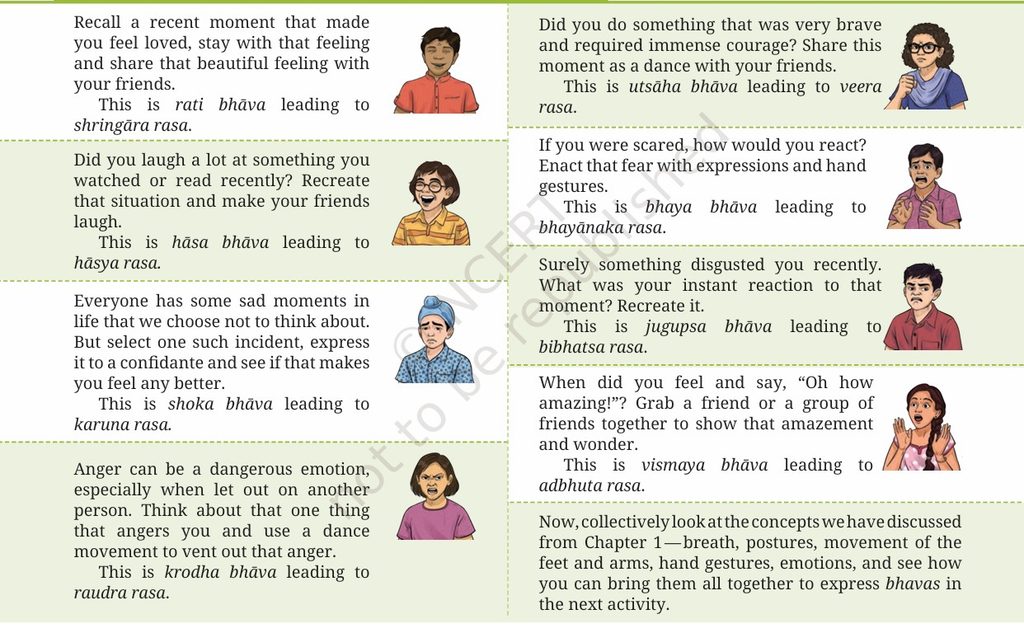
Activity 12.5: Dance To Express The Eight Emotions
Dance is a powerful way to communicate emotions and feelings without words. In this activity, explore eight emotions—love, humour, sorrow, anger, courage, fear, disgust, and wonder—through movement. Use facial expressions, eye movements, hand gestures, posture, rhythm, breath, and body movements to express each emotion clearly.
Notice how the quality of movement changes with different feelings. Gentle movements may express love, while strong and energetic movements may communicate courage or anger. Rapid movements and changes in breath can suggest fear, while graceful movements may express wonder.
By practising these emotions, you will learn how dance transforms inner feelings into meaningful artistic expression and how audiences can understand emotions through movement.
Activity 12.6: Dance From The Heart
Dance is not only about learning steps and movements; it is also about feeling and expressing emotions. When dancers perform with genuine feeling, their movements become more natural, meaningful, and expressive. The body, mind, breath, and emotions work together to communicate what words may not always express.
A dancer can use facial expressions, eyes, gestures, posture, rhythm, and movement to share feelings with the audience. Happiness may bring light and energetic movements, while sorrow may be expressed through slower and softer actions. Courage, anger, fear, love, and wonder can each create a different quality of movement.
To dance from the heart means to connect with the emotion before expressing it through the body. When the dancer truly experiences the feeling, the audience can often experience it too.
Dance therefore becomes a bridge between inner emotion and outward expression, allowing feelings to come alive through movement.
From Emotion to Peace
After both groups have completed their performances, the teacher should play soft, meditative music and invite all students to relax and sit comfortably. Hold the chin mudra with the hands and breathe slowly, focusing on a feeling of peace, calmness, and contentment. This is nirveda bhāva, leading to śānta rasa.
Now reflect on your experience. How did you feel while participating in this activity? Did expressing different emotions through dance change the way you felt? Could you use a similar process of breathing, movement, and expression when something upsets or disturbs you?
Next, think about your experience as an audience member. How did you feel while watching your classmates perform? Were you able to recognise the emotions they expressed? Could you connect with the feelings being communicated through their movements, gestures, expressions, and body language?
Discuss your observations with your classmates and explore how dance can help us understand, express, experience, and transform emotions.
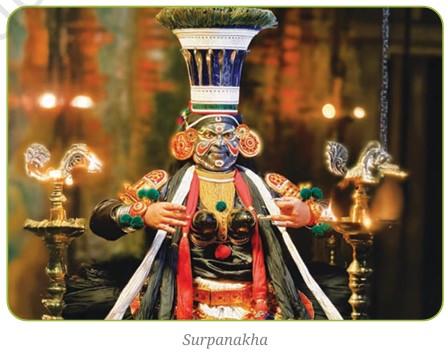
Surpanakha
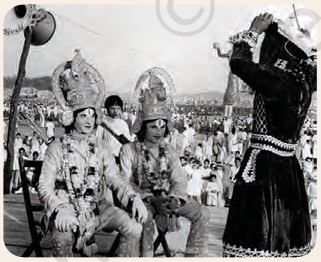
Surpanakha is a prominent female character in the Ramayana. She is traditionally described as the sister of Ravana and a member of the royal family of Lanka. Her encounter with Rama, Sita, and Lakshmana in the forest becomes an important episode in the Ramayana narrative.
Surpanakha is often portrayed as a strong, determined, and emotionally expressive character. Her story involves feelings such as desire, anger, humiliation, and revenge, making her an interesting character for dramatic interpretation through dance and theatre.
In dance, Surpanakha can be portrayed through facial expressions, eye movements, hand gestures, body posture, and changes in movement quality. Her emotions may shift from curiosity and attraction to anger and distress, allowing the performer to explore different bhāvas.
The character of Surpanakha demonstrates how dance and theatre can bring a literary character to life through movement, expression, emotion, and storytelling.
Dance For Healing And Well-Being
Dance can contribute to both physical and emotional well-being. Regular dance practice involves movements that develop body awareness, coordination, flexibility, balance, and control. For example, head and neck movements practised in dance can help maintain mobility and reduce stiffness when performed correctly. Similarly, eye movements used in certain dance exercises encourage eye coordination and awareness.
These movements are often included as part of the daily practice routines of dancers. However, they should be performed with proper technique and guidance, especially when used for managing a health condition.
Dance can also support emotional well-being. Dance Movement Therapy uses movement as a means of supporting emotional expression, self-awareness, communication, and overall well-being. Professionals such as dance movement therapists, psychologists, and physiotherapists may use movement-based approaches in appropriate settings.
Thus, dance is not only an art form but can also be a meaningful way to support physical health, emotional expression, and wellness.
Poothana Moksham From Kathakali
Poothana Moksham is a well-known episode from the Krishna stories presented in the Kathakali tradition of Kerala. It narrates the story of Poothana, a demoness who is sent by Kamsa to kill the infant Krishna.
Poothana disguises herself as a beautiful woman and visits Krishna with the intention of feeding him poisoned milk. However, Krishna, recognising her true nature, drinks the milk and also draws out her life force. Poothana dies, and the episode is known as Poothana Moksham, meaning the liberation or salvation of Poothana.
In Kathakali, this story is presented through a combination of dance, acting, facial expressions, eye movements, hand gestures, music, and percussion. The performer portraying Poothana uses changes in expression and movement to show her transformation from an attractive woman into a terrifying demoness. Krishna’s character is portrayed through expressive gestures and controlled movements.
The episode demonstrates how Kathakali uses abhinaya, movement, costume, makeup, music, and dramatic expression to bring mythological stories to life. It also shows how a complex story can be communicated through the body and face without relying only on spoken dialogue.
Activity 12.7: Dance Choreography
Dance choreography is the process of planning, creating, and arranging movements into a meaningful dance composition. A choreographer selects and organises steps, postures, gestures, expressions, formations, rhythm, music, space, and transitions to create a complete performance.
Choreography begins with an idea, theme, story, emotion, or concept. The choreographer decides how this idea can be communicated through movement. Movements are then arranged according to the music, rhythm, mood, characters, and purpose of the performance.
A choreographer also considers the use of space and time. Dancers may move in lines, circles, diagonals, or other formations, while changes in speed, level, direction, and energy can create variety and visual interest. Transitions between movements are carefully planned so that the performance flows smoothly.
In dance traditions that use storytelling, facial expressions, hand gestures, body movements, and characterisation are also important parts of choreography. The choreographer may work with dancers to develop movements that suit their abilities and the requirements of the performance.
Dance choreography therefore combines creativity, planning, movement, music, rhythm, space, and expression. It transforms individual movements into an organised and expressive dance performance.
Conclusion
Dance is much more than a form of entertainment or artistic performance. It is a holistic activity that brings together the body, mind, emotions, creativity, and social interaction. Through regular dance practice, we can become more aware of our bodies and develop strength, flexibility, balance, coordination, stamina, posture, and control. Different movements and dance exercises encourage us to use various parts of the body and improve our ability to move with confidence and awareness.
Dance can also have a positive influence on our mental and emotional well-being. Moving with rhythm and music provides an opportunity to express feelings that may sometimes be difficult to communicate through words. Happiness, excitement, love, courage, sadness, and even tension can be transformed into meaningful movement. This creative expression can help us become more aware of our emotions and develop greater self-confidence, concentration, and emotional awareness.
Dance also encourages social well-being. Group dance activities teach us to listen, cooperate, coordinate our movements, respect others, and work towards a common goal. Performing together can create a sense of belonging, friendship, confidence, and community. At the same time, learning different dance traditions helps us appreciate the diverse cultures, stories, music, and artistic practices of India.
Dance can also be connected with wellness and therapeutic practices. Movement-based approaches, including Dance Movement Therapy, may be used by trained professionals to support emotional expression, communication, self-awareness, and well-being. Appropriate movement practices can also complement physical rehabilitation under professional guidance.
Thus, dance offers many ways to nurture a healthy body, positive mind, balanced emotions, and meaningful social connections. By making movement a joyful part of our lives, we can experience the lasting benefits of dance and move towards a healthier, happier, more confident, and balanced way of living.