
Introduction
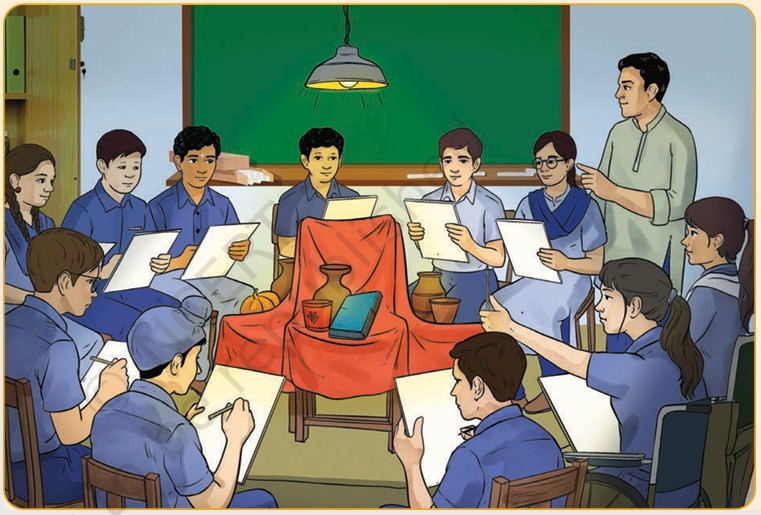
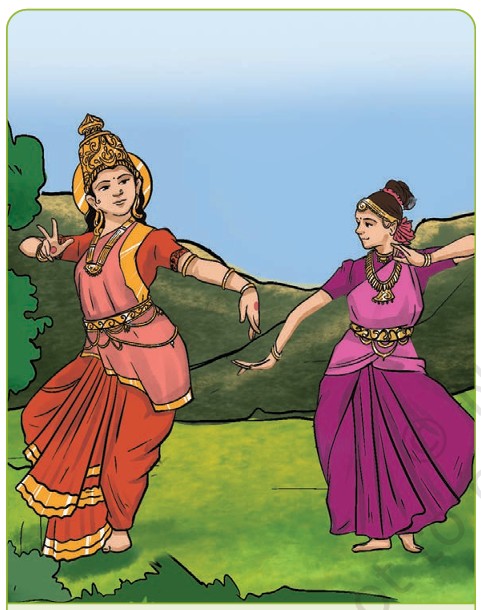
Visual art and design are important forms of creative expression that allow us to communicate ideas, emotions, experiences, and observations through images, objects, and compositions. From paintings and drawings to sculptures, crafts, textiles, and digital designs, artists use visual elements and principles to create meaningful and attractive artworks. Understanding these concepts helps us appreciate how different parts of an artwork work together to communicate a message.
The elements of visual art and design are the basic building blocks used to create an artwork. They commonly include point, line, shape, form, colour, value, texture, and space. Each element has a specific purpose. Lines can outline objects or suggest movement, shapes create patterns and structures, and colours can express moods and attract attention. Form gives objects a three-dimensional appearance, value shows variations between light and dark, texture describes surface qualities, and space refers to the area around, between, or within objects.
The principles of design explain how artists organise these elements to create effective compositions. They include balance, contrast, rhythm, pattern, emphasis, proportion, and unity. Balance creates visual stability, contrast highlights differences, rhythm guides the viewer’s eye, and emphasis draws attention to important parts of an artwork. Proportion helps maintain relationships between different parts, while unity brings the composition together.
Learning these concepts is similar to understanding the ingredients and methods needed to prepare a recipe. Artists combine elements and apply design principles according to their ideas and purposes. By exploring and practising them, students can develop observation, imagination, problem-solving, and artistic skills. These concepts provide a foundation for creating expressive artworks and understanding the visual world around us.
The Ingredients Of Creativity
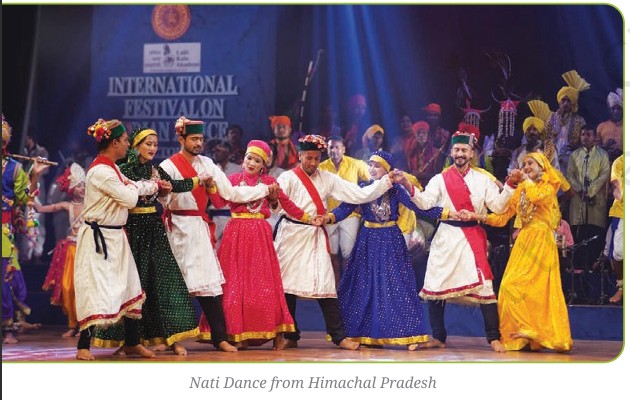
The elements of visual art and design are similar to the ingredients used in a recipe. For example, halwā is prepared by combining ingredients such as flour, sugar, ghee, and water in suitable proportions. Similarly, an artwork is created by combining different visual elements, including point, line, shape, form, colour, value, texture, and space.
Each element contributes to the appearance and meaning of the final artwork. Points and lines can create patterns and outlines, shapes and forms help represent objects, colours communicate moods, and value creates variations between light and dark.
Texture adds surface interest, while space helps organise objects within a composition. Artists combine these elements in different ways depending on their ideas, materials, and purposes. Understanding these basic elements helps us observe artworks carefully, appreciate their visual qualities, and develop our own creativity and artistic skills.
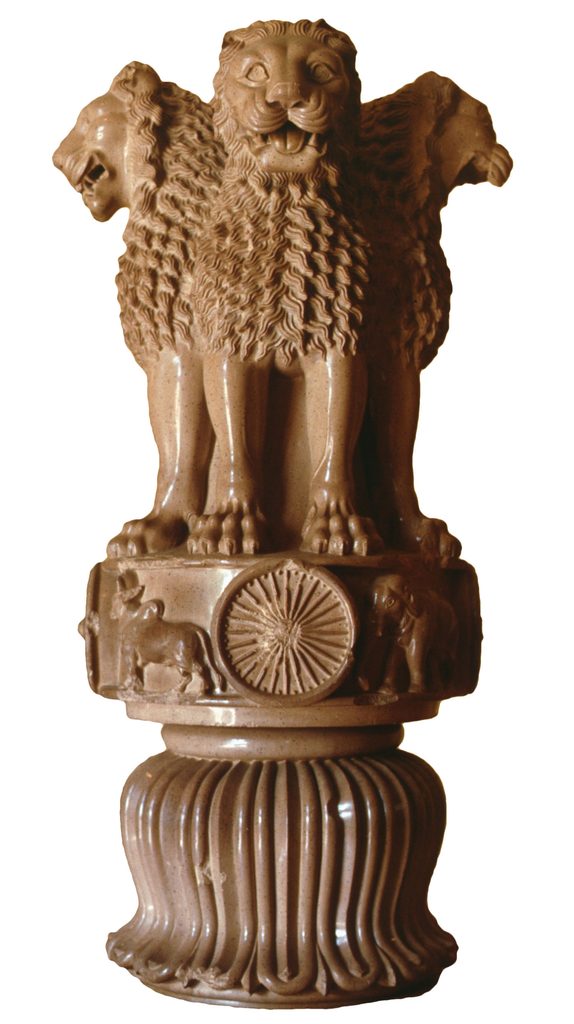
Lion Capital Of Ashoka: Mauryan Period, Circa 250 Bce
The Lion Capital is a famous example of ancient Indian sculpture from the Mauryan period, dating to around 250 BCE. It was originally placed atop an Ashokan pillar at Sarnath, Uttar Pradesh, where Gautama Buddha delivered his first sermon. Carved from polished sandstone, it features four lions standing back-to-back, symbolising power, courage, and authority.
Below the lions is an abacus decorated with figures of a bull, a horse, an elephant, and a lion, separated by wheels known as Dharmachakras. The capital demonstrates the remarkable craftsmanship and artistic skills of Mauryan sculptors. Its polished surface and balanced arrangement reflect the sophistication of the period’s stonework.
The Lion Capital was adopted as the National Emblem of India on 26 January 1950. The Ashoka Chakra from its base also appears at the centre of India’s national flag.
1. Point is a dot. It is the smallest element in any visual.
2. Line is the visible path that joins any two points. Lines can be horizontal, vertical, diagonal, dashed, wavy, zig-zagged and so on. They can also vary in thickness.
3. Shape and form A shape is a flat, two dimensional area enclosed by a line. It can be geometric or organic. A form is a three dimensional shape. It occupies space and has depth. Forms can also be created by arranging or joining many two-dimensional shapes. Notice the form of the lion in the image. what other forms do you see?
4. Texture can be visual and physical. It can be sensed by touching a surface that feels soft, rough, grainy, silky, prickly and so on. It can also be perceived visually through patterns of lines and dots.
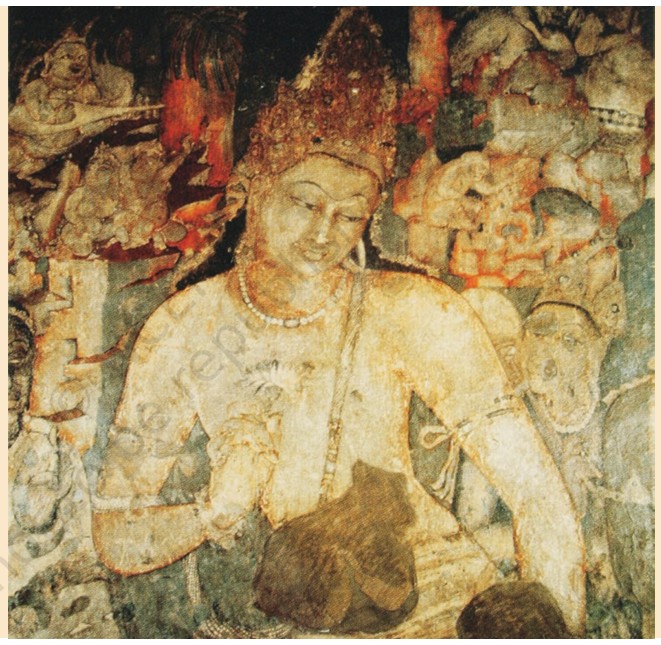
5. Colour is visible when light is reflected and perceived by our eyes. Colours are either extracted from nature or manufactured synthetically to make dyes and pigments. Notice the colours in the image, can you guess the natural materials used to create them?
6. Value or Tone is the lightness or darkness of a colour. Adding white to a colour makes it lighter (tints), whereas adding black to a colour makes it darker (shades). These create colour gradations. Observe the colour tonalities in the painting.
7. Space is where various elements are organised and composed to create an artwork. Space can be divided into positive and negative space. Identify the foreground and background in the painting.
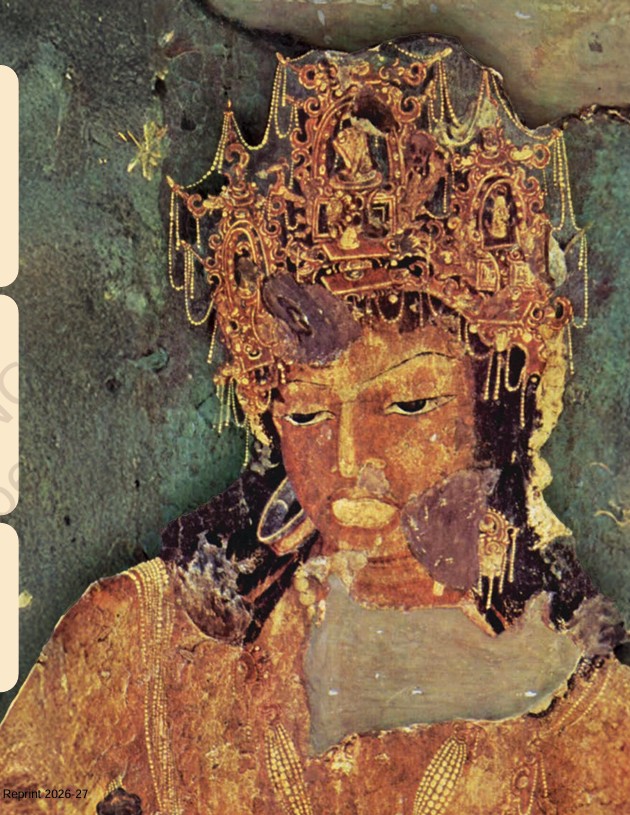
Bodhisattva Vajrapani,
Ajanta Mural in Cave 1
Activity 15.1: Identify The Visual Elements
Identifying the visual elements means observing an artwork carefully and recognising the basic components used to create it. These include point, line, shape, form, colour, value, texture, and space. By examining an artwork, we can identify how lines outline objects, shapes define areas, colours create visual interest, and textures suggest different surface qualities.
We can also observe light and dark areas, three-dimensional forms, and the space between objects. This activity develops observation skills and helps us understand how artists combine visual elements to create meaningful and expressive compositions.
Observing The Visual Elements Of Art And Design
The elements of art and design help us express our ideas, thoughts, and feelings through visual forms. These elements include point, line, shape, form, colour, value, texture, and space. They are present all around us—in nature, buildings, objects, paintings, sculptures, and everyday designs.
By carefully observing an artwork, we can identify how artists use these elements to create meaning and visual interest. For example, lines may outline objects or suggest movement, shapes define different areas, colours express moods, textures show surface qualities, and space helps arrange objects within a composition.
Activity: Examine the artworks on this page carefully. Identify the visual elements you can see and note down your observations. Think about how the artists have used these elements and how they contribute to the appearance and meaning of each artwork.
1.) lines and shapes
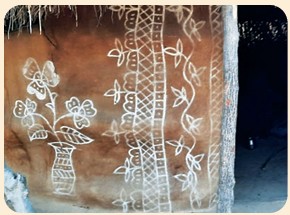
The maandana painted on the wall of the hut uses simple lines, geometric shapes, and repeated patterns to create a decorative design. Straight, curved, and zigzag lines may be arranged to form shapes such as triangles, circles, squares, and other patterns. These lines and shapes give the artwork rhythm and balance.
Other visual elements include colour, texture, and space. The contrast between the painted design and the wall makes the patterns stand out, while the wall’s surface adds texture. The arrangement of the motifs also creates a sense of unity and visual interest.
2.) Thanjavur style
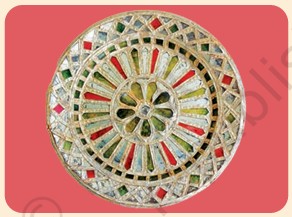
The plate crafted in the Thanjavur style may feature fine, curved, straight, and decorative lines arranged in intricate patterns. Its surface may have a smooth, polished texture with raised or embossed details that create a rich, three-dimensional appearance.
Another visual element associated with this object is form, as the plate has a rounded, three-dimensional shape. Colour and value may also add beauty through contrasting shades and highlights on its decorated surface.
3.) prominent visual elements
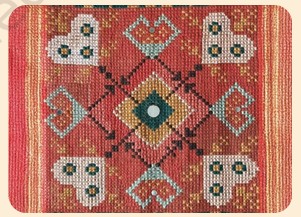
The prominent visual elements in this embroidered tapestry are line, colour, shape, texture, and pattern. Colourful threads create decorative designs, while straight and curved stitches form outlines and patterns. Different shapes represent flowers, leaves, figures, or other motifs. The raised stitches give the tapestry a textured surface, and the arrangement of the designs creates rhythm, balance, and visual interest.
Artists constantly experiment with the visual elements while creating artwork: –
i.) Mother and Child
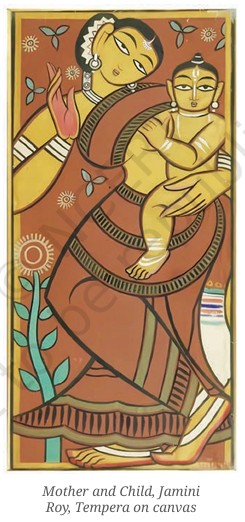
Title: Mother and Child
Artist: Jamini Roy (1887 – 1972)
Medium: Tempera on canvas
Inspirations: East Asian calligraphy, terracotta temple friezes, folk arts and crafts
Visual Elements in this Artwork:-
Mother and Child is an artwork by the renowned Indian artist Jamini Roy, who was inspired by traditional Indian folk art, especially the Kalighat painting style of Bengal. The painting portrays the loving bond between a mother and her child through simple forms and expressive features. The prominent visual elements include bold, curved lines, simplified shapes, earthy colours, and flat forms. Strong outlines define the figures, while the arrangement of shapes creates a balanced composition. The colours and distinctive style reflect the influence of Indian folk traditions. Through these visual elements, Jamini Roy expresses maternal love, tenderness, and the emotional connection between a mother and her child.
ii.) Spirit of Daily Work
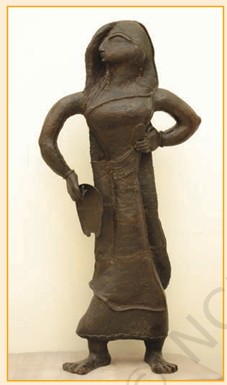
Title: Spirit of Daily Work
Artist: Meera Mukherjee
Medium: Bronze
Inspiration: Dhokra metal work
Visual Elements in this Artwork:-
Spirit of Daily Work is an artwork by the renowned Indian sculptor Meera Mukherjee, who drew inspiration from traditional Indian metal-casting techniques and the lives of ordinary working people. The bronze sculpture highlights the dignity, effort, and importance of everyday work. The prominent visual elements include line, form, shape, texture, and space. The arrangement of lines and shapes helps represent the figures and their activities, while the three-dimensional form gives the sculpture a sense of depth and realism. The bronze surface creates a distinctive texture, reflecting the artist’s craftsmanship. The positioning of the figures and the space around them contribute to the overall composition. Through these elements, Meera Mukherjee celebrates the skill, dedication, and spirit of people engaged in daily work.
iii.) Untitled
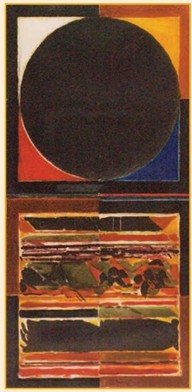
Untitled
Artist: Syed Haider Raza
Medium: Aquatint
Inspiration: Indian forest landscapes and the concept of Bindu (point or dot) from the Indian philosophy
Visual Elements in this artwork:-
Syed Haider Raza, popularly known as S. H. Raza, was a renowned Indian modern artist whose works were inspired by Indian landscapes, nature, and spiritual philosophy. His art explored the concept of Bindu, a point or dot symbolising the centre of creation, energy, and existence. Inspired by Indian forest landscapes, he used visual elements such as point, line, shape, colour, pattern, and space to create expressive compositions. Points and geometric shapes played an important role in his artistic language, while bold colours created contrast and visual interest. Lines and patterns helped organise the composition, and the arrangement of shapes created a sense of balance and harmony. Through these visual elements, Raza connected the beauty of nature with deeper ideas from Indian philosophy.
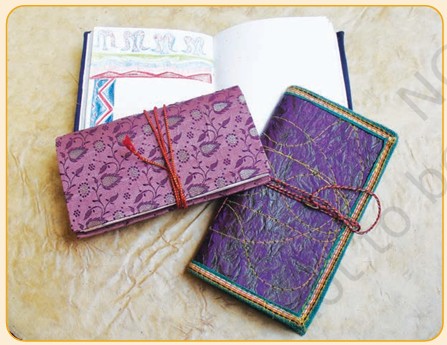
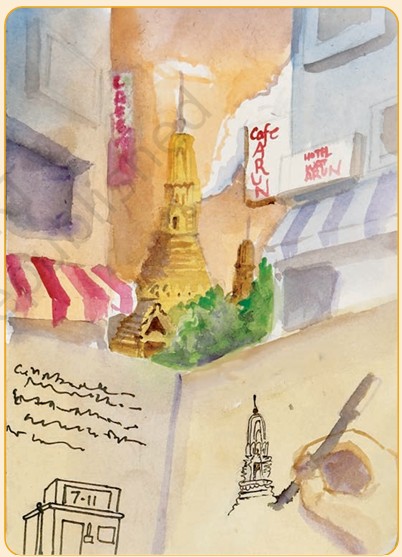
ACTIVITY 15.2: MAKE A JOURNAL OF VISUAL ELEMENTS
Objective: To observe and identify the visual elements found in everyday surroundings.
Materials Required: Sketchbook, pencil, eraser, and colours.
Procedure: For one week, observe the objects, plants, textiles, and architectural details around you. Draw these in your sketchbook and identify the visual elements you notice, such as point, line, shape, form, colour, value, texture, and space. For example, you may observe curved lines in leaves, geometric shapes in buildings, colourful patterns in textiles, and different textures on everyday objects. Add new drawings and notes to your journal every day.
Discussion: Share your journal with your friends and discuss your observations with your teacher. Compare the visual elements you identified and notice how they differ from one object to another.
Learning Outcome: This activity develops observation, drawing, and artistic skills. It helps you recognise how visual elements appear in everyday life and how artists use them to create meaningful artworks.
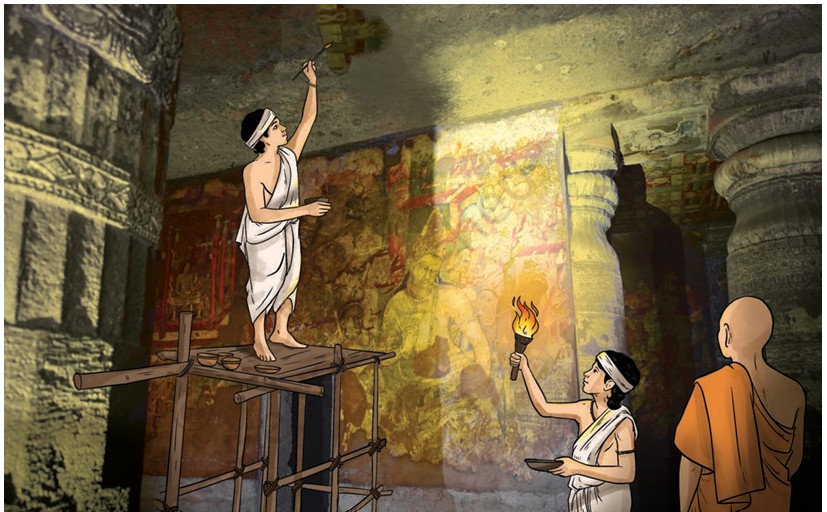
Shadanga: The Six Limbs Of Indian Art
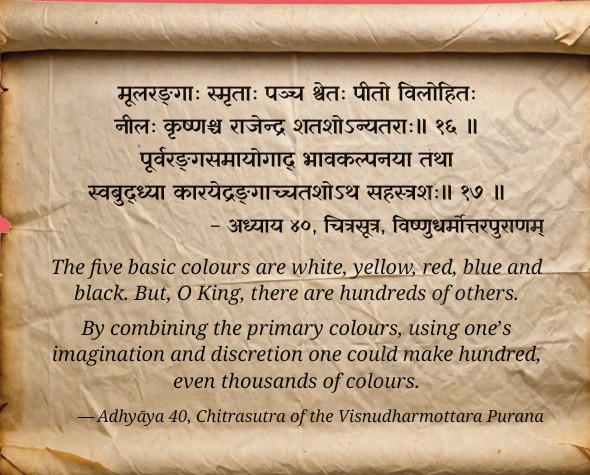
Shadanga refers to the six limbs or principles of Indian art. These principles are described in the ancient Indian text, the Vishnudharmottara Purana, which provides guidance on creating aesthetically pleasing and meaningful artworks.
Shadanga explains how artists can combine visual elements in suitable proportions to create a balanced and harmonious composition.
It is similar to preparing a delicious meal: the ingredients must be combined in the right proportions and cooked properly to achieve the desired taste. In the same way, artists use the principles of Shadanga to bring together different elements of art and create expressive and beautiful paintings.
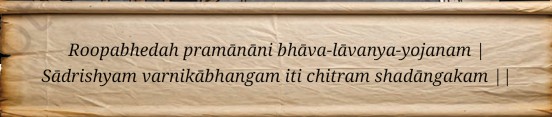
1. Roopabhedah — Difference between forms
2. Pramānāni — Measurement and structure
3. Bhāva — Expression and emotion
4. Lāvanya Yojanam — Aesthetic composition and grace in art
5. Sādrishyam — Similitude and resemblance
6. Varnikabhangam — Use of tools and colours
Principles Of Visual Art And Design
Well-composed artworks communicate ideas, feelings, and messages effectively because artists organise visual elements according to the principles of art and design. These principles include balance, contrast, emphasis, rhythm, pattern, proportion, and unity. Each principle helps artists arrange lines, shapes, colours, forms, and textures in a meaningful way.
Balance creates visual stability, while contrast highlights differences between colours, shapes, or textures. Emphasis draws attention to the most important part of an artwork. Rhythm guides the viewer’s eyes through repeated visual elements, and pattern is created by repeating lines, shapes, or motifs. Proportion refers to the size relationship between different parts of an artwork, while unity brings all the elements together to create a complete composition.
Look carefully at the painting on this page and identify how the artist has used these principles. Observe the arrangement of objects, the use of colours, the repetition of shapes, and the relationships between different parts. Connect each principle with the features you notice in the painting.
1. Unity and Harmony are created by bringing elements together in a way that is pleasing to the eye. Observe the combination and distribution of colours used in the painting.
2. Balance gives visual stability. For example, if one half of an artwork has a large image, it can be balanced in the other half. Symmetrically, either by a similar and large image or asymmetrically, by many small images. Observe the visual balance in the Tribhanga posture of the mother, and the position of the child.
3. Rhythm and Movement guide our eyes from one part to another in an appealing manner. They are created through pattern and repetition. Observe the plant stem next to the mother and other lines on her clothes.
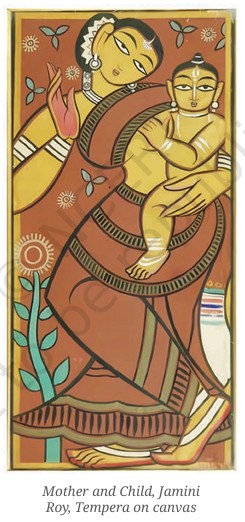
4. Emphasis is created by making any one of the visual element stand out. Observe the coloured palm of the mother’s hand, holding the flower.
5. Proportion is the relationship between the sizes of different visual elements. It contributes to the beauty, while also expressing the ideas and emotions. Observe the size of the baby in relation to the mother in this painting.
6. Hierarchy is the order of importance in a visual. Observe that the mother is given maximum space in the painting. After that, focus on the child, followed by other details of the surroundings.
Activity 15.3: Identify The Principles Of Visual Art And Design
The principles of visual art and design help artists organise visual elements to create attractive, balanced, and meaningful compositions. These principles include balance, contrast, emphasis, rhythm, pattern, proportion, and unity. Each principle contributes to the way an artwork looks and communicates its ideas and emotions.
Activity: Carefully examine the given images and analyse how the artists have used the principles of art and design. For each artwork, identify two principles and explain how they are visible in the composition. For example, you may observe balance in the arrangement of figures, contrast between colours, emphasis on a central subject, or rhythm created by repeating lines and shapes.
Write your observations in a few sentences for each artwork. Remember that you and your classmates may notice different principles or interpret the same artwork differently. All observations can be valid when they are supported by details from the artwork.
1. Ganga Sculpture, 5th Century Terracotta sculpture
Example: Rhythm and movement — created by the position of the legs and the patterns on the cloth, resembling water.
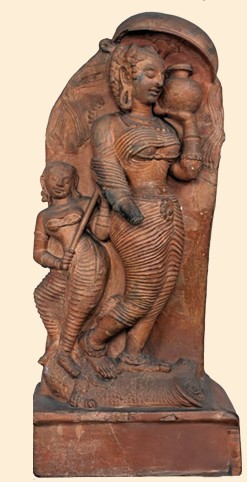
The Ganga Sculpture is an example of ancient Indian art from the 5th century CE. It represents the river goddess Ganga and reflects the graceful style and skilled craftsmanship of the period. The prominent principles of visual art and design in this sculpture are balance and proportion. Balance can be observed in the upright arrangement of the figure and the placement of its decorative details, which create visual stability. Proportion is visible in the relationship between the goddess’s body, ornaments, clothing, and other features, contributing to a harmonious appearance. The sculpture also displays visual elements such as form, line, shape, and texture. Its three-dimensional form and detailed surface show the artistic skill of terracotta sculptors in ancient India.
2. ‘Devi’ by Jyoti Bhatt, Etching
Example: Emphasis is created by the red bindi on the forehead.
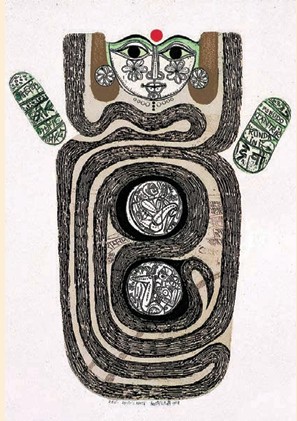
Devi is an artwork by the renowned Indian artist Jyoti Bhatt, who drew inspiration from Indian folk art, traditional motifs, and cultural practices. The artwork reflects the influence of Indian artistic traditions and presents the subject through a distinctive visual style. The principles of visual art and design that may be observed include emphasis and pattern. Emphasis draws the viewer’s attention to the central figure or important details, while pattern can be seen in the repetition of lines, shapes, or decorative motifs. The artwork may also use colour, shape, line, and texture to create visual interest and express cultural meaning. Together, these elements and principles help communicate the artist’s ideas and connect the artwork with India’s rich artistic heritage.
ACTIVITY 15.4: APPLY THE PRINCIPLES OF ART AND DESIGN
The principles of art and design help artists organise visual elements to create effective and meaningful artworks. These principles include balance, contrast, emphasis, rhythm, pattern, proportion, and unity. We can apply them by observing how lines, shapes, colours, forms, and textures are arranged in a composition. For example, balance creates visual stability, contrast highlights differences, emphasis draws attention to important details, and rhythm guides the viewer’s eyes through repeated elements. Pattern adds interest through repetition, proportion shows the relationship between different parts, and unity brings the entire artwork together. By understanding and applying these principles, we can improve our observation skills, develop our creativity, and create artworks that communicate ideas and emotions effectively.
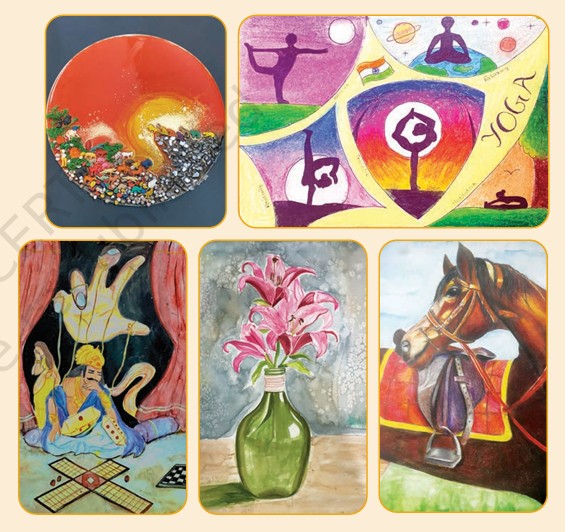
Create a simple symbol or motif that represents your personality, interests, or identity. Take inspiration from nature, everyday objects, letters, or your imagination. Use basic visual elements such as points, lines, shapes, and colours to develop your design. Apply principles such as balance, pattern, and unity to make your symbol attractive and meaningful. Keep your design simple, creative, and easy to recognise.
Make Multiple Iterations
Create several versions of your symbol or motif by changing the visual principles used in your design. Experiment with different arrangements to see how each change affects the overall appearance.
- Balance: Use symmetry or asymmetry to create visual balance.
- Pattern and Movement: Repeat lines, shapes, or other elements to create patterns or a sense of movement.
- Proportion: Observe the size of each part in relation to the whole motif.
- Emphasis: Highlight one part of the design to make it stand out.
- Hierarchy: Change the size, thickness, colour, or tone of different elements according to their importance.
- Harmony: Bring all the elements together so that they work well as a unified design.
Compare your versions and observe how these changes influence the appearance and meaning of your motif. Choose the design that best expresses your idea.
Conclusion
The elements and principles of visual art and design form the foundation of artistic expression. Elements such as points, lines, shapes, forms, colours, textures, values, and space provide the basic tools artists use to create images, patterns, and compositions. The principles of balance, contrast, emphasis, rhythm, pattern, proportion, and harmony help artists arrange these elements in meaningful and visually pleasing ways.
Understanding these concepts helps us look at artworks more carefully and recognise how artists communicate their thoughts, emotions, experiences, and cultural traditions through visual forms. We also learn that even simple lines, shapes, and colours can convey powerful ideas when arranged thoughtfully. By observing artworks, experimenting with different designs, and creating our own compositions, we can develop imagination, creativity, patience, and problem-solving skills.
The elements and principles are not limited to paintings and sculptures; they can also be found in nature, architecture, textiles, crafts, symbols, and everyday objects. Learning to identify and apply them allows us to appreciate the beauty and meaning of the world around us. Most importantly, these concepts encourage us to explore new ideas, make creative choices, and express our individuality through art and design.