
Introduction
Still life is an important genre of visual art that focuses on the representation of inanimate objects, such as fruits, flowers, vegetables, pottery, books, utensils, and other everyday items. Artists arrange these objects carefully and observe their shapes, sizes, colours, textures, and positions to create an interesting composition. Still-life painting helps us understand how ordinary objects can become subjects of artistic expression through careful observation and the creative use of visual elements.
Colour plays a significant role in still-life art. It helps artists represent the natural appearance of objects, distinguish different surfaces, and create a sense of depth and dimension. By observing how light falls on an object, artists can use highlights, shadows, and different colour tones to show its form and texture. Warm and cool colours can also be used to create contrast, establish a particular mood, and make the composition more expressive. Choosing suitable colour combinations helps bring unity and balance to the artwork.
Creating a still-life painting involves more than simply colouring the objects. Artists must consider the arrangement of objects, the relationship between foreground and background, the direction of light, and the proportion of each object. They may use different painting materials, such as watercolours, poster colours, or coloured pencils, to explore various effects and techniques.
Studying still life in colour encourages learners to look closely at their surroundings and appreciate the beauty of everyday things. It develops observation, concentration, patience, and creativity while strengthening an understanding of the elements and principles of visual art and design. Through practice and experimentation, learners can develop their artistic skills and express their ideas effectively through colour, form, and composition.
From Symbolic Objects To Artistic Subjects
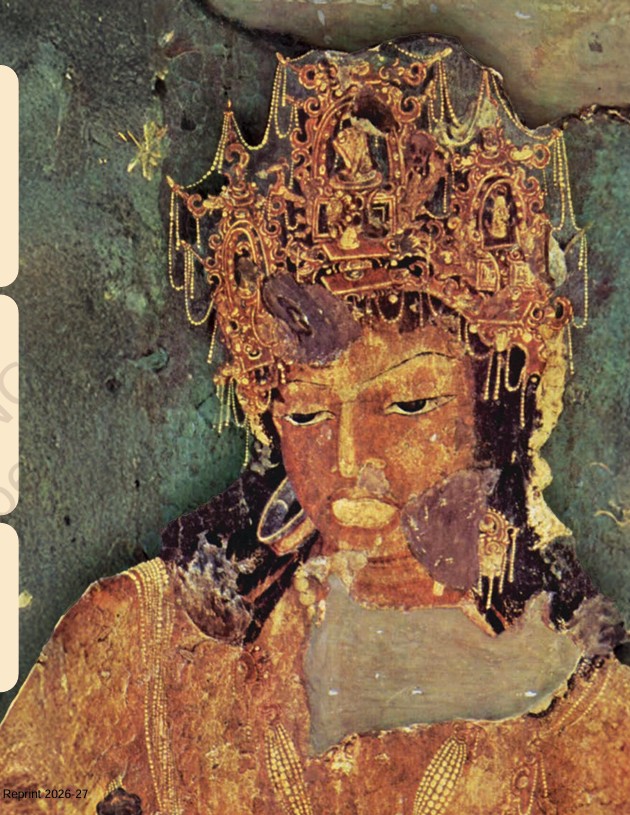
From cave paintings to temple sculptures, objects have been an important part of artworks, but they were rarely the main subject. In Indian art, objects were often included to convey symbolic meanings and contribute to the overall composition. For example, the Dharma Chakra (Wheel of Dharma) represents the teachings of dharma, while weapons and musical instruments held by deities and courtiers communicate their roles, qualities, or status.
Around the 16th century, a significant development took place in art, particularly in Europe, as artists increasingly began to focus on objects themselves. They became interested in arranging and carefully observing a variety of natural and human-made objects that remained still. The aim was to represent these objects with such skill that they appeared three-dimensional and almost lifelike. This type of artwork came to be known as still life.
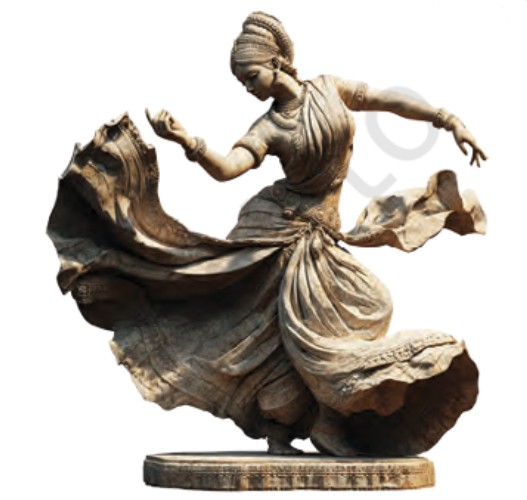
Still life is not limited to drawing and painting. Artists also create still-life compositions through photography and sculpture. These artworks help us observe the shapes, colours, textures, forms, light, and shadows of everyday objects.
Today, still-life compositions are also widely used in product advertising. Images of food, flowers, household items, and other products appear in magazines, newspapers, on television, and on billboards. Such compositions help present products attractively and communicate visual messages to viewers.
Still life therefore connects careful observation with artistic skill, creativity, and visual communication, transforming ordinary objects into meaningful works of art.
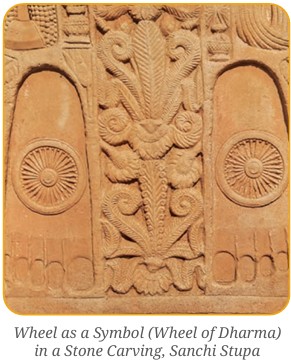
1.) Wheel as a Symbol (Wheel of Dharma) in a Stone Carving, Sanchi Stupa
The Wheel of Dharma, also known as the Dharma Chakra, is an important symbol in Buddhist art. It represents the teachings of the Buddha and the path towards wisdom, ethical conduct, and liberation from suffering. In the stone carvings of the Sanchi Stupa in Madhya Pradesh, the wheel appears as a significant religious symbol, reflecting the importance of Buddhist philosophy in ancient Indian art.
Its circular shape represents continuity and the spread of the Buddha’s teachings.
The spokes of the wheel are arranged around a central point, creating a sense of balance, order, and harmony. This example shows how an object can communicate a deeper spiritual meaning rather than simply serve as a decorative element.
The Dharma Chakra also demonstrates how lines, shapes, patterns, and symmetry can be used to create a meaningful visual composition. Through such symbols, artists expressed religious ideas and cultural beliefs in a form that people could recognise and understand.
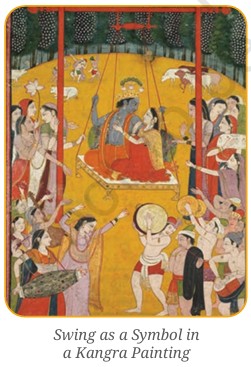
2.) Swing as a Symbol in a Kangra Painting
In Kangra miniature paintings, the swing is often depicted in scenes of love, nature, and the life of Lord Krishna and Radha. It may symbolise joy, romance, playfulness, and the beauty of togetherness. Swings are frequently shown hanging from flowering trees in lush gardens, creating a peaceful and charming setting. The swing also connects the figures with nature and reflects the seasonal celebrations associated with spring and the monsoon.
From the perspective of visual art and design, the swing adds lines, shapes, rhythm, and balance to the composition. Its ropes create vertical lines, while the seat forms a horizontal element. The surrounding trees, flowers, and figures add colour, pattern, and detail. The careful arrangement of these elements creates harmony and guides the viewer’s attention towards the main figures. Through the swing, Kangra artists transform an everyday object into a meaningful part of the painting, expressing emotions, relationships, and the beauty of the natural world.
Activity 16.1 – Arranging a Still Life
Arranging a still life is an important step in creating an interesting and balanced artwork. It involves selecting and placing objects carefully before drawing, painting, or photographing them. Artists may choose everyday objects such as fruits, flowers, bottles, bowls, books, utensils, or toys. The objects are arranged to create a pleasing composition and to show their different shapes, sizes, colours, and textures.
While arranging a still life, artists consider the position of each object, the space between objects, and the relationship between the objects and their background. Placing some objects in front of others can create a sense of depth, while using objects of different heights and sizes can make the composition more engaging. Light is also important because it creates highlights and shadows that help reveal the form and texture of each object.
Artists may use principles of visual art and design, such as balance, proportion, contrast, emphasis, and harmony, to improve their arrangements. A simple arrangement can be effective when the objects are positioned thoughtfully and the main subject is clearly visible.
By observing and arranging everyday objects, learners can develop their observation skills, creativity, and understanding of composition. This activity also helps them recognise the artistic possibilities of ordinary things and prepares them to represent objects more accurately through drawing, painting, or photography.
Step 1: Choosing objects for a still life
Objects should be selected from everyday life or culture.
Choosing objects for a still life means selecting suitable natural or human-made objects, such as fruits, flowers, utensils, books, bottles, or toys, to create an interesting artistic composition. The objects should have different shapes, sizes, colours, and textures so that the artist can explore their appearance and relationships. Careful selection and arrangement help create visual balance, depth, harmony, and emphasis in a still-life artwork.
Examples:
- Nature-themed still life: Flowers, leaves, stones, and a small branch.
- Kitchen still life: A teapot, cups, plates, and spoons.
- Study-table still life: Books, pencils, an eraser, and a notebook.
- Traditional still life: An earthen pot, a brass lamp, and a piece of fabric.
- Colourful still life: Fruits, vegetables, and containers of different colours.
Step 2: Choosing the Backdrop
Select one or two large pieces of plain, single-coloured cloth to create a backdrop for your still-life arrangement. Choose a colour that complements the objects without distracting the viewer’s attention. A simple backdrop helps the objects stand out clearly and makes their colours, shapes, and textures easier to observe. If cloth is not available, you can use plain paper, cardboard, or another suitable material.
Example: If your still-life arrangement includes red apples, yellow bananas, and a brown earthen pot, you could use a light blue or cream-coloured cloth as the backdrop. These colours would complement the objects and help them stand out. Avoid a heavily patterned or brightly decorated background, as it may distract attention from the main objects.
A FEW OF MY FAVOURITE THINGS
Step 3: Arranging the Objects
- Drape the Cloth: Arrange the backdrop cloth with a few natural folds to add depth and texture to the composition.
- Place the Objects Together: Position the objects so that they overlap slightly when viewed from the chosen angle. Arrange them as a single, connected composition rather than as separate items.
- Experiment with Placement: Try different arrangements before choosing the final one. Objects can be placed upright, on their sides, leaning against one another, or raised on a small platform to create variety and visual interest.
- Observe Light and Shadow: Place the objects where light falls on them from one side. This creates highlights, shadows, and different tones that help reveal their shapes and forms. You can adjust the light by partly opening or closing doors and windows, or by using curtains, sheets, or screens to filter it. Never look directly at the Sun or use unsafe lighting arrangements.
Example: Arrange a red apple, a yellow banana, and a small earthen pot on a table covered with a cream-coloured cloth.
Allow a few folds in the cloth to fall naturally behind the objects.
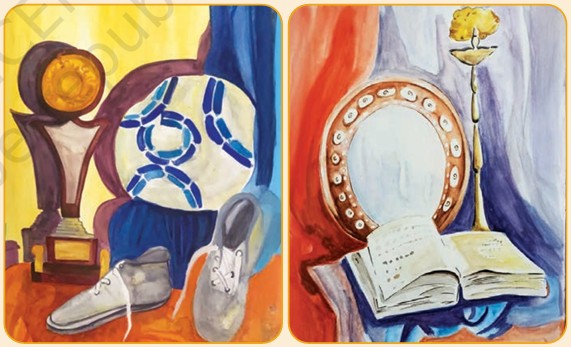
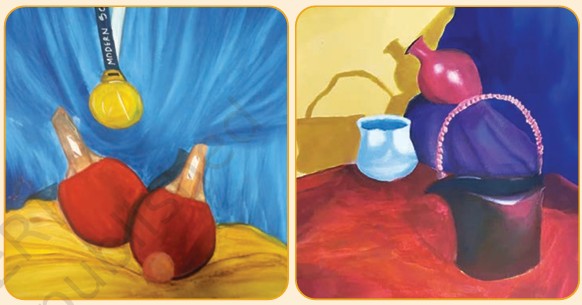
Identify the Direction of Light
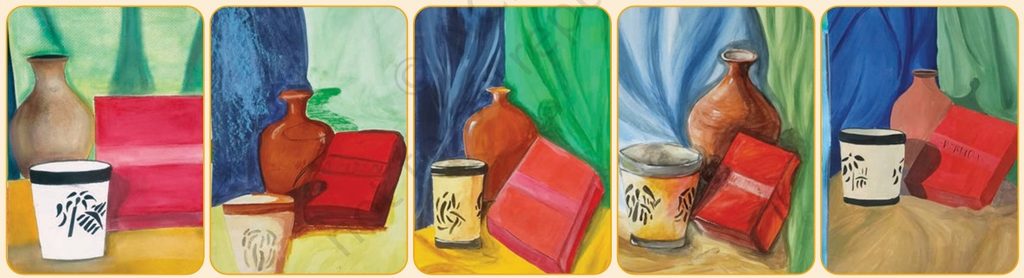
Observe each artwork carefully and identify the side from which the light is falling. Look for the brightest areas, highlights, and shadows on the objects. The side with stronger highlights usually faces the light source, while the opposite side generally has darker tones and shadows.
Do you know?
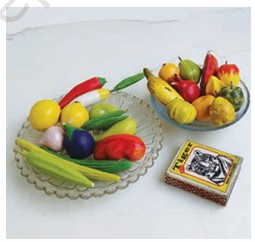
Hand-Painted Clay Objects in India
The tradition of making hand-painted clay objects is found in many parts of India. Skilled artisans create clay objects in different shapes, sizes, and colours, including fruits, vegetables, flowers, animals, and decorative items. These objects are carefully shaped, dried, and painted with fine details to make them look realistic.
Artists use colours, patterns, and textures to imitate the natural appearance of the objects. Such clay creations reflect India’s rich pottery and handicraft traditions and demonstrate the creativity and craftsmanship of local artisans. They also show how everyday objects can inspire artistic expression through form, colour, and texture.
Activity 16.2: Draw And Colour The Still Life
Drawing and colouring a still life is an activity that helps learners develop observation, drawing, and painting skills. Begin by carefully observing the objects in your arrangement, paying attention to their shapes, sizes, proportions, colours, and positions.
Use light pencil strokes to sketch the outlines of the objects, ensuring that they are placed correctly in relation to one another. Add details such as folds, patterns, and textures.
Next, apply colours that match the objects as closely as possible. Observe the direction of light and use lighter and darker tones to show highlights, shadows, and depth. Finally, refine the details and ensure that the objects and background work together to create a balanced and harmonious composition. This activity encourages creativity, patience, and a deeper understanding of the elements and principles of visual art and design.
Materials Required
- A4 paper or ¼ chart paper
- Pencil
- Eraser
- Sharpener
- Colours ( oil pastels, colour pencils, poster colours, sketch pens)
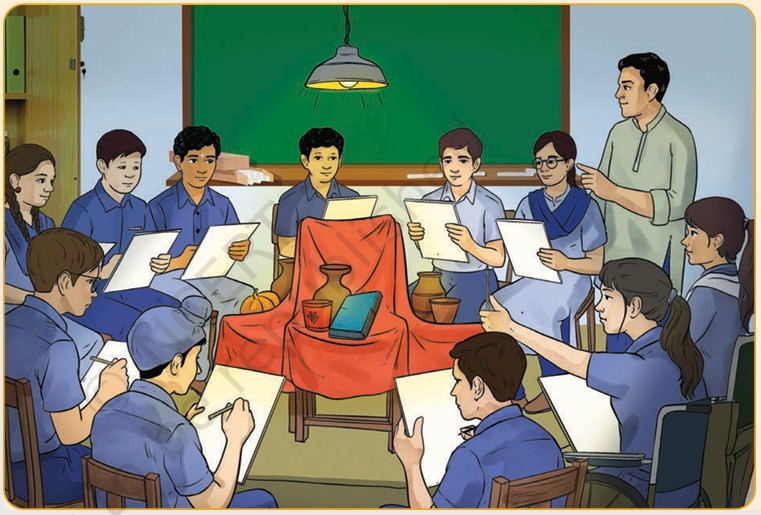
Students sit around the still life arrangement so each student sees it from a different angle.
Step 1 : Observe the Still life
Different students see the same objects differently because of different viewing angles.
Observe carefully:
- Background areas
- Overlapping objects
- Shadows and highlights
- Shapes and opening of objects
Step 2 : Five-Minute observation
Before drawing, observe:
- Size of each object
- Proportion between objects
- Lines and contours
- Basic shapes forming each object
- Symmetry or asymmetry
- Hidden or overlapping parts
- Distance between objects
- Negative spaces
- Direction of light and shadows
Also decide whether your drawing should be vertical or horizontal.
Step 3 : Draw the contour
Steps:
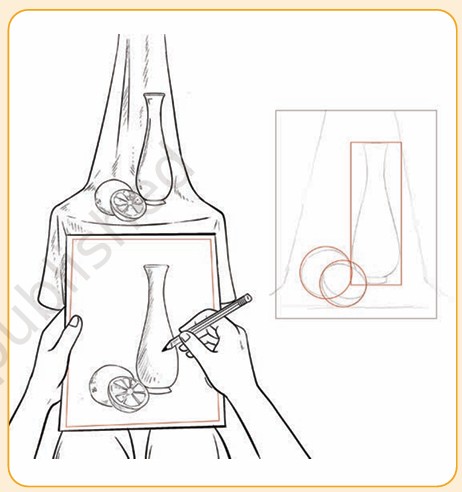
1. Mark positions of objects within the paper frame.
2. Maintain correct ratio and proportion of objects.
3. use basic shapes ( circle, rectangle, cylinder ) to sketch objects.
4. Draw outlines with light pencil lines.
5. Add small details.
Tip :
Keep looking at the objects frequently while drawing to improve accuracy.
Step 4 : Colour the Still Life
Use colours creatively to show light, shade, and texture.
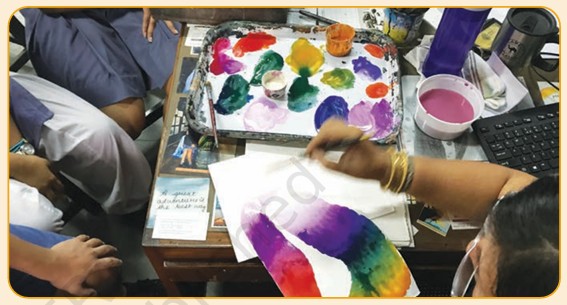
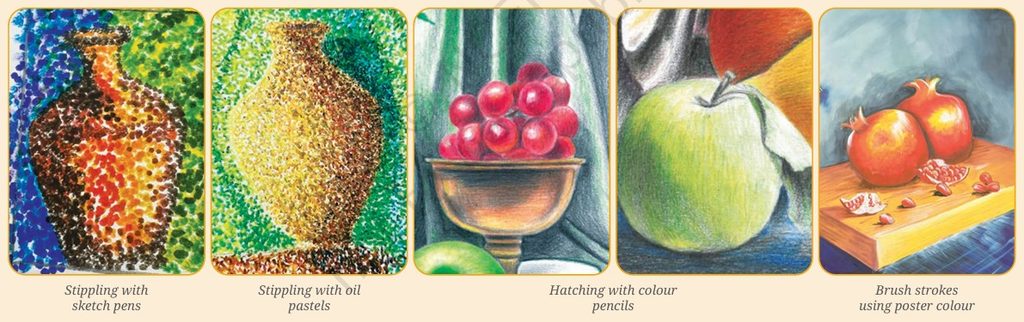
Different colouring techniques include:
1. Stippling
- Creating texture with small dots.
2. Hatching
- Using parallel lines for shading.
3. cross-Hatching
- Intersecting lines to create darker tones.
4. Brush Strokes
- Using paint strokes with poster colours.
Artists should experiment with dots, lines, strokes, and patches.
Artists Who Are Known For Their Still Life
Still-life painting is an important form of visual art in which artists represent everyday objects, such as fruits, flowers, vessels, and household items. Artists draw inspiration from their own cultures, traditions, surroundings, and experiences, as well as from artistic styles found in other cultures. As a result, still-life paintings can differ in their choice of objects, arrangements, colours, textures, and painting techniques.
Observe the two still-life paintings carefully and compare their visual features. Notice how the artists have arranged the objects, used colours, applied brushstrokes, and represented light and shadow. Look for similarities and differences in the shapes, sizes, textures, backgrounds, and overall compositions. Consider how each artist’s style influences the appearance and mood of the painting.
This activity will help you understand that the same subject can be represented in many different ways. By comparing artworks, you can develop your observation skills, appreciate diverse artistic traditions, and discover new ideas for creating your own still-life compositions.
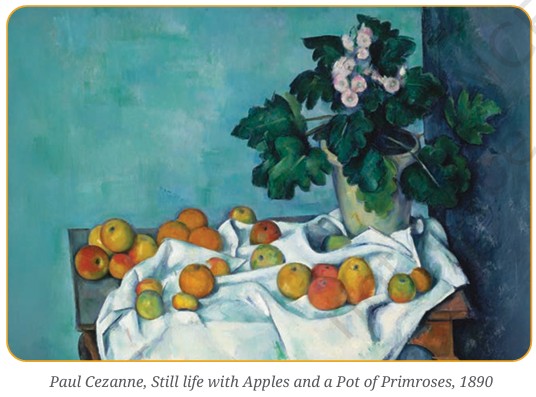
1.) Paul Cezanne, Still life with Apples and a Pot of Primroses, 1890
Paul Cézanne was a French artist known for his innovative approach to still-life painting. In Still Life with Apples and a Pot of Primroses (1890), he presents everyday objects, including apples and a flowering plant, as the main subjects of the composition. He carefully arranges the objects to explore their shapes, colours, forms, and relationships within the space.
The painting is notable for its use of colour and visible brushstrokes. Cézanne uses variations of colour and tone to suggest the rounded forms of the apples and the structure of the other objects. Rather than relying only on sharp outlines, he builds up forms through patches of colour and carefully observed light and shadow. The arrangement creates a sense of balance while allowing the objects to retain their individual character. This artwork demonstrates how an ordinary group of objects can become an engaging subject through thoughtful composition and artistic observation.
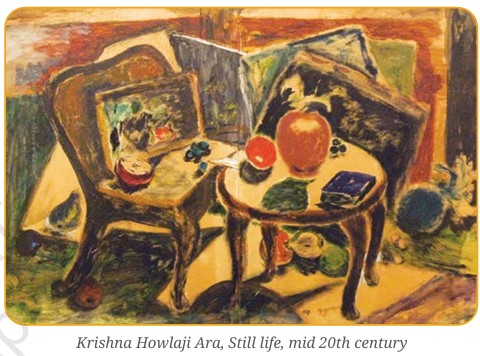
2.) Krishna Howlaji Ara: Still life (mid 20th century)
Krishna Howlaji Ara was an Indian modern artist known for his still-life paintings of everyday objects. His work explores how ordinary items can become interesting subjects through careful observation, composition, and the use of colour. In his still-life paintings, objects are arranged to highlight their shapes, forms, textures, and relationships with the surrounding space.
Ara’s approach to still life reflects an interest in representing familiar objects through his own artistic style. The arrangement, use of colour, and application of brushstrokes help create visual interest and give the objects a distinct presence. Light and shadow contribute to the appearance of form and depth, while the relationship between the objects and their background helps establish the overall composition.
His still-life work offers an opportunity to observe how an Indian modern artist interpreted everyday subjects. When comparing Ara’s Still Life with Paul Cézanne’s Still Life with Apples and a Pot of Primroses, notice the differences and similarities in object arrangement, colour choices, brushstrokes, light, shadow, and the treatment of three-dimensional forms. This comparison shows how artists can explore the same genre while expressing different artistic approaches.
Conclusion
Still-life art provides an opportunity to explore the beauty of everyday objects through careful observation, creative arrangement, and artistic expression. By studying the works of artists such as Paul Cézanne and Krishna Howlaji Ara, we learn that ordinary objects can become meaningful subjects when represented through different artistic styles and techniques. Each artist makes individual choices about composition, colour, brushstrokes, light, shadow, texture, and form, giving the artwork its distinctive character.
Comparing still-life paintings helps us recognise both similarities and differences in the ways artists observe and interpret the world around them. It also demonstrates that art has no fixed boundaries, as artists draw inspiration from their own cultures, personal experiences, and artistic traditions from different parts of the world. The same objects can be arranged and represented in many ways, creating different visual effects and moods.
Through still-life activities, learners can strengthen their observation, drawing, colouring, and critical-thinking skills. They can experiment with object placement, colour combinations, tonal variations, and different materials to create balanced and interesting compositions. Most importantly, still-life art encourages us to look beyond the ordinary, appreciate the details of our surroundings, and express our creativity through visual art and design.