
Introduction:
Indian classical music is a rich musical tradition built on two important elements: Rāga and Tāla. These elements work together to create beautiful melodies and rhythmic patterns. Rāga gives music its melodic structure and emotional character, while Tāla provides the rhythmic framework that keeps the music organised and balanced. Together, they help musicians express feelings, ideas, and stories through sound.
A Rāga is a melodic framework based on a particular arrangement of musical notes, known as svaras. It follows specific rules about how notes are used, how melodies move, and which musical phrases create its distinctive character. Different rāgas can evoke different moods, such as peace, devotion, joy, love, or sadness. Some rāgas are traditionally associated with particular times of the day or seasons. For example, Rāga Bhairav is traditionally associated with the morning, while Rāga Yaman is commonly performed in the evening. Musicians use the notes and characteristic phrases of a rāga to create melodies while adding their own creativity.
A Tāla is a rhythmic cycle made up of a fixed number of beats. It provides the rhythmic foundation for singing and instrumental performance. Musicians maintain tāla through clapping, hand gestures, percussion instruments, and repeated rhythmic patterns. Examples include Teen Tāla, which has 16 beats, and Ektāla, which has 12 beats in Hindustani classical music.
Rāga and Tāla complement each other in musical performance. While rāga guides the melody, tāla organises the rhythm. Understanding these concepts helps us appreciate the structure, beauty, and expressive power of Indian classical music. By listening, singing, clapping, and practising simple patterns, we can explore how melody and rhythm combine to create a harmonious musical experience.
Let Us Recall
- Nāda: Musical sound that forms the basis of music.
- Śhruti: A subtle pitch distinction that can be heard and recognised as different from another. In Indian classical music, śhruti refers to fine distinctions in pitch.
- Svara: A musical note. Indian music has seven basic svaras: Sa, Re, Ga, Ma, Pa, Dha, Ni, represented as S R G M P D N.
- Saptak / Sthāyī: A saptak is a group of seven basic musical notes spanning an octave. Musicians commonly use three registers: Mandra Saptak (lower), Madhya Saptak (middle), and Tāra Saptak (higher).
Svara
In Indian classical music, svaras are the basic building blocks of melody. There are seven basic svaras: Sa, Re, Ga, Ma, Pa, Dha, and Ni, represented by the letters S, R, G, M, P, D, and N. These notes are combined in different ways to create melodies and rāgas.
The seven svaras are divided into two categories:
- Achala-svaras (Prakṛiti-svaras): Sa (S) and Pa (P) are considered invariant notes because they do not have higher or lower variants within the basic system described here.
- Chala-svaras (Vikṛiti-svaras): Re (R), Ga (G), Ma (M), Dha (D), and Ni (N) have variants at different pitch positions. These variations allow musicians to create different melodic patterns.
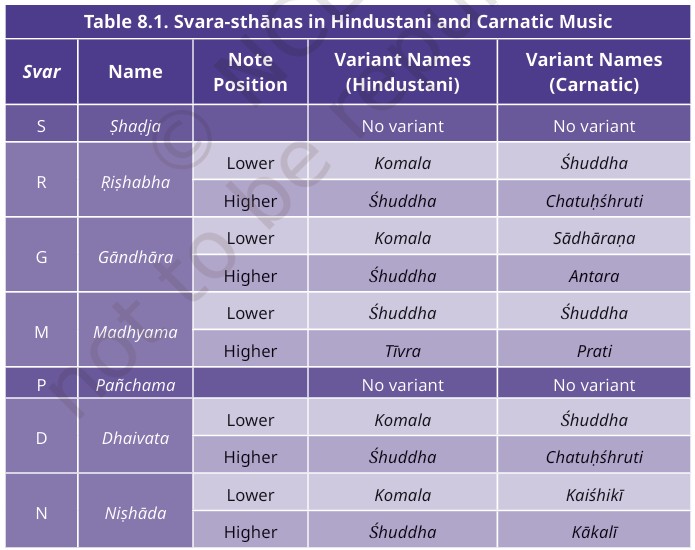
Thus, the seven basic svaras occupy 12 distinct svara-sthānas (note positions) in this system: two invariant notes, S and P, and two positions each for the remaining five notes.
A keyboard or harmonium makes these note positions easier to observe. Within an octave, the keys represent different pitch positions, and the same sequence of notes repeats in higher and lower octaves. This arrangement helps learners understand how musical notes relate to one another and how they form the foundation of melody in Indian classical music.
The Arrangement of Svaras and Octaves on a Keyboard
A keyboard shows how musical notes are arranged in a repeating pattern. In Indian classical music, the seven basic svaras—Sa, Re, Ga, Ma, Pa, Dha, and Ni (S, R, G, M, P, D, N)—correspond to musical pitches that repeat across different octaves.
An octave contains 12 semitone positions in the commonly used keyboard system, including the natural notes and the notes between them.
The same sequence of svaras can be played in different registers: Mandra Saptak (lower octave), Madhya Saptak (middle octave), and Tāra Saptak (higher octave). Although the notes have the same names, their pitches become lower or higher from one octave to another.
A keyboard or harmonium helps us observe these repeating patterns and understand the relationship between svaras, pitch, and octaves.
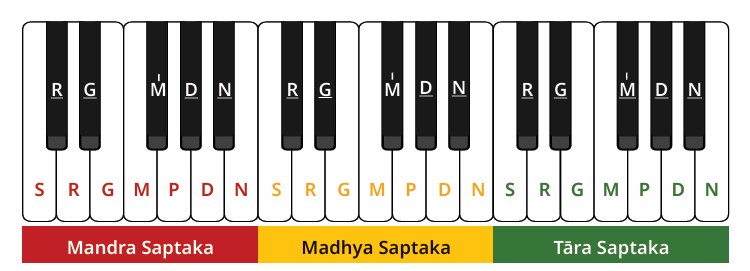
The arrangement of svaras and octaves on a keyboard
Svaras in Hindustani and Carnatic Music
Both Hindustani and Carnatic classical music use seven basic svaras: Sa, Re, Ga, Ma, Pa, Dha, and Ni (S, R, G, M, P, D, N). These svaras occupy 12 basic note positions in the commonly taught system.
However, the variants of the notes have different names in the two musical traditions. Although the terminology differs, both systems use these notes to create melodies, rāgas, and a rich variety of musical expressions.
Rāga
A rāga is a melodic framework in Indian classical music, based on a particular set of notes and specific rules for using them. Each rāga has its own characteristic patterns, movements, and melodic phrases that give it a distinct identity and mood.
The rāga system is one of the features that makes Indian classical music highly sophisticated, intricate, and systematic. Musicians use rāgas to express a wide range of emotions and create beautiful melodies.
But how can we classify the hundreds of rāgas found in Indian classical music? Just as plants and animals are classified into different groups and families according to their characteristics, rāgas are also organised into groups based on their musical features. This classification helps us understand their similarities, differences, structures, and relationships more easily.
Classification Based on the Number of Svaras
In both Hindustani and Carnatic classical music, rāgas can be classified according to the number of svaras (notes) used in their ārohaṇa (ascending scale) and avarohaṇa (descending scale).
In Hindustani classical music, this classification based on the number of notes is known as Rāga-jāti. It helps musicians understand the structure of a rāga and identify how its notes are arranged while moving upward and downward.
Depending on the number of notes used, rāgas are commonly grouped into three main jāti categories:
- Audava — uses five notes.
- Ṣhāḍava — uses six notes.
- Sampūrṇa — uses seven notes.
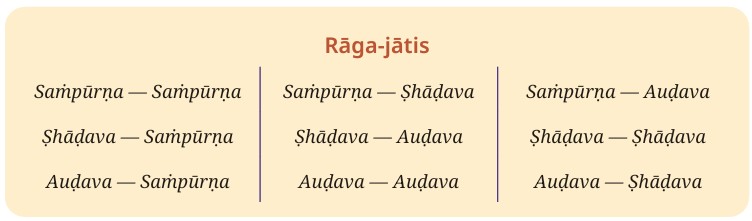
The ascending and descending scales of a rāga may belong to different categories. For example, a rāga may use five notes in its ārohaṇa and seven notes in its avarohaṇa. Thus, understanding rāga-jāti helps us recognise the distinctive melodic structure of different rāgas.
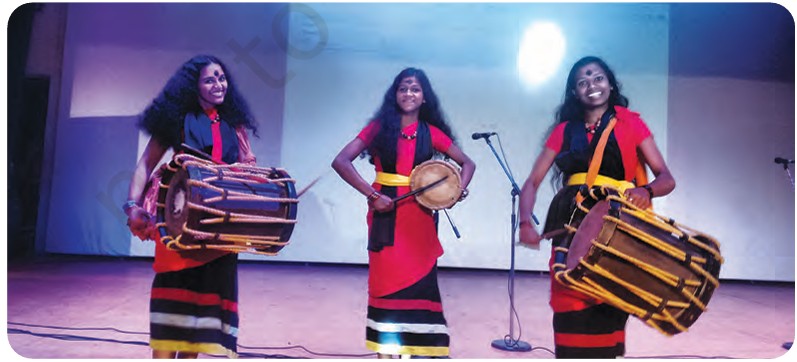
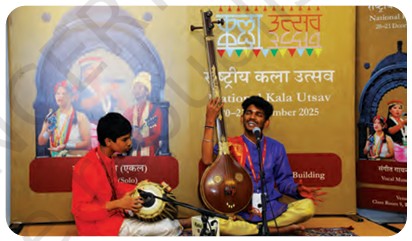
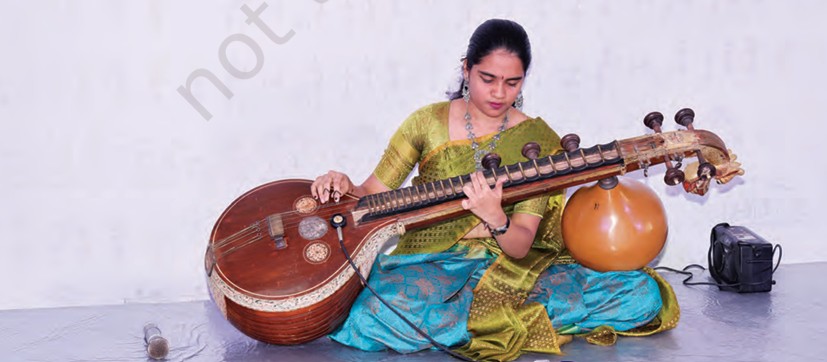
Students Performing Carnatic Classical Music (Kala Utsav 2025)
Carnatic classical music is a major tradition of Indian classical music, known for its rich rāga system, rhythmic patterns, and expressive compositions. Students performing at Kala Utsav 2025 showcase their musical skills, creativity, discipline, and appreciation of India’s rich cultural heritage.
Students Performing Carnatic Classical Music (Kala Utsav 2025)
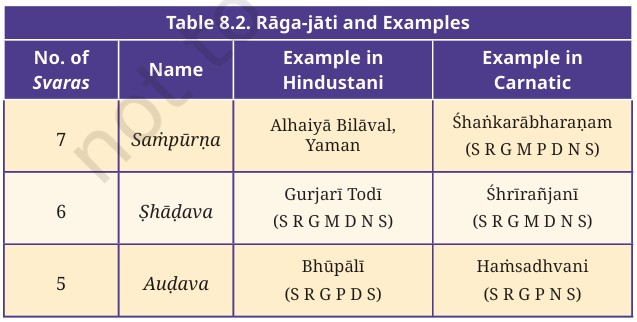
Rāgas can also have different numbers of notes in the āroha/ ārohaṇa and avaroha/ avarohaṇa:
Rāgas can have different numbers of notes in their ascending and descending sequences. The ascending sequence is called āroha or ārohaṇa, while the descending sequence is called avaroha or avarohaṇa.
Based on the number of notes used in these sequences, rāgas are classified as Auḍava (five notes), Ṣhāḍava (six notes), and Sampūrṇa (seven notes). A rāga may use different numbers of notes in its ascent and descent, giving it a distinctive melodic character.
Activity
1. Auḍava Rāga (5 notes) — Rāga Bhūpālī
- Ārohaṇa: Sa Re Ga Pa Dha Sa
- Avarohaṇa: Sa Dha Pa Ga Re Sa
2. Ṣhāḍava Rāga (6 notes) — Rāga Khamāj
- Ārohaṇa: Sa Ga Ma Pa Dha Ni Sa
- Avarohaṇa: Sa Ni Dha Pa Ma Ga Re Sa
3. Auḍava–Ṣhāḍava Rāga (5 notes ascending, 6 descending) — Rāga Gurjari Todi
- Ārohaṇa: Sa Re Ma Pa Dha Sa
- Avarohaṇa: Sa Ni Dha Pa Ma Ga Re Sa
Note: These are illustrative scale patterns; the number of notes and their specific forms can vary by rāga and tradition. Gurjari Todi’s conventional scale should be checked against the particular teaching tradition before using it as a textbook example.
Tānsen and the Rāga of Fire
According to a famous legend, Tānsen, one of the most celebrated musicians in Emperor Akbar’s court, possessed extraordinary musical talent. He was renowned for his mastery of Indian classical music and his ability to sing different rāgas with great skill.
The story says that some jealous courtiers tricked Tānsen into singing Rāga Dīpaka, a rāga traditionally believed to produce intense heat when performed perfectly. Knowing the danger described in the legend, Tānsen agreed to sing it but secretly prepared a way to save himself. He trained his daughter Sarasvatī and her friend Rūpavatī to sing Rāga Megha, which was believed to bring rain.
When Tānsen began singing Rāga Dīpaka, the atmosphere seemed to grow unbearably hot. According to the tale, lamps began to glow, and Tānsen’s body became overwhelmed by the heat. At the critical moment, Sarasvatī and Rūpavatī began singing Rāga Megha. Dark clouds gathered in the sky, and rain fell, saving Tānsen from the dangerous effects of the fire rāga.
This fascinating legend highlights the importance of rāgas in Indian musical tradition. It reflects the belief that music can influence human emotions and establish a connection with nature. Although the story is not scientifically proven, it continues to inspire musicians and music lovers with its powerful message about musical talent, courage, and devotion.
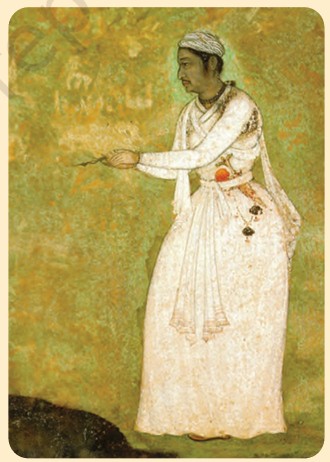
Portrait of Tānsen c. 1585–90, National Museum, New Delhi
Classification Based on the Svara-sthānas
In both Carnatic and Hindustani classical music, rāgas are traditionally classified into different groups or families based on their svara-sthānas, which refer to the positions of musical notes.
However, the two musical traditions follow different systems of classification. In Carnatic music, rāgas are organised using the Melakarta system, which consists of 72 parent rāgas. Other rāgas are derived from these parent rāgas and are known as janya rāgas.
In Hindustani music, rāgas are commonly grouped into ten parent categories called thāṭs. Each thāṭ represents a particular arrangement of seven notes, from which many rāgas can be associated with the category.
These classification systems help musicians study the structure of rāgas, understand the relationships between notes, and explore the rich diversity of Indian classical music.
Carnatic Music: The 72 Mēḷakarta System
The 72 Mēḷakarta system is the foundation of rāga classification in Carnatic classical music. It consists of 72 parent rāgas, each with a complete seven-note scale in both the ārohaṇa (ascending order) and avarohaṇa (descending order).
Every Mēḷakarta rāga uses all seven basic svaras: Sa, Ri, Ga, Ma, Pa, Dha, and Ni. The 72 scales are formed by systematically combining the different permitted variants of five svaras: Ri (R), Ga (G), Ma (M), Dha (D), and Ni (N). Sa (S) and Pa (P) remain fixed.
The system includes 36 rāgas with śuddha madhyama (M₁) and 36 rāgas with prati madhyama (M₂). Each group contains different combinations of the other variable notes, giving a total of 72 Mēḷakarta rāgas.
This systematic classification helps musicians understand the relationships between rāgas and provides a structured foundation for learning, composing, and performing Carnatic music.
Do You Know?
The mathematical system of organising 72 Mēḷakarta rāgas in Carnatic music is associated with Venkatamakhi, a musicologist who described this system in his important treatise, Chaturdaṇḍī Prakāśikā, written in the seventeenth century. His work established a systematic approach to classifying rāgas through combinations of different svara-sthānas. This method continues to play an important role in understanding the structure of Carnatic classical music.
Janaka and Janya Rāgas:
The 72 Mēḷakarta rāgas of Carnatic music are also known as Janaka rāgas, meaning parent rāgas. Many other rāgas, called Janya rāgas, are derived from these parent rāgas by omitting certain notes or changing the order in which notes are used.
For example, Rāga Śhaṅkarābharaṇam is a Janaka rāga that uses all seven svaras in both its ascending and descending scales.
- Ārohaṇa (ascending): S R₃ G₃ M₁ P D₃ N₃ Ṡ
- Avarohaṇa (descending): Ṡ N₃ D₃ P M₁ G₃ R₃ S
Rāga Haṁsadhvani is an example of a Janya rāga. It is commonly taught as a five-note (Auḍava) rāga in both ascending and descending scales. It omits Ma and Dha from the Śhaṅkarābharaṇam scale.
- Ārohaṇa (ascending): S R₃ G₃ P N₃ Ṡ
- Avarohaṇa (descending): Ṡ N₃ P G₃ R₃ S
Thus, Janaka rāgas provide a foundation for creating and understanding Janya rāgas. This relationship demonstrates how different combinations of notes can produce a wide variety of distinctive melodies in Carnatic classical music.
Hindustani Thāṭ System
The Thāṭ system is a method of classifying rāgas in Hindustani classical music according to the notes used in their scales. A thāṭ is a parent scale consisting of seven svaras arranged in ascending order: Sa, Re, Ga, Ma, Pa, Dha, and Ni.
The notes Re (R), Ga (G), Ma (M), Dha (D), and Ni (N) have different variants. Sa (S) and Pa (P) remain fixed. By combining these note variants in different ways, musicologists classify Hindustani rāgas into ten main thāṭs.
The ten thāṭs are Bilāval, Khamāj, Kāfī, Āsāvarī, Bhairav, Bhairavī, Kalyāṇ, Mārwā, Pūrvī, and Toḍī. Each thāṭ serves as a framework for grouping rāgas with related note structures.
Example: Kalyāṇ Thāṭ
The scale of Kalyāṇ Thāṭ uses tīvra Ma (sharp Ma), while the other notes are in their standard forms.
- Ascending scale: S R G M′ P D N Ṡ
- Descending scale: Ṡ N D P M′ G R S
The Thāṭ system helps students organise and understand the many rāgas of Hindustani classical music. However, a thāṭ is a basic classification scale; it does not include all the characteristic melodic movements and rules of an individual rāga.
Do you know?
The Thāṭ system was organised by the renowned musicologist Pandit Vishnu Narayan Bhatkhande in the early twentieth century. He classified Hindustani classical rāgas into ten main thāṭs based on their svaras, making the study and understanding of rāgas more systematic, structured, and accessible to students and musicians.
Two rāgas belonging to the Kalyāṇ Thāṭ are:
1. Yaman
- Ārohaṇa (ascending): N R G M′ D N Ṡ
- Avarohaṇa (descending): Ṡ N D P M G R S
2. Śhuddha Kalyāṇ
- Ārohaṇa (ascending): S R G P D Ṡ
- Avarohaṇa (descending): Ṡ N D P M′ G R S
Note: M′ represents tīvra Ma (sharp Ma).
Compositions
Let us explore musical compositions in both Carnatic and Hindustani classical music. Although the two traditions have their own styles, techniques, and performance practices, they share many similarities in their use of rāgas.
In this section, we will study two related rāgas: Śhaṅkarābharaṇam in Carnatic music and Alhaiyā Bilāval in Hindustani music. Both are associated with the notes of the major scale, although their characteristic phrases, melodic movements, and performance conventions differ.
By exploring compositions based on these rāgas, we can understand how musicians use svaras, rhythm, and melodic patterns to create expressive and beautiful music in both traditions.
Carnatic Music — Rāga Śhaṅkarābharaṇam
Rāga Śhaṅkarābharaṇam is one of the most important and widely performed rāgas in Carnatic classical music. It is the 29th Mēḷakarta rāga in the 72-rāga system and is known for its bright, balanced, and melodious character.
Scale of Rāga Śhaṅkarābharaṇam
- Ārohaṇa (ascending): S R₂ G₃ M₁ P D₂ N₃ Ṡ
- Avarohaṇa (descending): Ṡ N₃ D₂ P M₁ G₃ R₂ S
This rāga uses all seven basic svaras in both ascending and descending scales. Its notes correspond to the major scale in Western music when Sa is taken as the tonic, though Carnatic music uses its own melodic ornamentation and performance conventions.
Śhaṅkarābharaṇam is widely used in compositions, improvisations, and musical lessons. It helps students develop an understanding of svaras, rāga structure, and melodic expression.
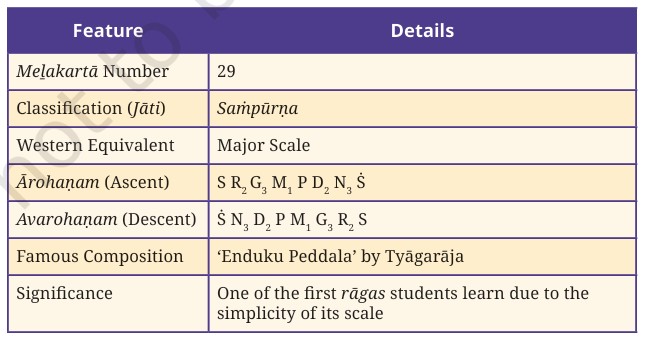
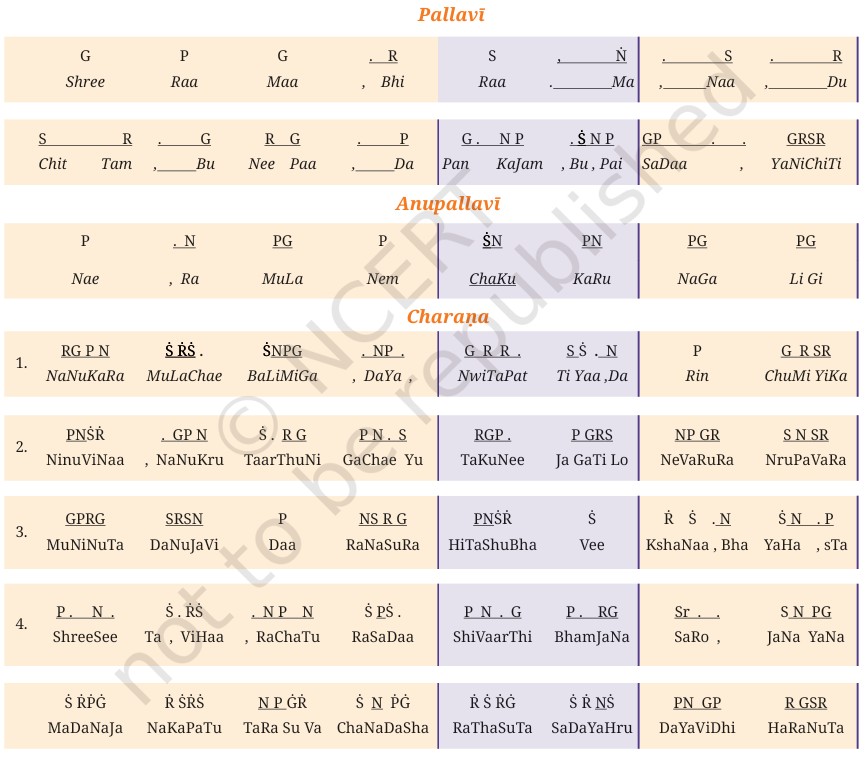
Let’s Learn Two Compositions in Janya Rāgas of Śhaṅkarābharaṇam:
1.) Jatisvaram
A Jatisvaram is a type of Carnatic music composition built mainly around svaras (musical notes) and rhythmic patterns. It may also include rhythmic syllables called jatis. Unlike many other Carnatic compositions, a Jatisvaram generally has no lyrics or sāhitya. It helps students practise melody, rhythm, and coordination while developing musical skills.
Rāga: Kaṇṇaḍā
Composer: Veena Padmanābhayya
Ārohaṇa (ascending): S G₃ M₁ D₂ N₃ Ṡ
Avarohaṇa (descending): Ṡ N₃ D₂ P M₁ G₃ M₁ R₂ S
This composition allows learners to explore the distinctive melodic movements of Rāga Kaṇṇaḍā while practising svara patterns and rhythmic precision. As a Janya rāga, Kaṇṇaḍā is associated with the parent rāga Śhaṅkarābharaṇam in this learning context.
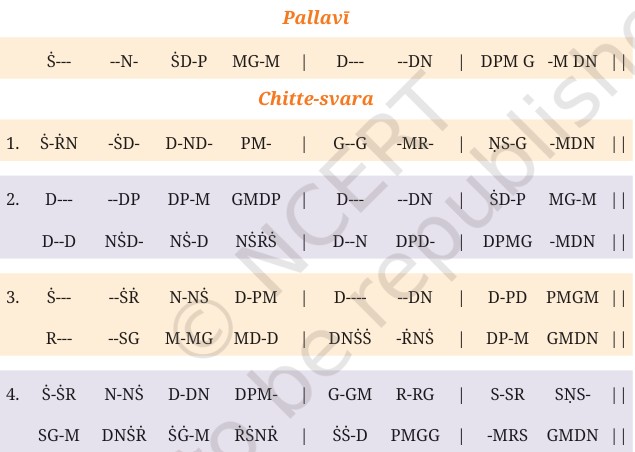
2.) Svarajati
A Svarajati is a type of Carnatic music composition that combines musical notes (svaras) with simple lyrics (sāhitya). It may also include rhythmic syllables (jati), which add variety and rhythmic interest to the composition. Svarajatis help students develop their understanding of melody, rhythm, and lyrical expression.
Rāga: Haṁsadhvani
Tāla: Ādi
Ārohaṇa (ascending): S R₂ G₃ P N₃ Ṡ
Avarohaṇa (descending): Ṡ N₃ P G₃ R₂ S
Rāga Haṁsadhvani is an Auḍava rāga, as it uses five notes in both the ascending and descending scales. Its bright, pleasant melody makes it popular in Carnatic music, particularly for opening concerts and compositions. Ādi tāla provides a rhythmic cycle of eight beats, helping learners practise timing and coordination.
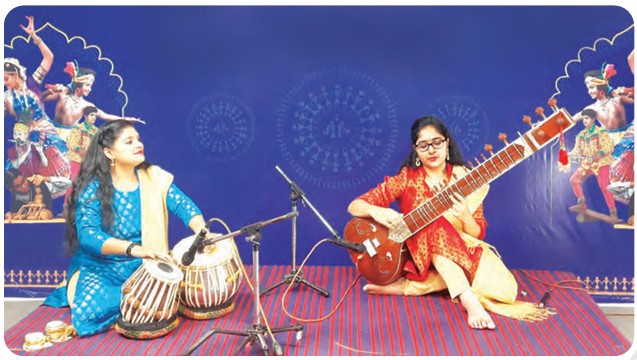
Kala Utsav participants playing the sitar and table
Hindustani Music — Rāga Alhaiyā Bilāval
Rāga Alhaiyā Bilāval is an important rāga in Hindustani classical music and is associated with the Bilāval thāṭ. It is known for its bright, graceful, and melodious character.
Thāṭ: Bilāval
Jāti: Ṣhāḍava–Sampūrṇa (commonly described in traditional classifications)
Ārohaṇa (ascending): S R G P D N Ṡ
Avarohaṇa (descending): Ṡ N D P M G R S
Rāga Alhaiyā Bilāval is often performed during the morning. Its melodic movements and characteristic phrases distinguish it from other rāgas belonging to the Bilāval thāṭ.
This rāga is used in both vocal and instrumental compositions. Studying it helps learners understand how Hindustani musicians create distinctive melodies through the arrangement of svaras, characteristic phrases, and rhythmic patterns.
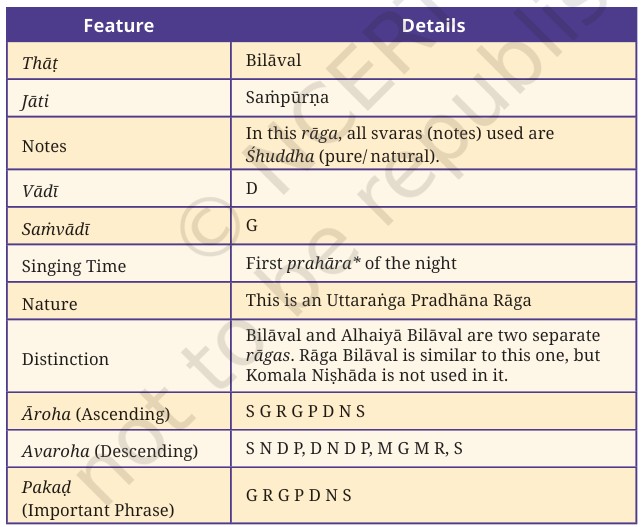
* A day is divided into eight parts. Each part is called a prahāra and lasts three hours.
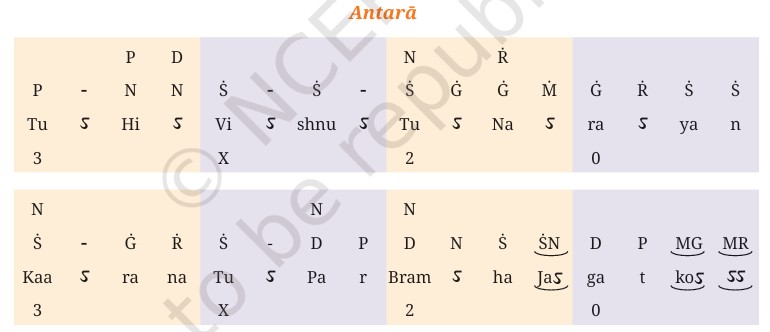
Bandiśh in Teen Tāla
Source: Kramik Pustak Mālika – Bhāg 2
Tāla: Teen Tāla (16 beats)
Sthāyī:
Tū Hī Ādhār Sakala Tribhuvana Ko,
Pālaka Sacharāchar Bhūtan Ko.
Tū Hī Viṣhṇu Tū Nārāyaṇa,
Kāraṇa Tū Parabrahma Jagat Ko.
Meaning in English
You alone are the support of all three worlds and the protector of all living and non-living beings. You alone are Vishnu and Narayana, the supreme cause and the ultimate Brahman of the universe.
About Teen Tāla: Teen Tāla is one of the most widely used tālas in Hindustani classical music. It has 16 mātrās (beats) arranged in four equal divisions (vibhāgs) of four beats each. Its claps and wave are marked as follows:
1 (clap) – 2 – 3 – 4 | 5 (clap) – 6 – 7 – 8 | 9 (wave) – 10 – 11 – 12 | 13 (clap) – 14 – 15 – 16

Lakṣhaṇa-Gīta
A Lakṣhaṇa-Gīta is a type of song in Hindustani classical music that describes the characteristic features of a rāga through its lyrics. The lyrics explain important musical details, such as the rāga’s name, its svaras (notes), vādī and samvādī svaras, jāti, performance time, and other distinguishing features.
Lakṣhaṇa-Gītas help students learn and remember the rules and characteristics of different rāgas in an enjoyable musical form. They combine musical learning with singing and are useful in the systematic study of Indian classical music.
Example: The Lakṣhaṇa-Gīta for Rāga Bilāval describes its use of śhuddha svaras, its morning performance time, and its vādī and samvādī svaras.
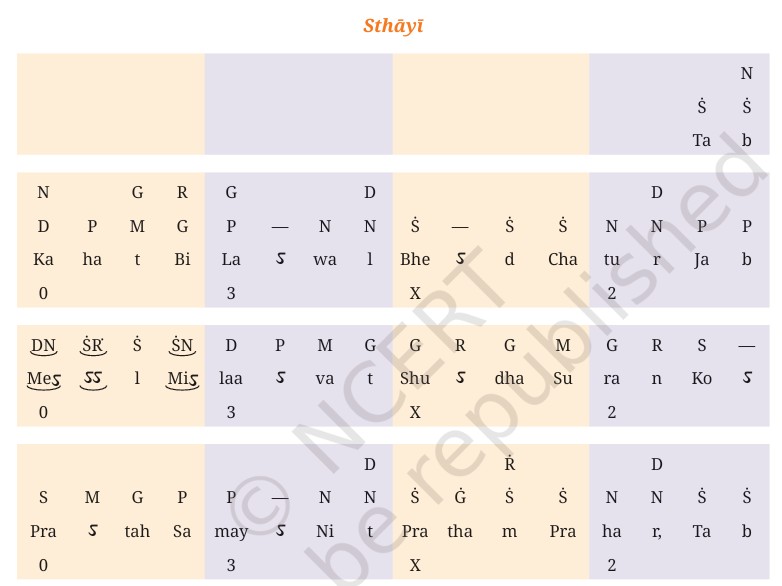
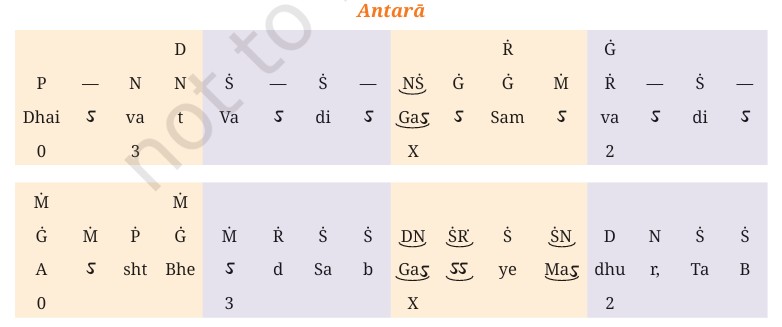
Tāla: Teen Tāla (Madhya Laya) Kramik Pustak Mālika – Bhāg 2
Sthāyī: Taba Kahata Bilāval Bheda Chatura Jaba Mela Milāvata Śhuddha Surana Ko Prātaḥ Samaya Nit Prathama Prahara Dhaivata Vādī Gā Samvādī Aṣhṭa Bheda Saba Gāye Madhura.
Tāla
A Tāla is a rhythmic cycle in Indian classical music that organises beats (mātrās) into a repeating pattern. It provides the rhythmic framework for a musical performance and helps singers and instrumentalists maintain a steady rhythm while performing a composition.
Both Hindustani and Carnatic classical music use tālas, but their systems differ in the way rhythmic cycles are classified, counted, and performed. Each tāla has a specific number of beats and a characteristic pattern of divisions and accents.
Let us revisit some of the basic tālas used in Hindustani and Carnatic classical music.
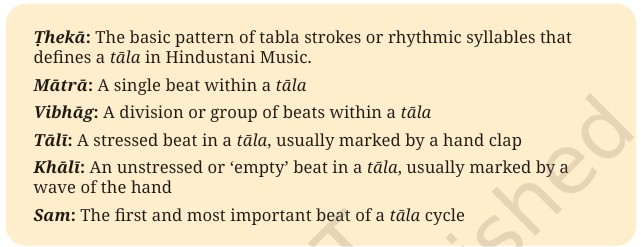
Tālas of Hindustani Music
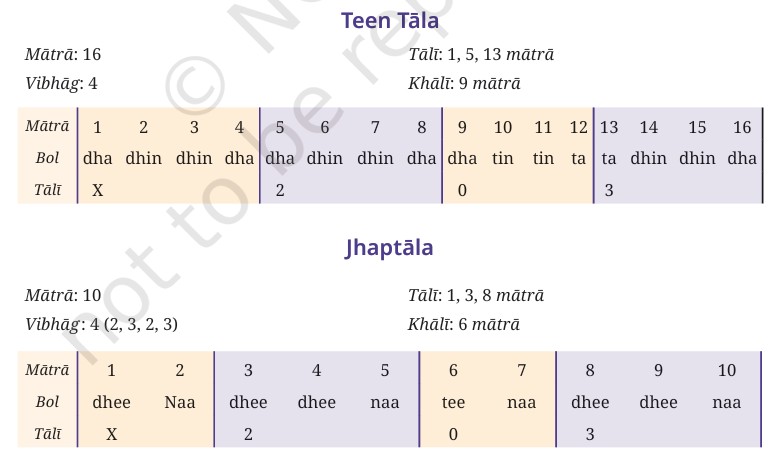
Activity
Identifying the Various Bols
Listen carefully to a recording of a ṭheka played on the tabla. Try to identify the different bols (spoken syllables representing tabla strokes) you hear. Pay attention to their sequence, sound, and repetition to understand how they form the rhythmic pattern of a tāla.
Activity
Finding Sam
Listen to the tabla ṭheka of the bandiśh being performed in class. Follow the tāla carefully by counting its beats and try to identify the sam, the first and most important beat of the rhythmic cycle.
Observe how the artist uses different melodic phrases and rhythmic patterns during the elaboration of the rāga to arrive at the sam. Notice how the tabla and the melody come together on this beat, creating a sense of rhythmic completion and balance.
Tālas of Carnatic Music
Carnatic music uses a variety of tālas to organise rhythm and maintain the rhythmic structure of a composition. Two of the most commonly used tālas are Ādi Tāla and Rūpaka Tāla.
In Carnatic music, tālas are counted using hand gestures, such as clapping, waving, and counting fingers. These gestures help musicians keep track of the beats and perform together in rhythm.
Let us revise how to count these tālas using our fingers and hand gestures, as shown below.


Conclusion:
Rāga and Tāla are two essential elements of Indian classical music that work together to create a beautiful and expressive musical experience. A rāga provides the melodic framework of a composition through its svaras, characteristic phrases, and distinctive mood, while a tāla provides the rhythmic structure through a repeating cycle of beats. Together, they bring melody and rhythm into harmony.
Through the study of Hindustani and Carnatic music, students learn to recognise rāgas, understand their characteristics, follow rhythmic cycles, identify tāla bols, and locate the sam—the first beat of a tāla cycle. Singing compositions such as bandiśhs and Lakṣhaṇa-Gītas helps students develop their musical knowledge, listening skills, rhythmic awareness, and appreciation of India’s rich musical heritage.
Learning rāga and tāla is not only about understanding musical rules; it is also about experiencing creativity, discipline, concentration, and emotional expression. With regular listening and practice, students can discover how melody and rhythm interact to create music that is both technically rich and deeply moving. By exploring these elements, they can develop a stronger connection with Indian classical music and appreciate its enduring beauty across generations.