

Introduction
Songwriting is the creative process of writing songs by combining lyrics, melody, rhythm, and musical ideas. It allows people to express emotions, experiences, stories, thoughts, and imagination through music. A songwriter may create a song for personal expression, entertainment, cultural activities, films, performances, or social messages. Songwriting combines creativity with musical knowledge and can be practiced by beginners as well as professional musicians.
Definition
Songwriting is the art of creating a song by developing lyrics, melodies, rhythms, and musical structures that work together to communicate an idea, story, or emotion.
Main Elements of Songwriting
1. Lyrics
Lyrics are the words of a song. They communicate the story, message, feelings, or ideas of the songwriter.
2. Melody
The melody is the sequence of musical notes that forms the main tune of the song.
3. Rhythm
Rhythm is the pattern of beats that gives a song its movement and timing.
4. Harmony
Harmony is created when different musical notes or chords are combined to support the melody.
5. Song Structure
A song can be organized into sections such as:
- Introduction
- Verse
- Chorus
- Pre-Chorus
- Bridge
- Outro
Objective: Building your own unique style to express your thoughts and ideas to your audience through lyric writing. Watch a video to understand what songwriting is all about.
Descriptive writing
Descriptive writing means describing. an object, place, experience or thing in detail to create a clear picture in the mind of the reader.
1. Describe in depth the details of the object of your song to help your listeners picture it easily.
2. Use all your senses — describe how it looks, smells, feels, and so on.
3. Use your imagination to describe (in detail) something unfamiliar.
4. Share your writing to get better at it; open yourself to feedback. This is an important part of the process.
5. Read other people’s writing as well to learn different perspectives. Watch the video to learn how to write descriptively.
Songwriting Tip Think of writing as collaboration, not competition, and try to be constructive and positive while leaving feedback for others.
1: Try it Yourself!
Write descriptively about a tree.
2: Write a Song based on Familiar or Popular Melody
Watch the video to understand how to write lyrics for existing melodies.
Let us take the example of Twinkle Twinkle Little Star. We have all heard this song multiple times. It is interesting to know that this melody is similar to Baa Baa Black Sheep and the popular alphabet song, A B C D. Make your own song to this popular melody.
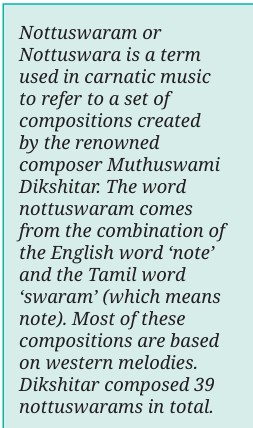
Watch this video for a few examples of the lyrics to Twinkle Twinkle Little Star. Listen to this popular Indian song (nottuswaram) Shyamale Meenakshi. Go on and write your own words for this popular song.
3: Write a Song based on Unfamiliar or Uncommon Melody
Listen to the melody in the audio and write your own lyrics to it. You can also listen nottuswaram and write your own lyrics to it.
Learn to Rhyme
Rhyming is a very important part of a song or a poem. One reason is that rhymes help our ears understand where the line changes. Rhymes also help highlight the idea that our song is trying to convey. People tend to listen carefully when words rhyme.
Examples cat, bat, mat love, above hand, understand Watch the video to learn to rhyme.
4: Listen to the Rhyme in the Solar System Song
The Solar System Song
Verse 1
I’m Mercury, the smallest,
I’m closest to the Sun
I take eighty-eight days
to complete my yearly run.
I’m Venus, the hottest,
I’m very, very bright
I look like a star
when you look at me in the night.
I’m Earth, your home,
the only place with life,
I have water, air, and food
to keep you all alive.
Chorus
(The planets, the planets, revolve around the Sun Don’t forget the solar system Once this song is done.) × 2
Verse 2
I’m Mars, I’m red,
I’m smaller than the earth
My moons are like potatoes,
They’re deimos and phobos.
I’m Jupiter, the largest,
I have a reddish spot;
Sixty-three moons surround me,
Which really is a lot.
I’m Saturn, I’m sparkly,
My rings are made of ice;
I can float on water
As I’m very, very light.
Chorus
(The planets, the planets, Revolve around the Sun Don’t forget the solar system Once this song is done.) × 2

Verse 3
Uranus, the coldest,
I’m tipped onto my side;
Thirteen rings surround me
But they’re very hard to find.
I’m Neptune, I’m blue,
I’m farthest from the Sun;
When you stand on me it feels
Like a cloud and that is fun.
Bridge
We know our rocky planets, They are the first four; After that the gas giants and Then many more. Pluto is a dwarf, He wants to join them all; But the problem is that he is So so so so small.
Chorus
(The planets, the planets, Revolve around the Sun Don’t forget the solar system Once this song is done.) × 2
Steps in Songwriting
Step 1: Choose an Idea
Start with a subject, experience, story, emotion, or message.
Step 2: Write the Lyrics
Develop words that communicate the chosen idea clearly and creatively.
Step 3: Create a Melody
Develop a tune that matches the emotion and meaning of the lyrics.
Step 4: Add Rhythm
Choose a rhythm and tempo that suit the song.
Step 5: Add Chords and Harmony
Use suitable chords or accompanying instruments to support the melody.
Step 6: Create the Song Structure
Arrange the verses, chorus, bridge, and other sections into a complete song.
Step 7: Revise and Practice
Sing or play the song, listen carefully, and make improvements where necessary.
Types of Songwriting
- Folk Songwriting – Based on traditional stories and cultural experiences.
- Devotional Songwriting – Focuses on spirituality and devotion.
- Patriotic Songwriting – Expresses love and respect for a country.
- Pop Songwriting – Usually focuses on catchy melodies and relatable themes.
- Inspirational Songwriting – Communicates hope, motivation, and positive messages.
- Film Songwriting – Songs created to support stories and scenes in films.
- Children’s Songwriting – Uses simple lyrics and melodies suitable for children.
Qualities of Good Songwriting
- Clear and meaningful lyrics.
- Memorable melody.
- Suitable rhythm and tempo.
- Strong emotional expression.
- Interesting song structure.
- Original and creative ideas.
- Good connection between lyrics and music.
Benefits of Songwriting
- Encourages creativity and imagination.
- Provides a way to express emotions.
- Improves language and communication skills.
- Develops musical understanding.
- Builds confidence and self-expression.
- Helps preserve stories and cultural traditions.
- Encourages critical and creative thinking.
Songwriting Activities for Students
Students can:
- Write a short song about nature.
- Create lyrics about friendship.
- Compose a simple school song.
- Write a song about their community.
- Turn a personal experience into lyrics.
- Create a song using a familiar melody.
- Work in groups to write and perform an original song.
Importance of Songwriting in Music Education
Songwriting gives students an opportunity to become creators rather than only listeners or performers. It helps them understand how lyrics, melody, rhythm, and harmony work together. It also encourages students to communicate their ideas and emotions in a creative and meaningful way.
Conclusion
Songwriting is a powerful form of musical and creative expression. It brings together words, melody, rhythm, and emotions to create meaningful songs. Through songwriting, individuals can tell stories, express feelings, share messages, and preserve cultural experiences. Regular practice helps develop creativity, musical knowledge, confidence, and communication skills, making songwriting an important part of music education and artistic expression.